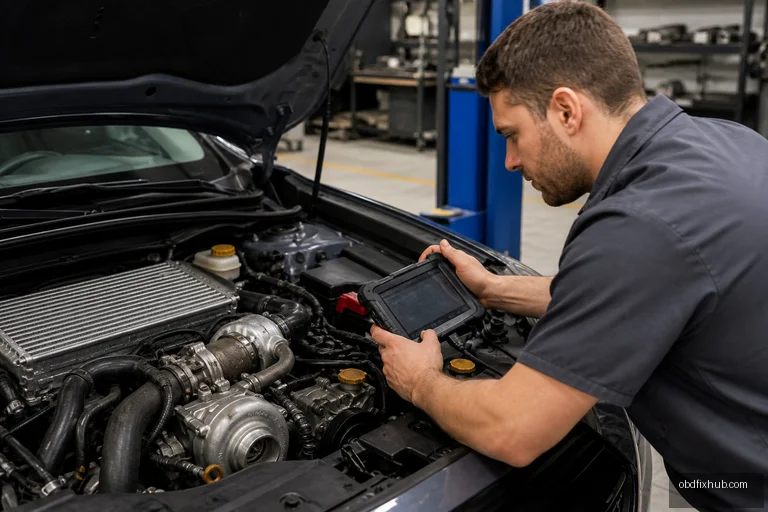
P2D2F cold-start turbocharger underboost means the engine computer detected that actual boost pressure stayed below the expected level during a cold-start operating condition. The fault is usually caused by a boost leak, a turbocharger control problem, inaccurate pressure information, restricted airflow, or an actuator that cannot reach its commanded position. Do not replace the turbocharger immediately; a careful pressure, vacuum, and scan-data diagnosis often identifies a much smaller and cheaper fault.
What Does P2D2F Cold-Start Turbocharger Underboost Mean?
P2D2F is not interpreted identically by every manufacturer, so the vehicle’s service information should always take priority over a generic code database. In applications that define it as cold-start turbocharger underboost, the powertrain control module compares requested boost with measured manifold or charge-air pressure during the first part of engine operation.
“Underboost” does not necessarily mean the turbocharger has mechanically failed. It means the pressure delivered to the engine was lower than the control module expected for a specific combination of engine speed, load, temperature, and turbocharger command. A code may set even when the vehicle feels normal after warming up.
Why Cold Start Matters
Cold-start monitoring is more demanding than a simple road test. Oil is thicker, air density is higher, exhaust energy is still developing, and the turbocharger actuator may need to move quickly while condensation or carbon affects its mechanism. The engine computer also uses a narrow time window to verify that the turbo system responds correctly.
For example, a diesel with a variable-geometry turbocharger may produce adequate boost at highway speed but fail the cold-start test because its vane ring sticks briefly in a low-boost position. That is why clearing the code and driving the vehicle only after it warms up can hide the fault rather than solve it.
Common Symptoms of P2D2F
- Reduced engine power or a temporary limp-home mode
- Slow acceleration, especially under load
- Delayed turbo response or little boost at low rpm
- Check Engine or Service Engine Soon light
- Hissing, whooshing, or whistling from the charge-air system
- Excessive smoke on some diesel engines
- Higher fuel consumption and poor throttle response
- Related codes for boost pressure, air mass, turbo actuator, or exhaust control
Some drivers notice only a warning light because the underboost event lasts a few seconds. Others experience a clear loss of power when merging or climbing a hill. The severity depends on whether the problem is a small hose split, a failed sensor, or a turbocharger that is physically damaged.
Most Likely Causes
1. Charge-air or intercooler leak
A loose clamp, split intercooler hose, cracked resonator, or leaking intercooler can release compressed air before it reaches the intake manifold. Oil mist around a connection is a useful clue because crankcase vapour commonly coats the inside of turbo plumbing; when a hose leaks, that oil can appear around the failed joint.
2. Turbocharger actuator or vane problem
Wastegate systems and variable-geometry turbochargers rely on an actuator to control boost. A seized linkage, failed electronic actuator, damaged vacuum diaphragm, weak vacuum supply, or carbon-bound vane mechanism can leave the turbo in the wrong position during cold operation.
3. Faulty boost or manifold pressure sensor
A MAP, boost pressure, or charge-air temperature sensor that reports incorrectly can make the computer believe boost is low. Before condemning the turbo, compare the sensor reading with key-on, engine-off barometric pressure. A large discrepancy at rest points toward the sensor, wiring, or a shared five-volt reference problem.
4. Airflow restriction or exhaust restriction
A heavily restricted air filter, collapsed intake duct, blocked diesel particulate filter, or restricted catalytic converter can prevent the turbocharger from producing the expected pressure. On a diesel, excessive exhaust backpressure may also interfere with turbo response and create several apparently unrelated codes.
5. Control, wiring, or calibration faults
Damaged wiring near the turbo, corroded connectors, a faulty boost control solenoid, or an outdated engine calibration can trigger underboost. If P2D2F appeared after engine work, inspect connectors and hose routing first; disturbed wiring and incorrectly connected vacuum lines are common post-repair causes.
How to Diagnose P2D2F Correctly
- Record all codes and freeze-frame data. Note coolant temperature, engine speed, load, requested boost, actual boost, and vehicle speed when the code set. Other codes may identify the root cause.
- Confirm the code definition for the exact vehicle. Use the manufacturer, engine, model year, and calibration information. P2D2F can be manufacturer-specific.
- Inspect the intake and charge-air system. Check the air filter, turbo inlet, intercooler, hoses, clamps, resonators, and intake manifold connections. Look for oil tracks, rubbed-through plastic, and soft or collapsed hoses.
- Perform a smoke or pressure test. A visual inspection often misses a leak that opens only under pressure. Use the vehicle manufacturer’s test pressure; excessive shop air can damage seals or sensors.
- Test actuator movement. With a suitable scan tool, command the wastegate or variable-geometry actuator through its range. Movement should be smooth, repeatable, and consistent with the commanded position.
- Check vacuum and electrical signals. On vacuum-controlled systems, measure vacuum at the source, solenoid, and actuator. On electronic systems, inspect power, ground, signal, and communication circuits rather than relying only on resistance checks.
- Compare live data under controlled conditions. Requested and actual boost should follow each other during a safe loaded drive. A pressure reading that remains low despite a correct actuator command suggests a leak, restriction, or turbocharger efficiency problem.
Repair Options: What Usually Fixes P2D2F?
The repair depends on the failed test. Replace a split hose, secure a loose clamp, repair damaged wiring, clean or replace a contaminated sensor, or repair the vacuum supply when those faults are confirmed. An actuator may require calibration after replacement, and some vehicles will not control boost correctly until the relearn procedure is completed.
If the turbocharger has excessive shaft play, damaged compressor blades, oil leakage, or a seized internal mechanism, turbocharger replacement or specialist rebuilding may be justified. However, a low boost reading alone is not proof of turbo failure. A pressure test and actuator test should come before an expensive turbocharger decision.
Can You Drive With P2D2F?
Short, gentle driving may be possible if the engine is not smoking heavily, overheating, making metallic turbo noises, or losing power suddenly. Avoid towing, hard acceleration, and sustained high boost until the cause is known. Stop driving and arrange a repair if the engine enters severe limp mode, the oil level drops, the turbo makes grinding sounds, or dense smoke appears.
How to Prevent the Fault From Returning
- Replace air and fuel filters at the recommended intervals.
- Inspect turbo and intercooler hoses during routine servicing.
- Keep oil changes on schedule with the manufacturer-approved oil.
- Repair small vacuum leaks before they become actuator faults.
- After repairs, verify actual versus requested boost on a cold start and under load.
Final Takeaway
P2D2F cold-start turbocharger underboost identifies a boost-control performance problem, not an automatic turbocharger failure. Start with the vehicle-specific code definition, freeze-frame information, a complete hose inspection, and a pressure test. Testing the actuator and validating sensor readings will usually separate a simple leak or control issue from a genuine turbocharger problem. If the code returns, have the repair verified with live data rather than relying only on a cleared warning light.
Frequently Asked Questions
Is P2D2F the same as a standard P0299 underboost code?
Not necessarily. P0299 is a widely used generic underboost code, while P2D2F may be manufacturer-specific and tied specifically to cold-start monitoring. Always confirm the definition for the exact vehicle.
Can a dirty air filter cause P2D2F?
Yes, a severely restricted filter or collapsed intake duct can limit airflow and turbocharger performance. It is easy to check, but it should not be assumed to be the cause without inspecting the complete intake and charge-air system.
Will clearing P2D2F fix the problem?
Clearing the code only removes the stored fault. If the underboost condition remains, the warning light will return after the vehicle completes the relevant monitor, often during another cold start.
Does P2D2F always mean the turbo must be replaced?
No. Boost leaks, sensors, vacuum faults, wiring, actuator problems, intake restrictions, and exhaust restrictions are all possible causes. Turbocharger replacement should follow testing, not precede it.




