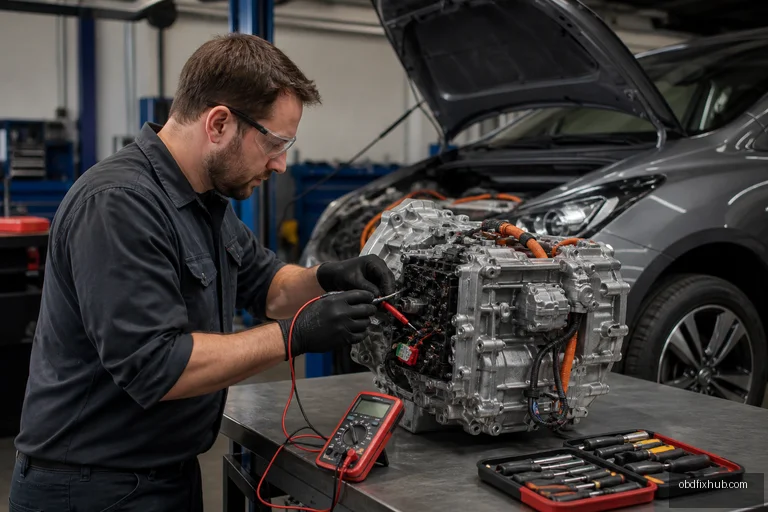
P2DF3 Engine Disconnect Clutch Position Not Learned: Meaning, Causes, Symptoms & Fix
P2DF3 Engine Disconnect Clutch Position Not Learned means the hybrid powertrain control system has not successfully learned the fully released, engaged, or reference position of the clutch that separates the gasoline engine from the electric drive unit. The vehicle may still start and move, but the fault usually requires a proper calibration procedure with a manufacturer-capable scan tool—not simply clearing the code.
This is an informational and diagnostic search query: most drivers want to know whether the car is safe to drive, why the code appeared, and whether a clutch, actuator, or control module must be replaced. In practice, the cause is often a weak 12-volt battery, an interrupted relearn, wiring trouble, or a clutch actuator that cannot reach its expected position.
What Does P2DF3 Mean?
Many hybrid vehicles use an engine disconnect clutch between the internal-combustion engine and the hybrid transmission. When the clutch opens, the vehicle can operate using electric drive without mechanically spinning the engine. When the clutch closes, the engine can provide torque, charge the battery, or restart smoothly during a transition from electric driving.
To control that transition, the vehicle must know the clutch actuator’s exact position. During a learn procedure, the hybrid control system moves the actuator through a defined range and records its mechanical limits or position values. P2DF3 sets when that learning process is incomplete, rejected, or lost.
The code does not automatically prove that the clutch itself is worn out. It identifies a failed position-learning state. A technician must determine whether the actuator moved correctly, whether the position feedback was credible, and whether the required voltage and temperature conditions were present.
Common Symptoms of P2DF3
Symptoms vary by vehicle software and by whether the clutch is stuck open, stuck closed, or simply has an invalid learned value. A vehicle may show only a warning message at first, while another may disable hybrid operation immediately.
- Check Engine, Hybrid System, or Service Powertrain warning light
- Reduced-power mode or limited electric-drive operation
- Engine starting when electric operation would normally be available
- Rough engine start, hesitation, or a noticeable transition between engine and EV drive
- Failure to enter Ready mode or a message such as “Hybrid System Fault”
- Additional communication, low-voltage, actuator, or clutch-position codes
- The code returning immediately after it is cleared
A warning that appears after a flat 12-volt battery is especially significant. Hybrid vehicles still depend on the conventional battery to wake control modules, operate relays, and complete calibration. Low voltage during a relearn can create a position-learning fault even when the clutch hardware is serviceable.
Why P2DF3 Sets: The Most Likely Causes
1. Weak or unstable 12-volt power
A battery can show acceptable voltage with no load and still collapse during actuator operation. Check battery state of charge, terminal tightness, ground connections, and charging voltage before attempting calibration. On many vehicles, a stable support charger is required during the procedure.
2. The relearn procedure was interrupted
Opening a door, switching the ignition off, pressing the brake incorrectly, moving the selector, or allowing voltage to drop can interrupt a learn routine. Some procedures also require a specific coolant temperature, transmission temperature, gear position, and parking-brake state.
3. Clutch actuator or position sensor failure
The actuator may have an internal motor, reduction gear, encoder, or position sensor. A failed sensor can report an implausible position even if the motor runs. A worn gear or stripped mechanism may move partway and then fail at the same point during every attempt.
4. Wiring, connector, or communication problems
Moisture, corrosion, pushed-back terminals, damaged wiring, and poor grounds can prevent the hybrid control module from seeing a valid actuator signal. Inspecting the connector is not enough; a proper diagnosis includes voltage-drop, continuity, reference-voltage, and communication checks under load.
5. Mechanical binding or clutch damage
Contamination, incorrect fluid, internal transmission damage, or a mechanically seized release mechanism can keep the actuator from reaching its learned stops. If the actuator repeatedly fails at one position, mechanical resistance becomes more likely than a software-only problem.
6. Software, module, or lost calibration data
A control-module update may be required when the manufacturer has released revised hybrid software. In other cases, a module replacement or low-voltage event can erase learned values. Software should be checked after basic power and wiring tests, not used as a substitute for them.
How to Diagnose P2DF3 Correctly
- Record every stored and pending code. Do not diagnose P2DF3 in isolation. Codes for low voltage, actuator feedback, CAN communication, or hybrid isolation may identify the primary failure.
- Verify the 12-volt system first. Test the battery under load, inspect grounds, and use a regulated charger if the service procedure permits it.
- Check manufacturer conditions. Confirm the exact clutch relearn instructions, temperature limits, ignition sequence, gear selection, and required scan-tool functions for that vehicle.
- Run the actuator test. A capable scan tool should show commanded position, actual position, movement direction, and whether the module accepts the endpoints.
- Inspect the actuator circuit. Test connectors and wiring for power, ground, signal integrity, and voltage drop while the actuator is commanded to move.
- Evaluate mechanical movement. If electrical values are correct but the clutch cannot reach its endpoints, inspect for binding or internal transmission damage.
- Perform the relearn and verify it. Clear codes only after the repair, complete the OEM calibration, cycle the system as instructed, and confirm that P2DF3 does not return.
One useful workshop clue is the timing of failure. If the learn procedure fails at random points, suspect voltage, communication, or unstable feedback. If it fails at the same commanded position every time, focus on actuator travel, mechanical obstruction, or a damaged clutch mechanism.
P2DF3 Repair: What Usually Fixes It?
The repair depends on the failed part or condition. Possible fixes include charging or replacing the 12-volt battery, repairing a ground or connector, correcting wiring, updating hybrid-control software, replacing the engine-disconnect clutch actuator, or repairing internal transmission components. The final step is normally a clutch position relearn followed by a road test and a complete module scan.
Do not replace the clutch assembly solely because P2DF3 is present. On a vehicle with a weak auxiliary battery, installing an expensive actuator will not solve the underlying problem. Likewise, clearing the code without completing the learn procedure may leave the vehicle with an invalid clutch position and cause the warning to return on the next drive cycle.
Can You Drive With P2DF3?
Short-distance driving may be possible if the vehicle operates normally and only a yellow warning is present, but it is not a fault to ignore. Avoid towing, hard acceleration, and long trips until the hybrid system has been assessed. If the vehicle will not enter Ready mode, shows a red hybrid warning, loses propulsion, smells overheated, or displays multiple high-voltage warnings, stop driving and arrange professional recovery.
High-voltage hybrid components can remain energized after the ignition is switched off. Never unplug orange cables, open the battery enclosure, or attempt to force the clutch actuator without the vehicle-specific safety procedure and proper training.
Frequently Asked Questions
Can a weak 12-volt battery cause P2DF3?
Yes. Low or unstable 12-volt voltage can interrupt the clutch calibration or make actuator feedback unreliable. Test the battery and charging system before condemning the clutch.
Will clearing P2DF3 fix the problem?
No. Clearing the code removes the stored fault but does not create a valid clutch position value. The underlying issue must be corrected and the manufacturer-specified relearn must be completed.
Can a basic OBD2 scanner perform the P2DF3 relearn?
Usually not. A generic scanner may read the code, but the relearn generally requires an OEM or advanced aftermarket scan tool with hybrid transmission actuator functions.
Does P2DF3 mean the hybrid battery is bad?
Not necessarily. P2DF3 concerns the engine-disconnect clutch position-learning function. A weak hybrid battery can contribute to system warnings, but separate battery-related data or codes are needed to establish that diagnosis.
What is the safest next step?
Have the complete code list, 12-volt battery condition, wiring, actuator feedback, and OEM relearn procedure checked by a technician familiar with high-voltage hybrid systems. This avoids replacing an expensive clutch based on the code alone.
Bottom Line
P2DF3 indicates that the hybrid system has not learned the position of its engine-disconnect clutch. Start with stable 12-volt power and all related codes, then test actuator operation, wiring, mechanical travel, and software before replacing parts. Once the cause is repaired, an approved clutch position relearn and verification drive are essential.




