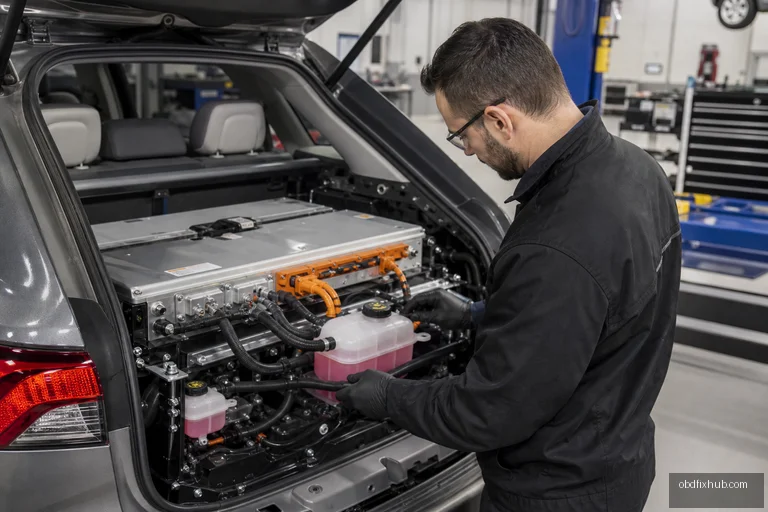
P2DFC means the vehicle’s hybrid or electric-vehicle battery control system has detected a possible coolant leak. The code is not simply a reminder to top off the reservoir. It can indicate low coolant, an external leak, air trapped in the battery cooling circuit, or a problem with the battery’s leak-detection monitoring system. Because the battery pack operates at high voltage, diagnosis should be treated as a safety issue rather than a routine cooling-system repair.
In many vehicles, the P2DFC hybrid battery coolant leak warning appears with a check-engine light, hybrid-system warning, reduced power, or a message telling the driver to service the vehicle. The exact test strategy varies by manufacturer, so the code description and service procedure must be confirmed with a scan tool and factory repair information.
What Does P2DFC Mean?
P2DFC is an OBD-II diagnostic trouble code associated with a detected leak or possible loss of coolant in the hybrid/EV battery thermal-management system. Hybrid battery packs generate heat during charging and driving, and their temperature must remain within a narrow operating range. Liquid coolant is often circulated through plates, channels, or a chiller assembly near the battery pack to control that temperature.
The vehicle may detect a problem in several ways. It can compare coolant level signals, monitor pressure or flow, calculate an unexpected change in temperature, or use a conductive coolant/leak-detection circuit. Some vehicles may set P2DFC after a genuine external leak, while others can set it when the system was serviced incorrectly or the monitoring circuit has failed.
P2DFC Hybrid Battery Coolant Leak: Common Causes
- Low coolant level: A low reservoir may be the result of a slow leak, incorrect filling, or air leaving the system after previous service.
- Damaged hoses or quick-connect fittings: Battery cooling lines can become brittle, cracked, loose, or damaged by road debris.
- Leaking battery cooling plate or internal manifold: A leak inside or immediately around the battery assembly is more serious and may require pack removal.
- Faulty coolant pump: A weak or seized electric pump can create abnormal flow and temperature readings that resemble a leak.
- Air trapped in the cooling circuit: If the system was filled without the correct vacuum-fill or bleed procedure, the battery may not receive consistent coolant flow.
- Coolant contamination: The wrong coolant, conductive fluid, or excessive moisture can interfere with insulation and leak-detection measurements.
- Sensor, wiring, or control-module fault: A damaged connector, corroded terminal, or failed level or pressure sensor can trigger the code without a visible leak.
- Battery case or thermal plate damage: Collision damage, corrosion, or improper lifting can compromise the battery’s sealed cooling components.
One useful diagnostic clue is whether the coolant level changes after the vehicle sits overnight. A reservoir that drops slowly without visible dripping may point to a leak hidden beneath the battery, in a shielded hose, or inside a component where coolant evaporates on a warm surface.
Symptoms You May Notice
P2DFC does not always produce dramatic symptoms at first. The vehicle may drive normally while the control module stores the code, especially when the leak is small or the battery is not under heavy load. However, ignoring the warning can eventually lead to battery overheating and reduced hybrid-system performance.
- Check-engine light or hybrid-system warning
- “Service Hybrid System” or “Stop Safely” message
- Reduced electric power or limited acceleration
- Cooling fan running more often or louder than usual
- Battery temperature warnings during fast charging or long climbs
- Low coolant level or visible wetness near hoses and fittings
- Sweet coolant odor around the battery area
- Intermittent warning that returns after clearing the code
Is It Safe to Drive With P2DFC?
Use caution. If the vehicle displays a red hybrid warning, overheating message, smoke, burning odor, fluid inside the cabin or battery area, or a “stop vehicle” instruction, pull over safely, switch the vehicle off, and arrange professional recovery. Continuing to drive can turn a small cooling fault into an expensive battery or inverter failure.
If the only symptom is a stored code and the vehicle operates normally, a short trip to a qualified hybrid repair facility may be possible. Avoid long journeys, towing, steep mountain driving, and repeated rapid charging until the system has been inspected. Never touch orange high-voltage cables or remove a battery cover to search for the leak.
How a Professional Diagnoses P2DFC
A proper diagnosis should identify why the module believes coolant is missing rather than simply clearing the code. The following sequence is more reliable than replacing a pump or sensor based on guesswork:
- Confirm the code and freeze-frame data. A manufacturer-capable scan tool should read all hybrid, battery, inverter, and thermal-management modules. Note coolant temperature, battery state of charge, vehicle speed, and whether related codes are present.
- Inspect the coolant type and level. The technician should verify the correct low-conductivity coolant specification, check the reservoir, and look for staining or residue around hoses, pumps, valves, and battery connections.
- Check for external leaks. A pressure test may reveal a slow leak, but the pressure must remain within the manufacturer’s specified limit. Excessive pressure can damage components that the test is intended to diagnose.
- Test pump operation and coolant flow. A scan tool may command the electric pump on and allow the technician to confirm current draw, sound, flow, and temperature change.
- Perform the correct air-bleeding procedure. Some systems require a service mode, vacuum filling, or bidirectional scan-tool commands. A conventional radiator bleed procedure may leave air trapped in the battery circuit.
- Test insulation and leak-detection circuits. If no physical leak is found, the technician should inspect connectors, wiring, sensors, and high-voltage insulation using the approved procedure.
A useful real-world distinction is the difference between a dry pressure test and a coolant contamination fault. If the system holds pressure but P2DFC returns immediately after the battery gets hot, the issue may be a sensor, internal monitoring circuit, incorrect coolant conductivity, or a flow problem rather than a hose leak.
Repair Options for P2DFC
The repair depends on the failed component. A loose clamp, cracked hose, or damaged reservoir is usually straightforward to replace, followed by a complete refill and bleed. A failed electric coolant pump or valve must be replaced with the correct part, then tested under commanded operation.
If coolant has entered the battery enclosure or reached high-voltage components, the repair becomes significantly more involved. The battery may need to be isolated, removed, opened, and inspected by a technician trained in high-voltage systems. In some cases, the manufacturer requires replacement of a cooling plate, manifold, battery section, or complete battery assembly.
Do not use stop-leak additives. They can restrict narrow battery cooling passages, contaminate pumps, and make future diagnosis more difficult. Also avoid mixing ordinary engine coolant with a battery-specific low-conductivity coolant unless the manufacturer explicitly allows it.
What Not to Do When P2DFC Appears
- Do not repeatedly clear the code and continue driving without checking the coolant level.
- Do not open the hybrid battery case as a DIY inspection.
- Do not probe orange cables or battery terminals with ordinary test equipment.
- Do not pressure-test the system above the factory specification.
- Do not assume a full reservoir rules out an internal or intermittent leak.
- Do not replace the battery before checking hoses, pumps, sensors, and coolant conductivity.
How Much Does a P2DFC Repair Cost?
Cost varies widely by vehicle and by where the leak is located. A hose, fitting, or coolant service may be relatively inexpensive, while a battery pump, cooling plate, or internal battery repair can cost considerably more. The largest cost difference usually comes from whether the battery must be removed and whether the manufacturer allows component-level repair.
Before approving a major repair, ask the shop for the test results: pressure-test findings, pump flow data, coolant specification, related codes, and evidence of moisture inside the battery area. A written diagnosis is especially important when the proposed repair is a complete hybrid battery replacement.
Final Takeaway
P2DFC is a warning that the hybrid battery cooling system may be losing coolant or reporting conditions consistent with a leak. Check for visible coolant only from a safe distance, avoid high-load driving, and have the vehicle scanned with manufacturer-level equipment. The correct fix may be as simple as repairing a hose and bleeding the circuit, but a confirmed leak inside the battery requires specialized high-voltage service.
Best next step: record every warning message, do not disturb the battery enclosure, and book a diagnosis with a qualified hybrid technician as soon as possible.
Frequently Asked Questions
Can low coolant alone cause P2DFC?
Yes. Low coolant can trigger the code, but the reason for the low level still needs to be found. A leak, trapped air, incorrect filling procedure, or faulty level monitoring circuit may be responsible.
Can I drive my hybrid with a P2DFC code?
Only a short trip for diagnosis may be reasonable if there are no red warnings, overheating messages, unusual smells, or power limitations. Stop driving and arrange recovery if the vehicle instructs you to stop or the battery temperature rises.
Does P2DFC always mean the hybrid battery must be replaced?
No. Hoses, fittings, pumps, valves, sensors, wiring, and air in the cooling circuit can all cause the warning. Battery replacement should be considered only after the cooling system and monitoring circuits have been properly tested.
Can I top up the battery coolant myself?
Do not add random coolant. Hybrid battery systems may require a specific low-conductivity fluid and a controlled bleeding or vacuum-fill procedure. Using the wrong coolant can create additional electrical and cooling faults.
Why does P2DFC return after the code is cleared?
The underlying fault remains present, or the problem occurs only when the battery is hot or under load. Check the cooling pump, flow, coolant conductivity, pressure, wiring, and leak-detection components rather than repeatedly clearing the code.




