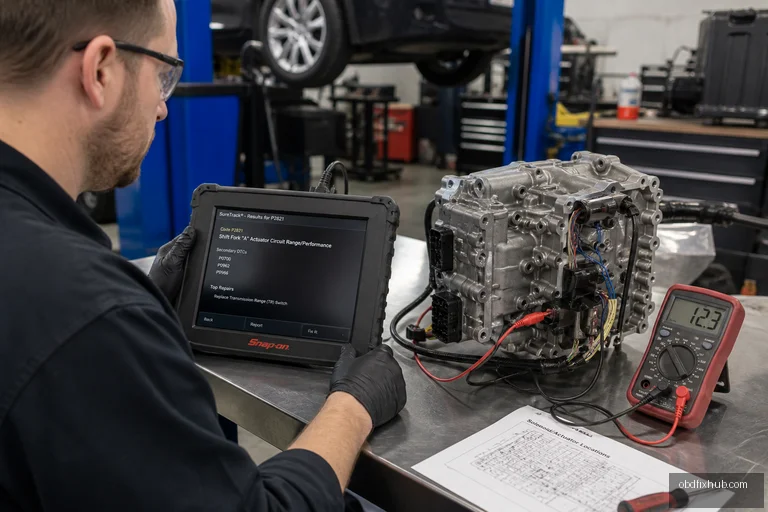
P2E10 Gear Selection Actuator Position Sensor Circuit means the transmission control system has detected an electrical or signal problem in the sensor that reports the gear actuator’s position. A bad sensor is possible, but it is not the only explanation: damaged wiring, poor power or ground, connector corrosion, a jammed actuator, or a control-module fault can produce the same code. You usually confirm a failed gear position sensor by comparing its live-data signal with the actual selected gear and testing the circuit under load—not by replacing the sensor immediately.
What Does P2E10 Mean?
The gear selection actuator moves or controls the mechanism that selects positions such as Park, Reverse, Neutral, and Drive. A position sensor, sometimes called a position feedback sensor, tells the transmission control module where that actuator actually is. The module uses this feedback to verify that the commanded gear and the achieved gear agree.
When the feedback signal is missing, implausible, intermittent, or outside its expected voltage range, the vehicle may store P2E10. The exact component differs by vehicle. It may be part of an automated manual transmission, dual-clutch transmission, electronically shifted automatic transmission, hybrid transmission, or another electronically controlled gear-selection system. Always check the manufacturer’s service information before assuming the sensor is a separate replaceable unit.
How Do You Know If a Gear Position Sensor Is Bad?
A gear position sensor becomes more suspect when the scan tool shows an incorrect or unstable actuator-position value while the wiring has correct power, ground, and signal continuity. For example, the transmission may be physically in Neutral while live data jumps between Neutral, Reverse, and an undefined position. If gently moving the harness changes the reading, however, the wiring or connector is more likely at fault than the sensor itself.
- The scan tool reports a position that does not match the gear selected by the driver.
- The sensor signal is stuck at one voltage or changes in abrupt, illogical steps.
- Power and ground remain stable, but the feedback signal is incorrect at the sensor connector.
- The fault returns immediately after clearing, even though the actuator is mechanically free.
- The sensor fails a resistance, voltage, or manufacturer-specific position test.
Do not diagnose the sensor from symptoms alone. A weak transmission battery supply, a poor ground strap, or water inside a connector can imitate a failed position sensor and lead to an unnecessary actuator replacement.
Common Symptoms of P2E10
Because the control module cannot reliably confirm gear position, it may place the transmission in a protective mode. The symptoms depend on the vehicle and the point at which the fault occurs.
- Check Engine, transmission, or hybrid-system warning light
- Delayed engagement when selecting Drive or Reverse
- Failure to select a gear, or a transmission that remains in Neutral
- Intermittent no-start condition because the module cannot confirm Park or Neutral
- Harsh shifting, incorrect gear selection, or limited gears
- “Transmission fault,” “Gear unavailable,” or similar dashboard message
- Actuator noise, repeated clicking, or movement followed by a warning
An intermittent P2E10 can be especially difficult to catch. The car may drive normally after a restart, then fail when the transmission is hot or when the wiring is exposed to vibration. Save the freeze-frame data before clearing the code; temperature, battery voltage, vehicle speed, and commanded gear often reveal when the problem occurred.
Most Likely Causes of the P2E10 Code
1. Damaged wiring or a poor connector
Transmission harnesses live in a harsh environment. Heat, oil contamination, road salt, and movement can damage insulation or loosen terminals. A terminal may look clean but fail when the circuit carries current or when the harness is flexed.
2. Failed gear selection actuator position sensor
The sensor may wear internally, develop a dead spot, or produce an unstable output. This is more likely when the code follows a specific actuator position or appears repeatedly after the transmission reaches operating temperature.
3. Actuator binding or mechanical misalignment
If the actuator cannot reach the commanded position, the sensor may accurately report a problem caused by a mechanical restriction. Low fluid where applicable, internal transmission damage, shift-fork problems, contamination, or incorrect installation can all prevent full travel.
4. Low voltage or poor grounding
Electronic actuators are sensitive to supply voltage. A weak battery, failing charging system, corroded ground cable, or voltage drop during cranking may set a position-sensor circuit code that disappears after the engine starts.
5. Control-module or software problem
Transmission control modules are less commonly at fault than wiring or sensors. Before condemning a module, check for technical service bulletins, software updates, water intrusion, communication codes, and manufacturer-required relearn procedures.
How to Diagnose P2E10 Properly
- Scan every module. Record P2E10, related transmission codes, communication codes, and freeze-frame information. A low-voltage code stored at the same time changes the diagnostic direction.
- Check the actual gear and commanded gear. Use live data to compare the driver’s selection, the commanded actuator position, and the reported actuator position. A disagreement between commanded and reported position is more useful than the generic fault description.
- Inspect the harness closely. Follow the wiring from the transmission actuator to the control module. Look for rubbed insulation, stretched sections, oil-soaked connectors, bent pins, and terminals pushed backward inside the plug.
- Test power, ground, and voltage drop. A static continuity check is not enough. Test the ground with the circuit operating, and measure voltage drop while the actuator is commanded to move. Excessive voltage drop can expose a fault that an ohmmeter misses.
- Test the sensor according to factory specifications. Depending on the design, the sensor may use a potentiometer, Hall-effect device, or multiple position switches. Check the specified signal range and confirm that the output changes smoothly through the full actuator movement.
- Check mechanical operation and perform relearn. If the circuit is sound, verify that the actuator moves freely and that the transmission linkage is correctly aligned. Many systems require a clutch, gear actuator, or transmission position calibration after repair.
Use back-probing methods approved for the connector. Piercing insulation can create a future corrosion path, and forcing test probes into small terminals can permanently loosen them. On high-voltage hybrid systems, follow the vehicle’s high-voltage disable procedure and use the specified personal protective equipment.
How Is P2E10 Fixed?
The correct repair depends on the failed part. A repair may involve securing or replacing a damaged harness, cleaning and tightening connector terminals, correcting a ground connection, replacing the actuator position sensor, replacing the complete actuator assembly, or repairing a mechanical transmission problem. Some vehicles do not sell the feedback sensor separately, so the factory procedure may require actuator replacement.
After the repair, clear the code only after recording the original data. Perform the required initialization or gear-position relearn, then road-test the vehicle through Park, Reverse, Neutral, and Drive while monitoring live data. A repair is not verified simply because the warning light goes out; the position signal must remain plausible during cold, hot, and repeated gear-selection conditions.
Can You Drive With P2E10?
Short-distance driving may be possible if the vehicle selects every gear normally and the warning is intermittent, but caution is appropriate. Do not continue driving if the transmission cannot select Park or Neutral, shifts unpredictably, remains in one gear, or displays a serious transmission or hybrid warning. Losing reliable gear-position feedback can leave the vehicle unable to move or prevent it from starting safely.
Practical Diagnostic Tips
- Check battery voltage before testing the actuator. Low system voltage can create misleading sensor codes.
- Compare the code’s freeze-frame temperature with the moment the symptom appears. Heat-related faults often point to connectors, internal sensor wear, or a failing actuator motor.
- Wiggle-test the harness while watching live position data, but keep clear of moving components.
- Do not use generic resistance values when the sensor is a Hall-effect or electronically monitored device.
- If P2E10 returns only after a transmission repair, verify linkage alignment, connector routing, and the required calibration procedure.
Frequently Asked Questions
Is P2E10 always caused by a bad gear position sensor?
No. Wiring damage, connector faults, low voltage, actuator binding, incorrect alignment, and control-module issues can all create the same code. Circuit testing and live-data comparison are necessary before replacing the sensor.
Can a bad gear position sensor cause a no-start condition?
Yes. If the control module cannot confirm Park or Neutral, it may prevent engine starting as a safety measure. The same fault can also cause an intermittent failure to select Reverse or Drive.
Will clearing P2E10 fix the problem?
Clearing the code may temporarily turn off the warning light, but it does not repair the circuit. If the underlying fault remains, P2E10 will usually return after the actuator is commanded or the vehicle completes its self-check.
How much does a P2E10 repair cost?
Cost varies widely. A corroded connector or damaged wire may be inexpensive to repair, while an integrated actuator, transmission calibration, or internal mechanical fault can be substantially more expensive. A proper diagnosis is the only reliable way to estimate the repair.
What is the best first step when P2E10 appears?
Scan all modules, save freeze-frame data, check battery voltage, and inspect the actuator connector and harness. Avoid replacing the sensor until power, ground, signal, and mechanical movement have been verified.
Bottom line: P2E10 identifies a gear-selection actuator position feedback problem, not automatically a failed sensor. Begin with live data, voltage-drop testing, and a careful connector inspection. Once the electrical and mechanical cause is confirmed, complete the required actuator or transmission relearn and verify the repair with a controlled road test.




