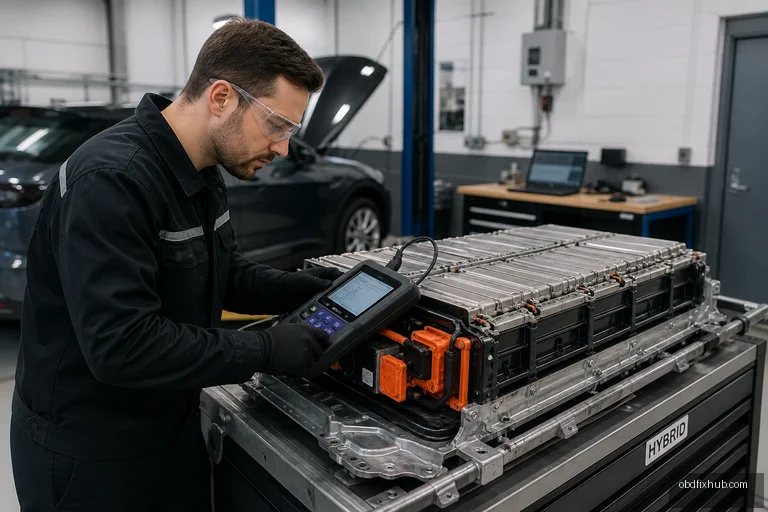
A P2E6C Hybrid Battery Cell Thickness Sensor Fault means the battery control system has detected an implausible signal, performance problem, or circuit issue from the sensor identified as “C.” It does not automatically prove that the entire hybrid battery has failed. The correct repair may involve a connector, wiring harness, battery pressure or swelling sensor, battery-control module, or—only in some cases—a damaged battery module.
This is an information-seeking fault code, but it should not be treated as a code that can be safely diagnosed with a basic engine-code scanner alone. P2E6C definitions and testing procedures vary by manufacturer, model year, and battery design, so the vehicle’s factory service information is essential.
What Does the P2E6C Code Mean?
P2E6C is a manufacturer-dependent hybrid/EV battery diagnostic trouble code. In many applications, it refers to the cell thickness sensor C or its monitored circuit. Despite the wording, this usually does not mean the vehicle is measuring the physical thickness of one individual battery cell with a simple ruler-like device.
Some high-voltage battery packs use pressure, compression, strain, or displacement sensing to detect abnormal cell expansion. Lithium-ion cells can swell when aged, overheated, overcharged, internally damaged, or exposed to abnormal operating conditions. Other battery designs may use a sensor arrangement that the manufacturer labels as a cell-thickness sensor even though the sensor is integrated into a battery subassembly.
The letter “C” normally identifies one sensor channel or sensing zone. It is not necessarily the third cell in the pack, and replacing the third cell without testing the circuit can waste money and create a dangerous high-voltage repair.
Common Symptoms of a P2E6C Hybrid Battery Cell Thickness Sensor Fault
The vehicle may continue to start and drive, particularly when the fault is intermittent. However, the hybrid control system can limit battery charging or electric assistance to protect the pack.
- “Check Hybrid System,” “Hybrid System Malfunction,” or a similar warning message
- Illuminated check-engine, master warning, or battery warning light
- Reduced acceleration or limited EV operation
- Engine running more frequently than normal
- Unusual battery state-of-charge swings
- Cooling fan operation at high speed
- Reduced fuel economy
- Failure to enter READY mode or a warning that appears after a battery-related repair
A genuine sensor-circuit problem may appear immediately after the battery is removed, serviced, or replaced. In that situation, a loose connector, pin pushed backward in the plug, pinched harness, or forgotten ground connection is often more likely than sudden battery swelling.
What Causes P2E6C?
1. Damaged wiring or connectors
High-voltage battery wiring is exposed to vibration, heat, condensation, and repeated service work. A connector that is not fully locked can create an intermittent signal. Corrosion, rodent damage, insulation rubbed through by a sharp bracket, or a terminal with weak tension can produce the same code.
2. A failed thickness or pressure sensor
The sensor itself can fail electrically or drift outside its expected range. A sensor that reports an implausible value at key-on, even when the battery is cold and stationary, is especially suspicious. Compare its reading with the other sensor channels rather than judging it from the code alone.
3. Battery swelling or mechanical deformation
Abnormal cell expansion can change the pressure or displacement measured by the sensor. Heat history, overcharging, internal cell damage, and age can contribute. A swollen battery pack is not a normal “reset” issue; it requires controlled inspection by a technician trained to work on high-voltage systems.
4. Battery-control module or software problems
The battery energy control module may misinterpret a valid signal because of an internal fault, poor power supply, ground loss, or outdated software. A technical service bulletin or software update may apply to some vehicles, so always check manufacturer documentation before condemning an expensive battery assembly.
5. Moisture, contamination, or previous repair errors
Water intrusion inside the battery enclosure can affect low-voltage sensor circuits and high-voltage insulation. Incorrectly routed busbar covers, missing seals, trapped debris, or a poorly installed replacement module can also trigger a sensor plausibility code.
How to Diagnose the P2E6C Fault Correctly
Do not begin by clearing the code and installing a battery. A professional diagnosis should establish whether P2E6C is current, pending, or history, and whether other codes point to the same root cause.
- Scan every relevant module. Use a scan tool that communicates with the hybrid battery ECU, power management ECU, and vehicle control modules. Record freeze-frame data, battery temperature, state of charge, and the conditions under which the code appeared.
- Confirm the manufacturer-specific definition. Generic OBD databases can be incomplete or misleading. Look up the exact P2E6C definition and pinout for that vehicle.
- Inspect the battery area safely. Look for water, corrosion, damaged covers, loose low-voltage plugs, rodent damage, and signs of mechanical distortion. Do not remove high-voltage covers without the correct training, insulated equipment, and service procedure.
- Compare live data. Compare sensor C with the other thickness, pressure, or displacement channels. A fixed value, an implausible jump, or a reading that disagrees sharply with neighboring channels can identify the faulty circuit.
- Test power, ground, continuity, and signal voltage. Follow the wiring diagram and use the manufacturer’s specified test values. Never apply arbitrary voltage to a high-voltage battery sensor circuit.
- Check for software updates and technical bulletins. Some apparently defective modules are caused by calibration or communication issues.
- Repair, then verify under the original conditions. After the repair, clear codes with a compatible scan tool and perform the required drive cycle or battery-system self-test.
One useful diagnostic clue is temperature correlation. If the fault occurs only after the battery becomes hot, inspect cooling airflow, fan operation, thermal history, and sensor drift. If it appears immediately at every cold start, an open circuit, short circuit, connector issue, or module plausibility failure becomes more likely.
Can You Still Drive With a Hybrid System Malfunction?
Sometimes, but driving should be limited until the fault is identified. If the vehicle has normal braking, stable steering, no burning smell, no smoke, no overheating warning, and only a stored intermittent code, driving directly to a qualified repair facility may be reasonable.
Stop driving and arrange professional assistance if the vehicle will not enter READY mode, loses power, shows a red battery or temperature warning, displays multiple high-voltage codes, smells overheated, leaks fluid, or behaves unpredictably. Hybrid systems can shut down propulsion without much warning, and repeatedly driving with an overheating or physically damaged battery can increase repair costs.
How to Reset the Hybrid Battery System
Clearing P2E6C is not the same as fixing it. A compatible scan tool can erase the DTC after the repair and allow the battery ECU to run its self-check. Disconnecting the 12-volt battery may temporarily remove dashboard warnings, but it usually does not repair the underlying issue and can erase useful diagnostic data.
Do not remove the high-voltage service plug simply as a reset method. That procedure requires the manufacturer’s shutdown sequence, waiting time, insulated tools, and verification that high voltage has discharged. If the code returns immediately after clearing, stop resetting it and diagnose the circuit.
Repair Options and Typical Cost
The cost depends heavily on the vehicle and whether the problem is electrical or mechanical. A basic scan and inspection may cost approximately $100–$250. Wiring or connector repairs often fall around $200–$800, while a sensor or battery subassembly can range from $500–$2,000 depending on availability and labor.
If the battery enclosure, control module, or several damaged modules are involved, the bill can reach $2,000–$6,000 or more. A complete dealer-installed hybrid battery may cost considerably more, while a reputable remanufactured unit can reduce the price but may carry different warranty and longevity risks.
Ask the shop for the exact failed component, test results, warranty terms, and whether the replacement is new, used, or remanufactured. “The battery is bad” is not a sufficient diagnosis for a sensor code unless the technician can show why the sensor circuit and control module have passed their tests.
Signs a Hybrid Battery May Need Repair
- Rapid state-of-charge changes without a matching driving condition
- Frequent engine cycling or noticeably weaker electric assistance
- Battery cooling fan running loudly or continuously
- Reduced fuel economy that persists after checking tire pressure and engine operation
- Hybrid battery block-voltage imbalance or repeated battery-related trouble codes
- Visible swelling, heat damage, corrosion, or moisture inside the battery enclosure
These signs do not prove that P2E6C itself is caused by failed cells. A battery can have healthy voltage performance and still have a faulty thickness-sensor circuit. Conversely, a sensor fault can be an early warning of mechanical battery damage, which is why live data and physical inspection matter.
Frequently Asked Questions
Is P2E6C the same as a bad hybrid battery?
No. P2E6C identifies a monitored sensor or sensor circuit, not automatically the complete battery pack. The battery may be repairable, or the issue may be limited to wiring, a connector, software, or the battery ECU.
Can I reset P2E6C by disconnecting the 12-volt battery?
It may clear some temporary dashboard messages, but it does not correct the fault. Use a compatible scan tool after diagnosis and repair, then confirm that the code does not return.
How long can I drive with a hybrid system malfunction?
There is no safe universal mileage limit. If the car drives normally, a short trip to a qualified shop may be acceptable, but reduced-power, overheating, burning smells, red warnings, or failure to enter READY mode require towing.
What is the cheapest way to fix P2E6C?
The cheapest legitimate fix is repairing the actual failed connector, wire, ground, or sensor—not installing a used battery without testing. A proper diagnosis prevents unnecessary battery replacement.
Should I take the vehicle to a dealer?
A dealer is useful when manufacturer-specific scan data, software updates, or battery procedures are required. An independent hybrid specialist can also be an excellent choice if the technician has high-voltage certification and access to factory-quality wiring diagrams and scan data.
Bottom Line
P2E6C is a warning that the hybrid battery control system cannot trust the signal from its “C” cell-thickness or related sensing channel. Treat it as a diagnostic starting point, not a verdict that the whole battery must be replaced. Have the exact code definition verified, inspect the low-voltage circuit and battery enclosure safely, compare live sensor data, and clear the code only after the underlying problem has been repaired.




