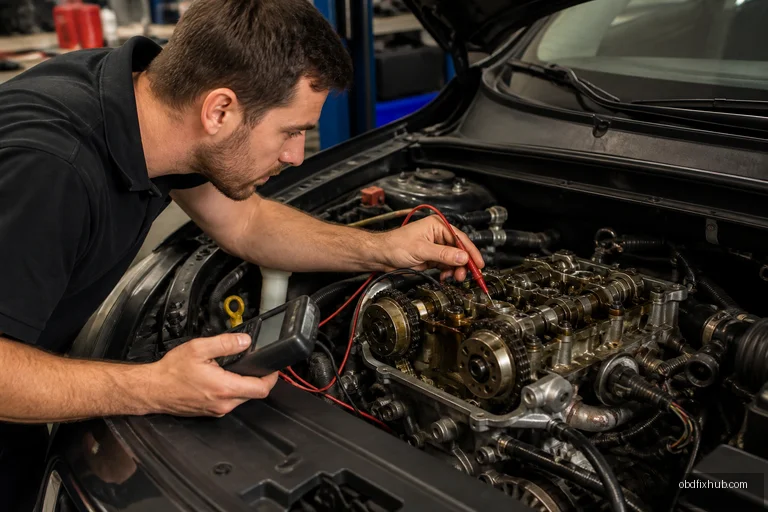
P34C8 indicates a performance problem in the camshaft position control system. In practical terms, the engine control module has detected that the commanded camshaft position does not match the position or response it expects. The exact definition and affected camshaft can vary by vehicle manufacturer, so the vehicle’s service information is essential before replacing any part.
This is usually a variable valve timing (VVT) or camshaft timing fault, not proof that the camshaft itself is damaged. Low or dirty engine oil, a sticking oil control valve, wiring problems, a failing camshaft actuator, timing-chain wear, or a control-module software issue can all trigger P34C8.
What Does P34C8 Camshaft Position Control Module Performance Mean?
The P34C8 code is commonly used to describe poor performance or an incorrect response from a camshaft position control module or camshaft timing control circuit. The engine control module (ECM) continuously compares the desired camshaft angle with feedback from the camshaft position sensor.
When the commanded angle and actual angle remain too far apart, move too slowly, or fail to change when requested, the ECM stores P34C8. On some vehicles, the “control module” wording refers to a dedicated camshaft control unit; on others, it refers to the VVT actuator, oil control solenoid, or the ECM-controlled camshaft timing circuit.
Do not rely on a generic code description alone. A factory scan tool may identify the bank, camshaft, actuator channel, or operating condition involved. That information can reduce diagnostic time considerably.
Common Symptoms of P34C8
The symptoms depend on whether the camshaft is stuck in an advanced position, stuck in a retarded position, or simply responding too slowly. Some vehicles continue to drive normally at light throttle, while others develop obvious drivability problems.
- Illuminated Check Engine Light
- Rough idle or an intermittent engine stumble
- Hesitation during acceleration
- Reduced power, especially at low or high engine speed
- Hard starting or extended cranking
- Increased fuel consumption
- Engine stalling when coming to a stop
- Reduced-power or limp-home mode
- Additional camshaft, crankshaft, or VVT trouble codes
A brief rattle at startup is especially useful evidence. It can point toward low oil pressure, a worn camshaft phaser, or a timing-chain tensioner that is not holding tension. However, a noise-free engine can still have an electrical or control problem.
Most Likely Causes of P34C8
1. Low, degraded, or incorrect engine oil
Most VVT systems use engine oil pressure to move a camshaft phaser. Oil that is low, badly sludged, overfilled, or the wrong viscosity can prevent the actuator from reaching its commanded position. A missed oil change is one of the first things to investigate, but an oil service alone will not repair a mechanically worn phaser.
2. Restricted or stuck oil control solenoid
The camshaft timing solenoid, also called an oil control valve or VVT solenoid, meters oil into the actuator. Sludge can restrict its screen, while a worn solenoid may stick intermittently. Measuring electrical resistance is useful, but it does not prove that the valve moves correctly under oil pressure.
3. Damaged wiring, connectors, or power supply
Oil-soaked connectors, loose terminals, chafed harnesses, corrosion, and poor grounds can interrupt the control signal. Heat near the cylinder head often hardens insulation and creates faults that appear only after the engine warms up. A visual inspection should include harness movement while monitoring the scan-tool data.
4. Failed camshaft actuator or phaser
The actuator may be internally worn, jammed, or unable to hold its commanded angle. A common real-world pattern is P34C8 accompanied by a startup rattle and a camshaft actual-angle value that drifts or remains fixed despite a commanded change.
5. Timing-chain or belt timing problems
A stretched chain, weak tensioner, damaged guide, or incorrectly installed belt can place the camshaft outside its expected relationship with the crankshaft. If P34C8 returns immediately after a timing repair, verify mechanical timing before installing another sensor or solenoid.
6. Camshaft position sensor or control-module software fault
A weak sensor signal can make a correctly operating actuator appear faulty. Less commonly, an ECM calibration issue or failed control module causes incorrect command or interpretation. Software updates should be considered only after power, grounds, wiring, and mechanical operation have been checked.
How to Diagnose P34C8 Correctly
A professional diagnosis starts with the conditions under which the code was set. Record all stored, pending, and history codes, along with engine speed, temperature, load, and commanded camshaft angle in the freeze-frame data.
- Confirm the code and vehicle-specific definition. Check the exact year, engine, bank, and camshaft identified by the manufacturer’s service information.
- Check the oil first. Verify the level and condition. Look for sludge, fuel dilution, coolant contamination, or an incorrect viscosity. If oil pressure is questionable, test it with a mechanical gauge rather than guessing.
- Inspect the electrical circuit. Check the solenoid connector, sensor connector, fuses, grounds, and harness routing. Test for proper power, ground, reference voltage, and control signal under the conditions that cause the fault.
- Compare commanded and actual camshaft position. With a capable scan tool, command the VVT system through its operating range. A healthy system should respond promptly and return toward its base position when commanded.
- Test the oil control solenoid. Confirm resistance against the manufacturer’s specification, then test its movement and oil passage. Applying battery voltage directly is safe only when the service procedure specifically permits it.
- Verify mechanical timing. If the actuator does not respond, the camshaft angle is consistently offset, or there is chain noise, inspect the timing components and compare crankshaft-to-camshaft synchronization.
- Check for technical service bulletins. Some vehicles have known connector, actuator, calibration, or oil-passage issues that change the correct repair procedure.
One valuable diagnostic shortcut is to watch the camshaft angle during a cold start and then again at operating temperature. If the fault appears only when hot, oil-pressure loss, thermal wiring failure, or a worn actuator becomes more likely than a permanently failed sensor.
How to Fix P34C8
The correct repair depends on the failed part, not the code label. Possible repairs include:
- Correcting the engine oil level and using the manufacturer-approved oil and filter
- Cleaning or replacing a restricted VVT oil control solenoid
- Repairing damaged wiring, terminals, grounds, or connectors
- Replacing a faulty camshaft position sensor after signal testing
- Replacing a worn camshaft phaser or actuator
- Repairing or replacing stretched timing-chain components
- Performing an applicable ECM software update or relearn procedure
After the repair, clear the code and complete the manufacturer’s camshaft actuator relearn or drive cycle if required. Then confirm that commanded and actual camshaft positions track one another during idle, acceleration, and deceleration. Simply clearing P34C8 without verifying live-data behavior often leads to a repeat failure.
Can You Drive With P34C8?
Short, gentle driving may be possible if the engine runs smoothly and the Check Engine Light is steady. Avoid continued driving if the light flashes, the engine stalls, power is severely reduced, or a loud timing-chain rattle is present. Incorrect camshaft timing can increase emissions, damage the catalytic converter, and, on some engines, create a risk of internal valve-to-piston contact.
How Much Does P34C8 Repair Cost?
Cost varies sharply by vehicle and by the underlying cause. An oil service or connector repair is relatively inexpensive, while a camshaft phaser, timing-chain job, or control-module replacement can be substantially more costly. Diagnostic labor is worthwhile because replacing a sensor first is a common way to spend money without correcting the actual timing problem.
Final Takeaway
P34C8 means the camshaft position control system is not performing as expected, but it does not identify one guaranteed failed component. Start with oil condition, scan data, wiring, and the VVT solenoid; then verify actuator operation and mechanical timing before condemning the ECM. If the code returns, use the vehicle-specific factory procedure and address the fault promptly, especially when startup rattle or reduced engine performance is present.
Frequently Asked Questions About P34C8
Is P34C8 the same as a camshaft position sensor code?
No. P34C8 is a performance or response code for the camshaft position control system. A faulty sensor can cause it, but the actuator, oil supply, wiring, timing chain, or control module may be responsible.
Can an oil change clear P34C8?
It can correct the problem when low, dirty, or incorrect oil is preventing the VVT actuator from operating. If the code returns after the oil and filter are replaced, further testing of oil pressure, the solenoid, actuator, and mechanical timing is needed.
Should I replace the VVT solenoid first?
Not automatically. Test its power, ground, resistance, movement, and oil passage first. Replacing a solenoid will not fix a stretched timing chain, poor oil pressure, damaged wiring, or a worn camshaft phaser.
Is P34C8 serious?
It can be. A mild performance issue may allow limited driving, but stalling, severe hesitation, a flashing warning light, or timing-chain noise requires prompt inspection to prevent further engine or emissions-system damage.
Why does P34C8 return after the repair?
The original cause may have been misdiagnosed, or the system may require a camshaft relearn. Persistent recurrence usually calls for live-data testing and mechanical timing verification rather than another round of parts replacement.




