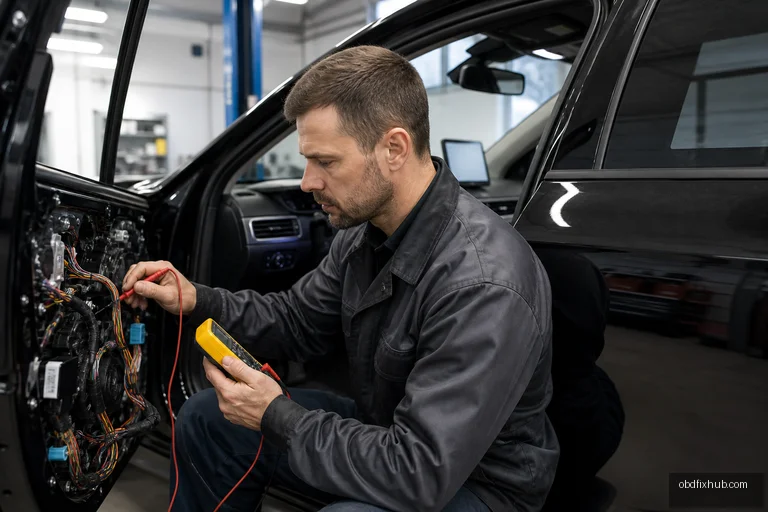
U0001 high-speed CAN communication bus fault means that one or more vehicle control modules cannot communicate correctly over the high-speed Controller Area Network (CAN). The code does not identify one failed part by itself. A damaged wire, poor ground, blown module fuse, corroded connector, failed control module, or incorrect CAN termination can all produce the same fault. The fastest reliable fix is to diagnose the network electrically before replacing expensive modules.
What Does Code U0001 Mean?
U0001 is a generic network communication diagnostic trouble code (DTC). It usually refers to the high-speed CAN-C network, the communication bus used by critical systems such as the engine control module, transmission control module, ABS module, body control module, and gateway module.
When communication stops or becomes electrically abnormal, modules may set U0001 or a manufacturer-specific version such as U0001-00. The final characters can describe the failure type, but the exact definition depends on the vehicle manufacturer and scan-tool software. Always check the service information for the specific year, model, and engine.
Common Symptoms of a U0001 Fault
A CAN fault can affect several systems at once because many modules share the same communication pair. Symptoms may appear suddenly, intermittently, or immediately after battery, wiring, or collision repairs.
- Check Engine, ABS, traction control, airbag, or transmission warning lights
- No-start, stalling, limp mode, or inability to select a gear
- Loss of communication with one or several control modules during scanning
- Instrument cluster warnings, missing gauges, or incorrect warning messages
- Power windows, climate control, cruise control, or other body functions operating incorrectly
- U-codes stored in multiple modules rather than only the engine computer
An important diagnostic clue is whether the vehicle still starts and drives. A single lost body module may produce warning lights while the vehicle remains usable. A shorted CAN bus or loss of communication with the gateway, ECM, or transmission controller can prevent starting entirely.
What Causes a U0001 High-Speed CAN Communication Bus Fault?
1. Open or shorted CAN wiring
High-speed CAN normally uses two twisted wires, CAN-High and CAN-Low. An open circuit, wire pulled from a terminal, crushed harness, or short to ground, battery voltage, or another circuit can disrupt the entire network. Harness damage is common near battery trays, engine mounts, transmission cases, and areas recently repaired after a collision.
2. Poor power or ground at a control module
A module may appear to have failed when its fuse, ignition feed, or ground connection is actually the problem. Voltage-drop testing is more useful than simply checking for continuity. A ground that looks acceptable with no load can still lose several volts when the module is operating.
3. Corroded or loose connectors
Water intrusion, green corrosion, backed-out terminals, and connector lock damage can create an intermittent U0001. Inspect connectors in the engine bay, under the carpet, near the kick panels, and around the fuse or gateway module. Do not force a terminal back into position without checking its tension; a loose terminal can pass a quick continuity test and fail under vibration.
4. Failed CAN bus termination
Most high-speed CAN networks use two 120-ohm termination resistors, one at each end of the bus. With the vehicle powered down and the network asleep, a typical measurement across CAN-High and CAN-Low is approximately 60 ohms because the two resistors are in parallel. A reading near 120 ohms, very low resistance, or an unstable reading suggests a termination, wiring, or module problem. Follow the manufacturer’s test conditions because some vehicles use gateway arrangements that differ from a simple two-resistor layout.
5. A defective control module
A failed module can electrically pull the CAN network down and make several unrelated modules report communication errors. This is why replacing the module that first stored U0001 is unreliable. The first module to log the code is not necessarily the cause; it may simply be the first one to notice the bus problem.
Can a Bad Bus Star Connector Cause U0001?
Yes. A faulty CAN bus star connector can cause U0001 when it contains a loose terminal, corrosion, water intrusion, broken internal splice, or poor connection to the CAN backbone. Star connectors distribute the network to several branches, so one damaged junction can interrupt communication with multiple modules at the same time.
To test a suspected star connector, compare the wiring diagram with the actual connector, inspect each terminal under magnification, and check resistance and voltage on each branch. If disconnecting one branch restores normal CAN voltage or allows the scan tool to communicate again, that branch may contain the shorted module or harness. Never bridge terminals randomly; use the pinout and isolation procedure specified for the vehicle.
How to Diagnose and Fix U0001
- Record all codes before clearing anything. Perform a full-vehicle scan, not only an engine scan. Note which modules communicate and which do not, along with battery voltage and freeze-frame information.
- Check battery voltage and grounds. A weak battery or low system voltage can create misleading network codes. Inspect battery terminals, main grounds, module grounds, and relevant fuses. During cranking, excessive voltage drop is a significant clue.
- Inspect recent work first. If the fault appeared after a battery replacement, stereo installation, collision repair, engine replacement, or water leak, begin in that area. Pinched harnesses and incorrectly seated connectors are frequent real-world causes.
- Test CAN resistance with power off. Disconnect the battery only as instructed by the manufacturer, allow modules to go to sleep, and measure between CAN-High and CAN-Low. An abnormal value points toward wiring, termination, or a connected module that must be isolated.
- Check CAN voltage with the network powered. A healthy high-speed CAN network typically shows CAN-High and CAN-Low switching around a common bias voltage, but exact readings vary. A scope is preferable because a digital multimeter can miss intermittent noise, reflections, or a bus that is stuck dominant.
- Isolate branches and modules methodically. Disconnect only the modules identified in the wiring diagram and rescan after each change. If communication returns when one module is unplugged, confirm its power, ground, and internal resistance before condemning it.
- Repair, then verify under real conditions. Use the correct twisted-pair repair method, sealed splices, terminal repairs, and harness routing. Clear codes, cycle the ignition, perform a complete scan, and road-test the vehicle while monitoring network communication.
Do not use a test light or apply battery voltage to CAN terminals. A simple wiring mistake can damage several control modules. If the bus is shorted and the vehicle will not communicate, a wiring diagram, oscilloscope, and manufacturer-level scan tool can save far more money than trial-and-error parts replacement.
What Does U0001 Mean on a Toyota or Lexus?
On Toyota and Lexus vehicles, U0001 commonly refers to a high-speed CAN communication failure and may appear as U0001-00, depending on the scan tool. The affected network can include the ECM, skid control ECU, transmission control, gateway, combination meter, and other modules. The exact repair depends on the model’s CAN topology, which may include junction connectors, network gateways, and multiple CAN branches.
For Toyota and Lexus, begin by scanning every available ECU and checking whether the Techstream or capable aftermarket tool can communicate with the gateway and skid control systems. Pay close attention to battery condition, ground points, junction connectors, water entry, and wiring near the driver-side kick panel and engine compartment. A generic code definition is useful, but the factory wiring diagram and communication chart are essential for locating the failed branch.
How Do I Fix Error Code U0001?
Fix U0001 by finding the condition that is interrupting high-speed CAN communication, then repairing the wiring, connector, power supply, ground, termination, or failed module responsible. Clearing the code, replacing the battery, or installing a new ECM without testing the bus will not provide a dependable repair.
If the vehicle has multiple warning lights, will not start, or has lost communication with several modules, avoid driving it until the network is repaired. A professional diagnostic shop with CAN testing equipment is usually the safest option when the fault is intermittent or the wiring diagram is not available.
Frequently Asked Questions
Is U0001 a serious code?
It can be serious. U0001 may affect ABS, steering, transmission, engine control, or starting functions. The vehicle’s drivability and the modules that have stopped communicating determine the immediate risk.
Can a weak battery cause U0001?
Yes. Low voltage during starting or unstable battery connections can trigger network communication codes. However, the battery should be tested under load and the grounds checked before assuming it is the only cause.
Will disconnecting the battery fix U0001?
Disconnecting the battery may temporarily clear a communication glitch, but it does not repair a short, corroded connector, damaged harness, or failing module. If the code returns, perform a complete CAN diagnosis.
Can I drive with a U0001 code?
Only if the vehicle operates normally and no safety systems are disabled, and even then, arrange diagnosis promptly. Do not drive if ABS, airbag, steering, transmission, or multiple critical warning lights are active.
What is the most reliable first test?
Perform a full-module scan, verify battery and ground integrity, and check CAN resistance with the vehicle powered down according to the manufacturer’s procedure. These tests quickly separate a power problem from a bus wiring or module fault.
Final Takeaway
U0001 is a network fault, not a parts-replacement instruction. Start with a complete scan, power and ground checks, CAN resistance and voltage testing, and careful inspection of connectors and star junctions. Once the defective branch or module is isolated, repair the wiring correctly and confirm that every control unit communicates before returning the vehicle to service.




