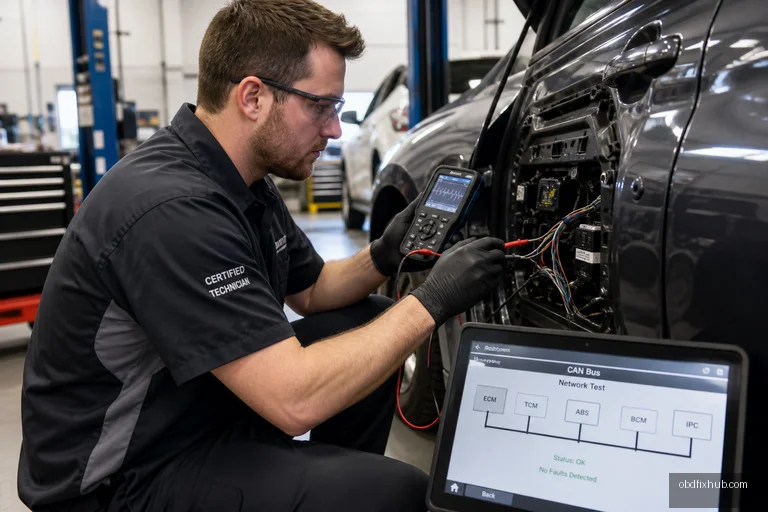
U0028 Vehicle Communication Bus A Fault means the vehicle has detected a problem on a designated communication network, commonly involving the CAN bus wiring, power supply, termination, or one of the modules connected to it. The code does not identify a single failed part by itself. A proper diagnosis requires checking related communication codes, battery voltage, network resistance, wiring, connectors, and module activity before replacing anything.
This is an information-focused fault code, not a direct indication that the engine or transmission has mechanically failed. However, a communication fault can disable important systems such as ABS, air bags, body controls, instrument-cluster functions, power steering, or advanced driver-assistance features, depending on the vehicle.
What Does the U0028 Code Mean?
U0028 is a generic network communication diagnostic trouble code defined as Vehicle Communication Bus A Fault. The letter “U” identifies a communication-related fault rather than a powertrain, body, or chassis sensor code. “0028” points to the particular bus or communication circuit that the vehicle’s diagnostic system has identified as abnormal.
The exact network name can vary by manufacturer. On some vehicles, Bus A may correspond to a high-speed CAN network, while on others it may be assigned to a specific module group or communication branch. For that reason, a generic code reader can tell you that the bus has a problem, but the manufacturer’s wiring diagrams and network description are often needed to identify every module connected to it.
Common Symptoms of U0028
The symptoms depend on which control modules share the affected bus and whether the failure is intermittent or complete. A brief voltage drop may create several stored codes without causing a noticeable drivability problem, while a hard short can take multiple modules offline.
- Check Engine, ABS, air bag, traction-control, or warning lights
- Several modules showing “no communication” during a scan
- Instrument-cluster gauges, warning lamps, or display functions behaving incorrectly
- Hard starting, no-start, reduced-power operation, or stalling
- Inoperative cruise control, power windows, central locking, or climate functions
- Intermittent electric power steering, transmission, or stability-control faults
- Battery drain caused by a module that fails to enter sleep mode
A useful clue is the number of modules reporting communication errors. If one module is missing from the scan, that module or its local power and ground circuit may be the issue. If nearly every module reports communication failure, suspect a network-wide problem such as low battery voltage, a blown shared fuse, a shorted bus line, or a failed gateway module.
Most Likely Causes of U0028
Low system voltage or a weak battery
Modern modules can set communication codes during cranking when voltage falls too low. A battery may still start the engine and yet dip below the level required for stable module communication. Test the battery at rest and during cranking; do not assume a recently replaced battery is healthy.
Open, shorted, or damaged CAN wiring
CAN networks use twisted-pair communication wires, commonly called CAN High and CAN Low. Damage from a previous repair, water intrusion, rodent activity, accessory installation, or chafing against a bracket can create an open circuit, a short to ground, a short to voltage, or excessive resistance between modules.
Corroded connectors and poor grounds
A connector can look connected while corrosion prevents reliable electrical contact. Inspect connectors near the battery, fuse box, door sills, footwells, and areas exposed to water. A loose ground strap or corroded module ground can imitate a defective communication bus.
Failed control module
One internally failed module can hold a CAN bus in a dominant state and prevent other modules from communicating. This is especially common after water damage, incorrect jump-starting, amplifier or accessory failures, and severe overvoltage events. A module should not be condemned until its power, grounds, and network circuits have been tested.
Aftermarket equipment or incorrect repairs
Remote starters, audio amplifiers, tracking devices, alarm systems, and poorly installed accessories can interfere with vehicle communication. A recent stereo installation or amplifier failure is worth investigating, particularly if U0028 appeared immediately afterward. Never cut or splice CAN wires casually; an apparently harmless connection can alter network resistance and signal quality.
How to Diagnose U0028 Correctly
Start with a full-system scan, not just an engine-code scan. Record every code, the module that stored it, and the freeze-frame or event data. Communication codes often appear in clusters, and the order in which they were stored can reveal which module went offline first.
- Check battery voltage. A healthy fully charged battery is generally close to 12.6 volts with the engine off. During cranking, voltage should not collapse abnormally. With the engine running, verify that charging voltage is stable and appropriate for the vehicle.
- Look for a recent event. Ask whether the vehicle had a dead battery, jump-start, collision, flood exposure, audio-system work, or module replacement immediately before the code appeared.
- Inspect fuses, grounds, and connectors. Test circuits under load rather than relying only on visual inspection. Pay particular attention to shared module power supplies and grounds.
- Check bus resistance with the vehicle powered down. On many conventional CAN networks, approximately 60 ohms is measured across CAN High and CAN Low because two 120-ohm terminating resistors are connected in parallel. This value is a guideline, not a universal rule; some network sections and vehicles use different configurations.
- Check for shorts and opens. Compare CAN High and CAN Low continuity with the manufacturer’s specifications. Look for unwanted continuity to ground or battery voltage, and inspect the twisted pair for stretched, crushed, or untwisted sections.
- Isolate the offending branch or module. If the bus is being held down, technicians may disconnect modules one at a time while monitoring network recovery. Follow the service procedure because disconnecting certain modules can create safety risks or trigger additional faults.
- Confirm the repair. Restore the network, clear codes, cycle the ignition, perform a complete scan, and road-test the vehicle. The repair is not proven until all expected modules communicate and the code does not return.
U0028 Vehicle Communication Bus A Fault: Repair Options
The fix depends on the test results. A weak battery may require charging or replacement, followed by clearing codes and verifying charging-system performance. A damaged wire should be repaired with the correct automotive-grade splice and protected so the original twisting and shielding characteristics are maintained.
For connector corrosion, clean or replace the affected terminals and correct the source of moisture. If a ground strap is loose, remove corrosion from the contact surfaces and tighten it to specification. When an aftermarket device is involved, temporarily return the vehicle to its original wiring configuration before drawing conclusions.
A failed module may need replacement and, on many vehicles, software configuration, coding, immobilizer pairing, or calibration. This is why replacing an expensive gateway, ABS unit, or body-control module based only on the U0028 code is risky. A new module will not solve a shorted network wire, and an incorrectly coded replacement can create even more communication errors.
Can You Drive With U0028?
Driving is not automatically safe simply because the engine runs. If the ABS, air bag, electronic stability control, power steering, or transmission system is offline, the vehicle may have reduced safety or altered driving behavior. Avoid driving and arrange professional diagnosis if warning lights are accompanied by steering problems, brake-system warnings, stalling, a no-start condition, or multiple systems failing at once.
If U0028 is stored as a history code and every system currently operates normally, the vehicle may have experienced a temporary low-voltage event. Even then, check the battery and charging system before clearing the code. Repeated network codes usually indicate an unresolved electrical problem rather than a harmless glitch.
Practical Diagnostic Tips From the Workshop
- Scan all modules before disconnecting the battery; clearing the evidence can remove useful fault history.
- Do not probe CAN terminals with test equipment that can load or damage the circuit. Use the correct breakout leads and high-impedance equipment.
- Compare the wiring diagram with the actual vehicle. Model-year changes can move a gateway or change the network topology.
- When a code appears after an amplifier or accessory failure, inspect the accessory’s power, ground, and network connections before replacing factory modules.
- Use a scope when resistance checks are inconclusive. Distorted CAN waveforms can expose intermittent interference, poor termination, or a module that is disrupting the bus.
Frequently Asked Questions
What does the U0028 code mean?
U0028 means the vehicle has detected a fault on Vehicle Communication Bus A. The problem may involve network wiring, connectors, termination, power, grounds, or a control module, and the exact circuit depends on the manufacturer.
Is U0028 a serious code?
It can be serious because communication failure may disable safety or drivability systems. The risk depends on which modules are affected and whether the code is current or only stored in history.
Can a bad battery cause U0028?
Yes. Low voltage during starting or unstable charging voltage can interrupt module communication and set U0028. Battery and alternator testing should be among the first diagnostic steps.
Can I fix U0028 by replacing a control module?
Only if testing proves that module is defective. Wiring faults, poor grounds, water-damaged connectors, and aftermarket accessories are common causes, so replacement without testing can waste money and may require additional programming.
How much does it cost to repair U0028?
Costs range from a battery or connector repair to extensive network diagnosis and module programming. The diagnostic time is often the major variable because the code identifies a communication problem, not a specific failed component.
Bottom Line
U0028 Vehicle Communication Bus A Fault is a network diagnosis, not a parts-replacement instruction. Begin with a full vehicle scan, battery and charging checks, power and ground testing, and a careful inspection of CAN wiring and connectors. If several modules are offline or safety warnings are active, have the vehicle diagnosed with manufacturer-level information before driving or replacing an expensive control unit.




