U0124 means that one or more control modules have lost communication with the lateral acceleration sensor. This sensor is a key input for the ABS, traction control, and electronic stability control systems. In a Toyota, the problem may be caused by a damaged wiring harness, low system voltage, a failed sensor, or a communication fault—not necessarily a sensor that simply needs replacement.
What Does U0124 Mean?
The diagnostic trouble code U0124 is a network communication code. It is stored when a vehicle module, usually the ABS or skid control ECU, cannot exchange data with the lateral acceleration sensor over the CAN communication network.
The lateral acceleration sensor measures the vehicle’s sideways movement during cornering, swerving, or loss of traction. The stability control system compares this information with steering angle, wheel speed, and yaw-rate data. If the sensor disappears from the network, the vehicle may disable stability functions as a precaution.
What Is a Lateral Acceleration Sensor?
A lateral acceleration sensor, sometimes called a side acceleration sensor, measures forces acting from side to side across the vehicle. For example, when a driver turns sharply to the left, the sensor detects the resulting lateral force.
Its signal helps the vehicle determine whether it is following the driver’s intended path. If the steering wheel indicates a turn but the vehicle begins sliding outward, the stability control module can reduce engine torque or apply individual brakes to help restore control.
Where Is the Lateral Acceleration Sensor Located?
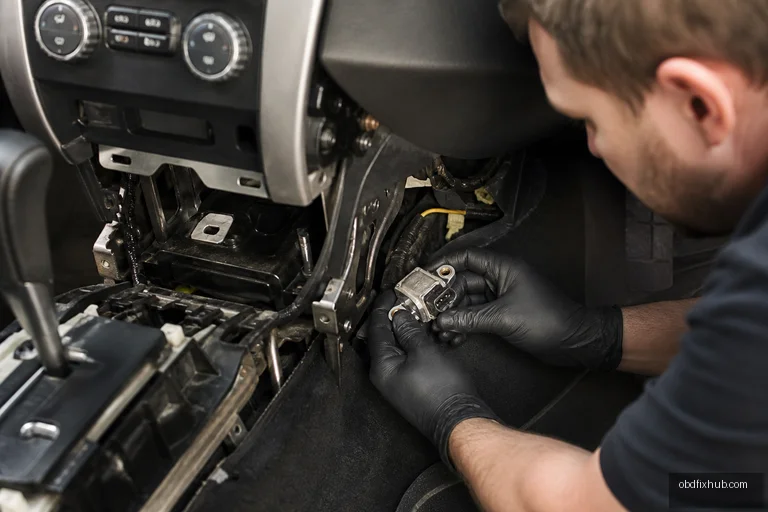
There is no single universal location. In many modern vehicles, the sensor is mounted low inside the passenger compartment, close to the vehicle’s center of gravity. Common locations include beneath the center console, under a front seat, on the floor tunnel, or near the airbag and yaw-rate sensor assembly.
On many Toyota models, the lateral acceleration sensor is part of, or mounted beside, the combined yaw-rate and deceleration sensor assembly. It is often located under the center console or near the floor below the console. Exact placement changes by model year, drivetrain, and body style, so the vehicle-specific repair manual should be used before removing trim or seats.
- Keep the vehicle level when inspecting or replacing the sensor.
- Do not strike, drop, or rotate the sensor unnecessarily.
- Disconnect the battery and follow airbag safety procedures before working near SRS wiring.
- After replacement, a zero-point calibration may be required.
What Does U0124 Mean in a Toyota Vehicle?
In a Toyota, U0124 generally indicates that the skid control ECU cannot communicate with the lateral acceleration sensor or its combined sensor assembly. Toyota may also store related codes such as C1210, C1234, C1241, C1336, or manufacturer-specific acceleration sensor codes, depending on the model.
A Toyota with U0124 may illuminate the ABS, traction control, VSC, or brake warning lamps. Some vehicles enter a fail-safe mode and continue driving with ordinary hydraulic braking, but stability control and traction assistance may not operate correctly. The warning lamps should therefore be treated as a safety issue rather than a minor dashboard nuisance.
Common Causes of U0124
- Low battery voltage: A weak battery or poor charging system can interrupt CAN communication during starting.
- Open or shorted wiring: Harnesses under seats and consoles can be pinched, stretched, or damaged by water intrusion.
- Loose or corroded connectors: A connector that looks attached may still have pushed-back terminals or oxidation inside.
- Blown fuse or missing power supply: The sensor and ABS ECU need stable ignition and ground circuits.
- Failed lateral acceleration sensor: Internal electronic failure can prevent the module from transmitting data.
- CAN bus fault: A short to power, short to ground, or damaged CAN-H/CAN-L circuit can affect multiple modules.
- Incorrect calibration: A sensor may communicate but report implausible data after suspension repairs, collision damage, or replacement.
- Water or collision damage: Flooding, a wet carpet, or impact near the center console can damage the assembly and its wiring.
Symptoms You May Notice
The most obvious symptom is a group of warning lights rather than a noticeable engine problem. Depending on the vehicle, drivers may see the ABS, VSC, TRAC, slip, brake, or check-engine light.
- ABS, traction control, or stability control becomes unavailable.
- TRAC or VSC cannot be switched off or flashes unexpectedly.
- Steering or brake-related warning messages appear.
- The vehicle applies reduced stability intervention or enters fail-safe operation.
- Several communication codes appear at the same time.
- The code returns after clearing, especially when the vehicle is started or driven over bumps.
U0124 does not usually cause a rough idle or hard starting by itself. If those symptoms are present, look for additional powertrain or low-voltage faults rather than blaming the acceleration sensor alone.
How to Diagnose U0124 Correctly
- Scan every module. A basic engine-code reader may not access the ABS or VSC system. Use a scan tool that can communicate with Toyota chassis modules and identify which module set U0124.
- Check battery and charging voltage. A healthy battery should generally measure about 12.4–12.7 volts with the engine off and approximately 13.5–14.8 volts while running, although specifications vary.
- Inspect fuses, grounds, and connectors. Look for water, green corrosion, loose terminals, crushed wiring, and aftermarket accessories connected to the CAN network.
- Check CAN communication. With the battery disconnected and the network asleep, many systems measure close to 60 ohms across CAN-H and CAN-L. Always verify the manufacturer’s test procedure before drawing conclusions.
- Compare live data. A scan tool can show whether lateral acceleration, yaw rate, steering angle, and wheel-speed values are plausible and changing correctly.
- Perform zero-point calibration when required. The vehicle must normally be parked on a level surface with the steering wheel centered and no one moving inside the cabin.
A practical diagnostic clue is the timing of the fault. If U0124 appeared immediately after a battery replacement, seat installation, interior spill, or suspension work, inspect the related wiring and calibration before ordering a sensor.
What About the C0061 Code?
The meaning of C0061 is not identical across every manufacturer and scan-tool database. On some vehicles, it relates to an acceleration sensor circuit or a longitudinal acceleration sensor; on others, the description can differ. Because of that variation, C0061 alone should not be used to identify the exact sensor location.
If C0061 appears with U0124, use the vehicle’s factory service information to confirm whether the affected component is the lateral acceleration sensor, longitudinal acceleration sensor, or a combined yaw/deceleration assembly. In many cars these sensors are housed together near the center console or floor tunnel, but the connector pinout and calibration procedure are model-specific.
How Is U0124 Fixed?
The correct repair depends on the failed part of the circuit. A loose connector may need cleaning and terminal repair; a damaged harness may require solder-free automotive-grade wiring repair; and a failed sensor assembly may need replacement followed by calibration.
- Repair corroded terminals, damaged wiring, power feeds, or grounds.
- Replace a failed lateral acceleration or combined yaw sensor assembly.
- Correct CAN-H or CAN-L wiring faults before replacing electronic modules.
- Perform sensor zero-point calibration and clear all codes.
- Road-test the vehicle and rescan every chassis module.
Replacing the sensor without checking voltage and communication circuits is a common mistake. If the original problem is a broken CAN wire, the replacement sensor will produce the same U0124 code.
Can You Drive With U0124?
You may be able to move the vehicle carefully, but driving normally is not recommended until the fault is diagnosed. Basic braking may remain available, while ABS, traction control, and electronic stability control may be disabled. Avoid high speeds, rain, snow, and aggressive cornering, and have the system inspected promptly.
Final Takeaway
U0124 is a communication failure involving the lateral acceleration sensor, not a guaranteed sensor failure. Start with battery voltage, fuses, grounds, connectors, and CAN wiring; then confirm the sensor with live data and the correct calibration procedure. For Toyota vehicles and any vehicle showing C0061, verify the exact factory code definition and sensor location before replacing parts.
Frequently Asked Questions
What does U0124 mean in a Toyota vehicle?
It means the Toyota’s control network has lost communication with the lateral acceleration sensor or its combined yaw/deceleration sensor assembly. Wiring, power supply, low voltage, CAN faults, and sensor failure are all possible causes.
Where is the lateral acceleration sensor located in a car?
It is commonly mounted inside the cabin near the vehicle’s center of gravity, such as beneath the center console, under a front seat, or on the floor tunnel. The exact position depends on the make and model.
What is a lateral acceleration sensor used for?
It measures side-to-side vehicle movement during turns and skids. The ABS and stability control systems use its data to manage braking and engine torque.
Where is the lateral acceleration sensor located on a vehicle with C0061?
C0061 has different definitions depending on the manufacturer. Confirm the code with a factory-level scan tool and service manual; if it identifies a combined acceleration sensor, it is often near the center console or floor tunnel.
Does replacing the sensor automatically clear U0124?
No. The wiring and communication fault must be repaired, and many vehicles require zero-point calibration after sensor replacement. The code should be cleared only after the system passes a road test and rescan.




