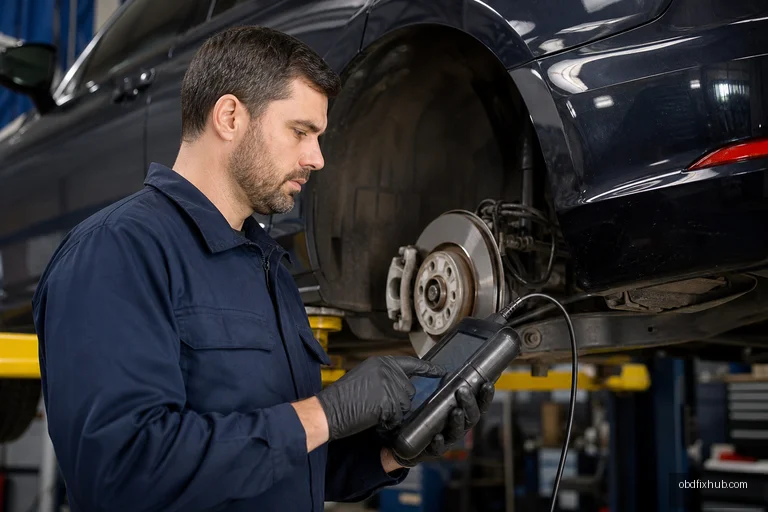
U0127 Lost Communication With Tire Pressure Monitor Module means another control module can no longer exchange data with the vehicle’s TPMS module over the communication network, usually the CAN bus. It does not automatically mean that one tire-pressure sensor is defective. The fault may be caused by a dead battery, damaged wiring, corrosion, a blown fuse, low system voltage, or a failed TPMS control module.
This is an information-focused diagnostic code, not a parts-swapping instruction. The safest repair begins by confirming actual tire pressures and then testing the TPMS module’s power, ground, network wiring, and communication status.
What Does the U0127 Code Mean?
Diagnostic trouble code U0127 is a generic network communication code defined as Lost Communication With Tire Pressure Monitor Module. A vehicle’s body control module, instrument cluster, ABS module, or another controller expects messages from the TPMS module. When those messages stop arriving for a calibrated period, the vehicle stores U0127.
The exact suffix can vary by manufacturer. For example, a code displayed as U0127-00 may indicate that no additional subtype information is available, while other vehicles may record a manufacturer-specific communication status. Always check the service information for the specific year, make, model, and engine before interpreting the code as a failed module.
Common Symptoms of a U0127 TPMS Communication Fault
A failed TPMS module can produce more than a warning light. The symptoms depend on whether the fault is intermittent or complete and on how the manufacturer integrates tire-pressure information into the vehicle network.
- TPMS warning light remains illuminated.
- The TPMS light flashes for approximately one minute at startup, then stays on.
- Tire-pressure readings show dashes, blank values, or unavailable data.
- The instrument cluster displays messages such as “Tire Pressure Monitor Fault” or “Service Tire Monitor System.”
- A scan tool cannot communicate with the TPMS module.
- Several unrelated communication codes appear in other modules.
- The warning appears after battery replacement, jump-starting, water exposure, or collision repair.
A flashing TPMS warning is particularly useful diagnostically. A steady light often means the system has detected low pressure, whereas a flashing light commonly indicates a system fault or loss of sensor/module communication. However, this pattern is not universal, so the owner’s manual and factory diagnostic information still take priority.
What Causes U0127 Lost Communication With Tire Pressure Monitor Module?
In real workshop diagnostics, U0127 is frequently caused by a power or network problem rather than by the TPMS module itself. The most likely causes include:
- Blown fuse or missing power supply: A fuse can fail after an electrical short, accessory installation, or jump-start event.
- Weak battery or charging-system voltage: Low voltage may make several modules drop offline and create misleading U-codes.
- Damaged CAN wiring: Open circuits, shorted CAN-H/CAN-L wires, crushed harnesses, and poor repairs can interrupt communication.
- Corroded connectors or water intrusion: TPMS modules located near wheel wells, the spare-tire area, or the rear body can be exposed to moisture and road salt.
- Poor ground connection: A loose or rusty ground may allow the module to work intermittently before communication is lost completely.
- Failed TPMS control module: Internal electronic failure is possible, especially after water damage or overvoltage.
- Incorrect programming or configuration: A replacement module may require initialization, coding, or relearning before the vehicle recognizes it.
- Aftermarket equipment: Remote starters, alarm systems, trailers, and poorly installed accessories can interfere with the vehicle network.
Do not confuse the TPMS module with the tire-pressure sensors inside the wheels. A sensor reports pressure and temperature by radio frequency. The TPMS module receives those signals and communicates their status to the rest of the vehicle. A sensor with a dead battery usually creates a missing-sensor or sensor-specific fault, while U0127 points more strongly toward the module’s network connection or power supply.
How to Diagnose U0127 Correctly
A basic code reader may display U0127 but often cannot access the TPMS module itself. A professional scan tool with manufacturer-level coverage is normally required to determine whether the module is online, whether it has internal codes, and whether other modules are reporting the same communication failure.
1. Check the tires and battery first
Measure all four tires, and the spare if the vehicle monitors it, with a reliable gauge. Do this when the tires are cold and compare the readings with the pressure label on the driver’s door jamb. Then test battery voltage and charging voltage. A battery that was recently discharged or replaced can explain multiple U-codes, but it should not be assumed to be the only problem.
2. Perform a complete vehicle scan
Scan every available module, not just the engine computer. If the TPMS module is the only unit offline, inspect its fuse, ground, power feed, and connector. If several modules show lost-communication codes, investigate the shared CAN network, main grounds, gateway module, or low-voltage event first.
3. Verify power and ground at the TPMS module
Use a wiring diagram and a digital multimeter to test the module under load. A fuse may look intact but still be supplied through a damaged circuit. Voltage-drop testing is more reliable than simply checking for voltage with the connector unplugged, especially when corrosion creates a high-resistance connection.
4. Inspect the harness and CAN network
Look for stretched wiring, previous repairs, water marks, green corrosion, rodent damage, or harnesses pinched by interior trim. With the vehicle powered down and the network asleep, many CAN systems measure close to 60 ohms across CAN-H and CAN-L because two 120-ohm terminating resistors are connected in parallel. This is a useful clue, not a universal pass/fail rule; follow the manufacturer’s test procedure and avoid probing terminals carelessly.
5. Confirm module operation and programming
If power, ground, wiring, and network resistance are correct but the scan tool still cannot communicate, the TPMS module may have failed. A replacement often needs configuration, sensor identification, and a relearn procedure. Installing a used module without matching the vehicle can leave the warning active even when the hardware is good.
U0127 Repair Options
The correct fix depends on the test results. A loose connector may only require cleaning and terminal repair, while a damaged CAN harness may need a precise splice or section replacement. If a fuse keeps blowing, replace the fuse only after finding the short; repeatedly installing a larger fuse can damage the harness or cause a fire.
- Repair or replace damaged wiring and connectors.
- Restore a corroded chassis or module ground.
- Replace a failed fuse, relay, or power-feed component after confirming the cause.
- Dry and repair water-damaged connectors, then correct the leak.
- Replace and program the TPMS control module when it fails internal communication tests.
- Register or relearn each tire sensor after the communication fault is repaired.
How Much Does It Cost to Fix a Tire Pressure Monitor Fault?
Repair costs vary significantly by vehicle and by the actual cause of U0127. A diagnostic scan and electrical testing commonly cost about $80–$180, although dealer rates and regional labor prices may be higher. A simple fuse, connector, or ground repair may cost approximately $50–$250.
Harness repairs often fall between $150 and $600, depending on access and damage. Replacing and programming a TPMS module can commonly total $300–$900 or more. Individual wheel sensors are often less expensive, but replacing sensors will not fix U0127 if the module itself has no power or cannot communicate. Ask the repair shop whether the estimate includes programming, sensor relearn, and a post-repair network scan.
Can You Still Drive With a Tire Pressure Sensor Fault?
You may be able to drive if the vehicle runs normally, but you should not treat the warning as harmless. When U0127 is active, the vehicle may not receive reliable pressure information, so a slow leak or puncture could go unnoticed. Check tire pressures manually before driving and at regular intervals until the system is repaired.
Stop driving and inspect the vehicle immediately if a tire looks low, the steering changes, the vehicle pulls to one side, or a tire-pressure warning appears with unusual handling. The TPMS fault itself may not disable the vehicle, but driving on an underinflated tire can cause overheating, sidewall damage, poor braking, and a blowout.
A Practical Diagnostic Example
Consider a pickup that develops a flashing TPMS light after heavy rain and stores U0127-00. The tires test correctly, but the scan tool cannot access the TPMS module. Inspection finds moisture around a rear body connector. Cleaning the terminals alone may provide a temporary fix; the technician must also repair the seal or body leak, verify module power and ground, clear the code, and confirm communication during a road test.
By contrast, if U0127 appears immediately after a weak battery and several other modules report communication failures, replacing the TPMS module first would be poor diagnosis. Battery testing, charging-system verification, and a complete network scan should come before expensive parts.
Key Takeaway
U0127 means the vehicle has lost communication with its tire-pressure monitoring module, not necessarily that a tire sensor has failed. Confirm tire pressure, scan all modules, test power and ground, inspect CAN wiring, and only then consider module replacement. Repair the fault promptly because the vehicle may no longer warn you about a developing low-tire condition.
Frequently Asked Questions
What does the U0127 code mean?
It means another vehicle control module is no longer receiving messages from the TPMS control module. Common causes include lost power, bad grounds, damaged CAN wiring, corrosion, low voltage, or a failed module.
What are the symptoms of a bad TPMS module?
Typical symptoms include a flashing or steady TPMS warning light, missing tire-pressure readings, a “service tire monitor” message, inability to communicate with the module using a scan tool, and additional network codes.
How much does it cost to fix a tire pressure monitor fault?
A basic diagnosis may cost $80–$180. Wiring or connector repairs may range from $50–$600, while module replacement and programming can cost $300–$900 or more, depending on the vehicle.
Can I still drive with a tire pressure sensor fault?
Only with caution and after manually checking tire pressures. The system may not warn you about a puncture or slow leak. Do not drive if a tire is visibly low or the vehicle’s handling has changed.
Will replacing the tire-pressure sensors fix U0127?
Usually not if the TPMS module itself is offline. Sensor replacement is appropriate only when testing identifies a sensor-specific failure and the central module can still communicate normally.




