U013C Lost Communication With Accelerator Pedal Module: Meaning, Causes, Symptoms & Fix
U013C means that one or more vehicle control modules have lost communication with the accelerator pedal module over the CAN network. In practical terms, the engine computer may no longer receive a reliable accelerator-pedal position signal, which can trigger reduced power, an unresponsive throttle, or a no-start condition. Do not assume the pedal itself is defective until power, ground, wiring, and CAN-bus communication have been tested.
Search intent: This is an informational and diagnostic query. The safest approach is to identify whether the fault is an electrical supply problem, a network fault, or a failed accelerator pedal assembly before buying replacement parts.
What Does U013C Mean?
Diagnostic trouble code U013C is a network communication code. It is commonly described as “Lost Communication With Accelerator Pedal Module,” although the exact wording can vary by manufacturer and scan-tool software.
The accelerator pedal assembly normally contains two or more position sensors. These sensors report pedal movement to a dedicated pedal module or directly to the powertrain control module, depending on the vehicle design. The signals are continuously compared for plausibility. If the expected messages disappear from the CAN bus, or another module cannot communicate with the pedal controller, U013C may be stored.
Some vehicles do not use a separate, removable accelerator pedal module. The electronics may be built into the pedal assembly or integrated into another controller. For that reason, the vehicle’s wiring diagram and manufacturer-specific service information are essential.
Common Symptoms of U013C
Symptoms depend on whether the communication loss is intermittent or permanent. A loose connector may produce an occasional warning, while a missing power supply can leave the vehicle in a fixed reduced-power mode.
- Check Engine, electronic throttle, or reduced-power warning light
- Accelerator pedal response that is delayed, limited, or completely absent
- Engine stuck at idle or unable to increase speed
- Hard starting or a no-start condition on some vehicles
- Transmission or stability-control warning messages caused by network data loss
- Intermittent limp mode, especially after hitting bumps or moving the pedal harness
- Multiple U-codes stored in several control modules
If the accelerator becomes unresponsive while driving, move to a safe location without repeatedly cycling the ignition or attempting to continue at highway speed. Loss of pedal communication can be a genuine drivability and safety issue.
Most Likely Causes of U013C
1. Low battery voltage or a poor ground
A weak battery, corroded terminal, or loose ground strap can make control modules reboot or drop off the CAN network. This is especially common after jump-starting, battery replacement, or extended storage. Check battery voltage under load rather than relying only on a static reading.
2. Blown fuse or missing module power
The accelerator pedal circuit may have a dedicated fuse or share power with the engine-control system. A fuse can fail because of a shorted wire, water intrusion, or an internal module fault. Replacing the fuse without finding the reason it failed can create a repeat fault or damage the harness.
3. Damaged CAN wiring
Open circuits, shorted CAN-high or CAN-low wires, corrosion, and poorly repaired wiring can interrupt messages. Inspect areas near the pedal, kick panel, carpet edge, aftermarket alarm installations, and previous collision repairs. A harness can look intact while an internal conductor is broken from repeated flexing.
4. Loose, contaminated, or water-damaged connectors
The accelerator pedal connector is exposed to footwell moisture, cleaning chemicals, and accidental impact. Look for pushed-back terminals, green corrosion, bent pins, moisture, or a connector lock that is not fully engaged. Do not pack a connector with grease before checking terminal tension and circuit integrity.
5. Failed accelerator pedal module or assembly
Internal sensor failure, a damaged circuit board, or an internal communication fault can cause U013C. However, a pedal assembly should be replaced only after its power, ground, signal circuits, and network connections pass testing. Parts swapping is one of the most common reasons this repair becomes unnecessarily expensive.
How to Diagnose U013C Correctly
- Record every code. Scan all available modules, not just the engine computer. Note whether the code is current, pending, or history, and save freeze-frame data.
- Check the battery and charging system. Inspect terminals and grounds. A healthy charging system typically produces approximately 13.5–14.8 volts with the engine running, though the vehicle specification takes priority.
- Check fuses and module power. Test both sides of each relevant fuse with the circuit loaded. A visual inspection alone can miss a poor fuse connection or an open feed.
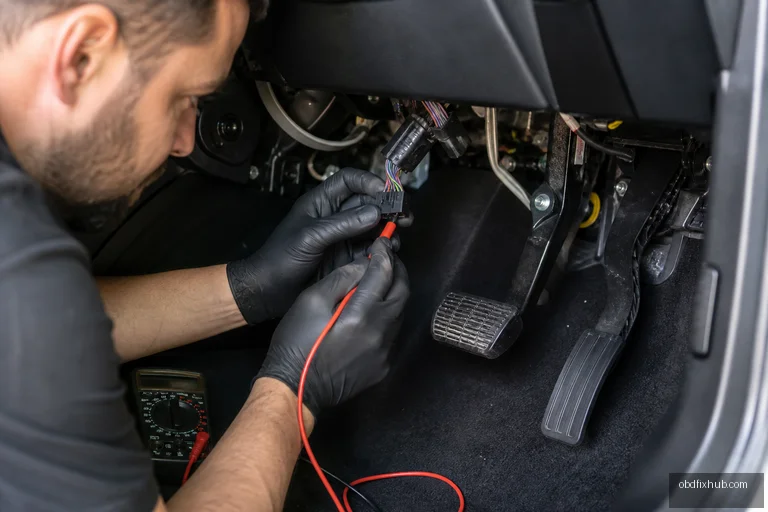
- Inspect the pedal connector and harness. With the ignition off, look for moisture, stretched wires, damaged insulation, or terminals pushed into the connector body. Gently move the harness while observing live data if the fault is intermittent.
- Test CAN-bus resistance. With the vehicle powered down and appropriate modules asleep, approximately 60 ohms is commonly measured across CAN-high and CAN-low on a properly terminated network. The exact test procedure varies, and measuring resistance on a powered circuit can cause damage.
- Check network voltage and waveforms. A professional scan tool, multimeter, or oscilloscope can reveal a shorted line, missing bias voltage, or a controller that is pulling the bus down.
- Compare pedal-position data. If the scan tool can communicate with the module, slowly press the pedal and check that redundant sensor signals change smoothly and plausibly. Sudden jumps, dropouts, or disagreement point toward a sensor or wiring fault.
A useful real-world clue is the timing of the fault. If U013C appears immediately after battery work, start with power, grounds, and connector disturbance. If it appears after rain or carpet cleaning, investigate moisture in the footwell. If it appears after an accident, inspect the harness where it passes through the kick panel and firewall.
How to Fix U013C
The correct repair depends on the failed test result. Clean and secure corroded connections, repair wiring with appropriate automotive splices, restore damaged grounds, or replace a failed fuse only after correcting the underlying short. If the pedal module itself fails its power, ground, communication, and sensor tests, replace the accelerator pedal assembly or module specified for that vehicle.
After the repair, clear the codes and perform the manufacturer-required accelerator pedal or throttle relearn procedure. Some vehicles need a scan-tool initialization; others use a precise ignition-pedal sequence. Confirm that pedal data is smooth, road-test carefully, and rescan every module for returning communication codes.
Can You Drive With U013C?
Driving is not advisable when the pedal is unresponsive, the vehicle is in reduced power, or the code is current with multiple warning lights. A vehicle that still responds normally may have an intermittent fault, but it can lose acceleration without warning. Have it diagnosed promptly, and use a tow service if the engine cannot be controlled reliably.
Why Am I Getting “NVIDIA Kernel Module Is Missing, Falling Back to Nouveau”?
This message is not related to automotive code U013C. It is a Linux graphics-driver message. It means the proprietary NVIDIA kernel module was not built, loaded, or permitted, so the system is using the open-source nouveau driver instead.
Common causes include missing kernel headers or DKMS packages, an NVIDIA driver/kernel version mismatch, Secure Boot blocking the unsigned module, a failed driver installation, or a recent kernel update. Check the installed NVIDIA package, DKMS status, kernel logs, and Secure Boot configuration. On Fedora and similar systems, reinstalling the matching driver and kernel-development packages may be necessary. This computer error has no diagnostic connection to the vehicle’s U013C code.
Frequently Asked Questions
Is U013C the same as a bad accelerator pedal?
No. U013C identifies lost communication, not a confirmed pedal failure. A fuse, ground, CAN wire, connector, battery, or another control module can produce the same code.
Can a weak battery cause U013C?
Yes. Low voltage can make the accelerator pedal controller or another network module shut down temporarily. Test the battery, charging voltage, terminals, and grounds before replacing electronic components.
Will clearing U013C fix the problem?
Clearing the code may remove a stored warning temporarily, but it will not repair a wiring or communication fault. If the problem remains, U013C will return when the modules perform their next network check.
Do I need to replace the accelerator pedal immediately?
No. Confirm power, ground, connector condition, CAN communication, and pedal-position data first. Replacing the pedal without these tests can waste money and leave the real wiring fault unresolved.
Can I diagnose U013C with a basic code reader?
A basic reader may display the code, but a full-system scan tool is usually needed to identify which module lost communication and to view live pedal data. Electrical testing with a wiring diagram is often required for a reliable repair.
Bottom Line
U013C is a communication failure between vehicle control modules and the accelerator pedal system. Start with battery voltage, grounds, fuses, connectors, and CAN wiring; only then consider replacing the pedal or its module. Because a failed accelerator signal can cause sudden loss of power, treat a current U013C code as a safety-related fault and obtain a proper diagnosis before continuing to drive.




