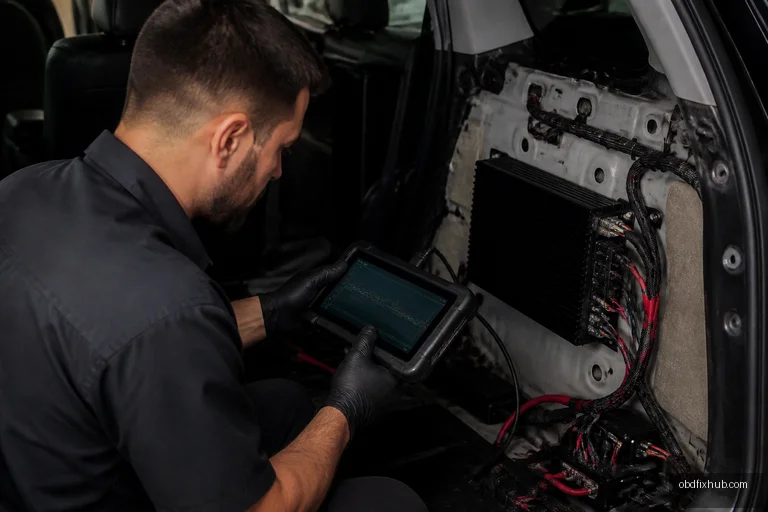
U0186 Lost Communication With Audio Amplifier means one or more control modules can no longer communicate with audio amplifier A over the vehicle’s CAN network. The most common causes are a failed amplifier, blown fuse, poor ground, water intrusion, damaged wiring, or a CAN-bus fault. Before replacing an expensive amplifier, verify its power, ground, connectors, and network signals.
What Does OBD-II Code U0186 Mean?
U0186 is a network communication trouble code. The vehicle’s body control module, radio, infotainment controller, or gateway module expects a response from the audio amplifier, but the amplifier does not answer within the required time. The letter A identifies the amplifier module used by that particular vehicle; it does not necessarily mean there is a second amplifier.
This code is not the same as a traditional speaker or radio fault. A damaged speaker may cause distortion or silence in one channel, while U0186 indicates that the vehicle cannot communicate with the amplifier electronically. In many vehicles, the amplifier controls power distribution, speaker output, chimes, warning tones, and sometimes turn-signal or parking-sensor sounds.
Common Symptoms of U0186
Symptoms vary by vehicle design and by whether the amplifier has lost power completely or is only intermittently dropping off the network. Typical complaints include:
- No sound from any speaker, including the radio, Bluetooth, navigation, or USB audio.
- Radio or infotainment display works, but the volume control has no effect.
- Missing door chimes, turn-signal clicks, parking sensor tones, or navigation prompts.
- An amplifier, audio system, or communication warning stored in the scan tool.
- Intermittent audio that returns after cycling the ignition or hitting a bump.
- Multiple U-codes caused by a shared CAN-bus, power, or ground problem.
If only one speaker is silent and the other channels work normally, investigate the speaker, speaker wiring, or amplifier output channel before assuming U0186 is the primary fault.
Most Likely Causes of U0186
1. Lost amplifier power or ground
A blown AUDIO, AMP, RADIO, or infotainment fuse can make the amplifier appear offline. Some amplifiers also use a separate constant battery feed and an ignition or wake-up feed. A loose ground under a seat or behind a trim panel is another frequent cause, especially after interior water leaks or accessory installation.
2. Water intrusion
Factory amplifiers are commonly mounted under a seat, in a trunk side panel, behind the dashboard, or near a door pillar. Wet carpet, clogged sunroof drains, leaking hatch seals, and spilled liquids can corrode the amplifier connector. Green terminals, white residue, or moisture inside the connector are strong clues.
3. CAN-bus wiring damage
The amplifier communicates through twisted CAN-H and CAN-L wires. A pinched harness, aftermarket radio splice, short to ground, short to voltage, or poor repair can interrupt communication. Do not probe CAN wires with a test light; use the wiring diagram and a digital multimeter or oscilloscope.
4. Failed amplifier or software issue
Internal amplifier failure is possible, particularly after a battery jump-start, reverse-polarity event, overheating, or water exposure. Some models also require amplifier software updates or configuration after replacement. A new module may remain silent until it is programmed to the vehicle.
How to Diagnose and Fix U0186
Use this sequence rather than immediately ordering an amplifier. The exact fuse locations and voltage specifications must come from the vehicle’s service information.
- Scan every module. Use a scan tool capable of reading body, infotainment, gateway, and amplifier modules. Record whether U0186 is current or history, and note any additional U-codes. If several modules are offline, the fault may be upstream of the amplifier.
- Check the battery first. Low system voltage can cause communication faults. A healthy battery should generally measure about 12.4–12.7 volts with the engine off and approximately 13.5–14.8 volts while running, depending on the charging system.
- Inspect all related fuses. Test both sides of each audio and amplifier fuse with the circuit powered. A visual inspection can miss a hairline fuse failure. If a replacement fuse blows again, find the short instead of installing a larger fuse.
- Test amplifier power and ground under load. Confirm the constant feed, switched or wake-up feed, and ground at the amplifier connector. A voltage reading with no load can be misleading; a corroded terminal may show battery voltage but fail when the amplifier draws current.
- Inspect the connector and harness. Look for bent pins, pushed-back terminals, corrosion, aftermarket splices, crushed wiring, and evidence of water. Gently tug each relevant wire near the connector to identify a terminal that is not locked correctly.
- Test the CAN network. With the vehicle powered down and the battery isolated according to the service procedure, resistance across CAN-H and CAN-L is commonly near 60 ohms on a properly terminated network. This is only a general reference; always follow the manufacturer’s test method. An oscilloscope is better for finding intermittent or distorted communication.
- Clear the code and retest. After repairing the cause, clear all modules, cycle the ignition, and operate every audio source. Confirm that chimes and other vehicle sounds return, not just music from the radio.
My Car Amplifier Is Not Working: What Should I Do?
Start by determining whether the radio display and amplifier are both dead. If the display is working but every audio source is silent, focus on amplifier power, ground, wake-up control, and CAN communication. If the system cuts out when driving over bumps, move and inspect the amplifier harness while monitoring the module connection; an intermittent terminal can be more difficult to find than a failed component.
Do not bypass the factory amplifier or connect speakers directly to a modern infotainment unit without a wiring plan. Many systems use low-level audio signals, digital audio links, active noise cancellation, or vehicle-specific impedance. An incorrect bypass can damage the radio or create new communication faults.
What Does the Dodge U0186 Code Mean?
On Dodge vehicles, U0186 generally indicates lost communication with audio amplifier A. The exact module name and repair procedure depend on the model, year, sound-system option, and infotainment platform. A Dodge with an amplifier under a seat or in the rear quarter panel may develop this code after water intrusion, a discharged battery, an aftermarket radio installation, or a failed amplifier fuse.
When diagnosing a Dodge, check whether other modules report lost communication with the radio, telematics module, or body control module. If the scan tool cannot communicate with several related modules, replacing the amplifier first is unlikely to solve the problem. A dealer-level scan tool may be required for configuration or proxy alignment after replacing the audio module.
What Does Harley-Davidson Code U0186 Mean?
On a Harley-Davidson motorcycle equipped with factory infotainment and an audio amplifier, U0186 can refer to lost communication with the amplifier over the motorcycle’s network. However, Harley-Davidson diagnostic terminology and module naming can vary by model year and infotainment system. Confirm the code in the official service manual or with a scan tool that supports Harley modules before treating it exactly like an automotive U0186.
For a Harley, inspect battery voltage, accessory fuses, amplifier ground, fairing or saddlebag connectors, and wiring disturbed by accessory speakers or handlebar modifications. Motorcycle vibration makes loose terminals and poorly crimped aftermarket connections especially important suspects. If the amplifier is replaced, verify whether the system requires a software update, pairing procedure, or module setup.
How to Fix Lost Communication With the ECM
U0186 itself is an audio amplifier communication code, not a code that specifically means lost communication with the ECM. If the scan tool also reports lost communication with the ECM, treat that as a separate and higher-priority network problem. Check battery voltage, ECM fuses, grounds, main connectors, CAN wiring, and any module that may be shorting the network.
Disconnecting modules one at a time can help locate a device that is pulling the CAN bus down, but follow the manufacturer’s shutdown and battery-disconnection procedure. Never disconnect an ECM or gateway module with the ignition on. If the engine will not start, multiple modules disappear from the scan tool, or CAN voltage is abnormal, professional network diagnosis is safer than replacing parts by trial and error.
When Is Amplifier Replacement Necessary?
Replace the amplifier only after confirming that it has correct power, ground, wake-up input, and CAN wiring, and that the connector is clean and secure. A module that remains completely offline with verified circuits is a strong replacement candidate. Before installation, compare the part number and sound-system option, because visually similar amplifiers may not be interchangeable.
After replacement, the vehicle may need coding, configuration, theft-related pairing, or calibration. If the amplifier was damaged by water, repair the leak and dry the surrounding carpet before installing another unit, or the replacement may fail again.
Final Takeaway
U0186 points to a communication failure between the vehicle network and audio amplifier A. Begin with a complete module scan, battery and fuse checks, then test amplifier power, ground, connectors, and CAN wiring. Once those circuits are proven good, amplifier replacement or module programming becomes a sensible next step. This method avoids the most common mistake: spending money on an amplifier when the real fault is a fuse, ground, corroded connector, or damaged network wire.
Frequently Asked Questions
Can U0186 cause the radio display to work with no sound?
Yes. The radio and display may remain operational while the amplifier is offline, leaving music, chimes, and navigation prompts silent.
Is U0186 caused by a bad speaker?
Usually not. A bad speaker normally affects one channel, while U0186 describes lost electronic communication with the amplifier. Check the amplifier network and power circuits first.
Will disconnecting the battery clear U0186?
It may temporarily erase a stored code, but it will not repair the underlying problem. If communication is still missing, U0186 will return after the vehicle completes its network checks.
Can a low battery trigger U0186?
Yes. Low voltage during starting or charging-system problems can make several modules shut down or lose communication. Test battery and alternator performance before replacing audio components.
Do I need programming after replacing the amplifier?
Many modern vehicles do. The replacement amplifier may require configuration, coding, pairing, or a software update before it produces sound and communicates correctly.




