U017E Lost Communication With Seat-Belt Pretensioner Module means that another control module, usually the airbag or restraint control module, can no longer exchange data with the seat-belt pretensioner module on the vehicle network. The airbag or seat-belt warning light may illuminate, and the restraint system may disable some safety functions until the fault is repaired. Because this code involves crash-protection equipment, it should not be treated like a minor communication fault.
What Does the U017E Code Mean?
Diagnostic trouble code U017E is a network communication code. In practical terms, the vehicle’s restraint control system expects a response from Seat-Belt Pretensioner Module A, but the expected message is missing or invalid for a defined period. The exact location and naming of Module A vary by manufacturer; it may be integrated into a seat-belt retractor, mounted beneath a seat, or incorporated into a larger restraint control assembly.
The code does not automatically prove that the pretensioner itself is defective. A discharged battery, damaged CAN wiring, loose connector, water intrusion, blown fuse, software issue, or a failed control module can produce the same U017E fault. The correct diagnosis starts with the complete restraint-system network, not with immediately replacing a seat belt.
What Does the Airbag or Seat-Belt Pretensioner Warning Light Mean?
The airbag or seat-belt pretensioner warning light means the vehicle has detected a fault in the supplemental restraint system. Depending on the vehicle, this can affect airbags, seat-belt pretensioners, occupant classification sensors, crash sensors, or communication between those components.
When the light remains on after the normal bulb check, the system may not deploy correctly in a collision. Some vehicles disable the affected pretensioner or airbag circuit to prevent an unintended deployment, while others retain limited operation. You cannot determine the system’s actual safety status from the warning light alone, so the fault codes must be read with a scanner that can access the airbag or SRS module.
Common Symptoms of U017E
- Airbag, SRS, or seat-belt warning light remains illuminated.
- A message such as Check Airbag System or Service Restraint System appears on the dashboard.
- Seat-belt pretensioner or airbag-related codes are stored in more than one module.
- Generic OBD scanners show limited information or cannot communicate with the SRS module.
- The fault appears intermittently after moving a seat, driving over bumps, or starting the vehicle with a weak battery.
- Additional U-codes appear because other modules are also missing CAN-bus messages.
An intermittent warning after seat adjustment is particularly useful evidence. Wiring under the front seats can be pulled, pinched, or exposed to spilled drinks, while repeated seat movement gradually loosens a connector that looked secure during a quick visual inspection.
Most Likely Causes of the U017E Code
- Low system voltage: A weak battery, poor ground, or charging-system problem can interrupt module startup and create several communication codes at once.
- Open or shorted CAN-bus wiring: The communication pair may be broken, shorted to ground, shorted to power, or damaged by seat rails or previous repairs.
- Loose or corroded connectors: Moisture beneath a carpet or seat can corrode terminals and increase resistance in the power, ground, or network circuits.
- Blown fuse or missing power supply: A fuse may protect the pretensioner module or a shared restraint-system feed.
- Failed pretensioner control module: Internal electronics can fail after water intrusion, impact damage, overheating, or an electrical surge.
- Previous collision or seat replacement: Salvage parts, incorrect module coding, deployed pretensioners, or unrepaired crash data can cause communication and configuration faults.
- Software or configuration problems: Some vehicles require module programming, calibration, or a manufacturer-specific software update after replacement.
How to Diagnose U017E Properly
Use a professional scan tool capable of communicating with the SRS or restraint control module. A basic engine-code reader may display U017E but cannot show the module’s live data, network status, manufacturer-specific subcodes, or deployment history.
1. Record every stored code
Scan all available modules before clearing anything. Note whether U017E is current, history, or intermittent, and record companion codes for low voltage, CAN communication, lost power, or internal module failure. The first code in the vehicle’s timeline is often more useful than the longest list of symptoms.
2. Check the battery and grounds first
Test battery voltage with the vehicle at rest and during cranking, then verify charging voltage with the engine running. Inspect the body and battery grounds for looseness or corrosion. If several modules logged communication faults immediately after a flat battery or jump start, correct the voltage problem before condemning the pretensioner module.
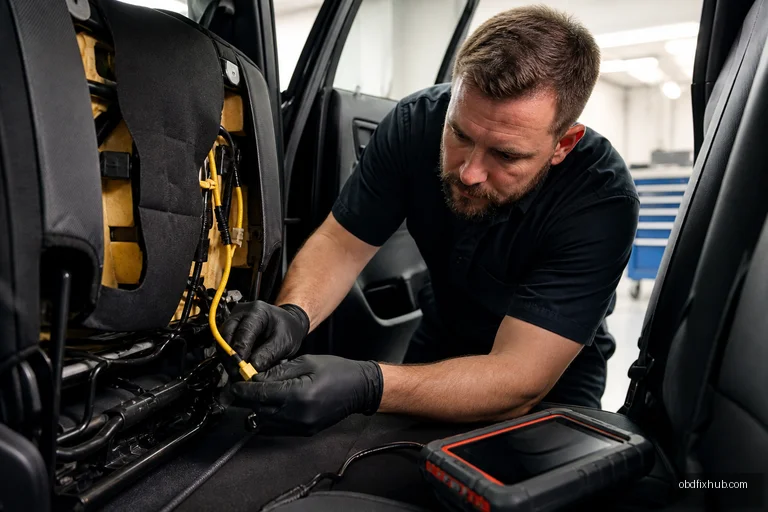
3. Inspect the seat and restraint wiring safely
Turn the ignition off, disconnect the battery according to the manufacturer’s procedure, and wait the specified discharge period before working near airbag or pretensioner connectors. Do not probe yellow SRS terminals with a test light, incandescent bulb, or ordinary multimeter unless the service information specifically permits that test.
Look for crushed wires beneath the seat, stretched harnesses, water marks, bent terminals, damaged locks, and aftermarket accessories sharing the harness. Pay close attention to areas where a seat rail can contact wiring at its full forward and rearward travel.
4. Test power, ground, and the communication network
With the wiring diagram for the exact vehicle, verify that the module receives the correct power and has a clean ground under load. If power and ground are correct, test the CAN high and CAN low circuits using the manufacturer’s resistance and voltage procedures. Network tests must be performed carefully because a shorted module elsewhere on the bus can make the pretensioner module appear to be the problem.
5. Confirm module identity and configuration
If the seat belt or module has been replaced, check the part number, vehicle configuration, side designation, and software requirements. A physically compatible-looking component may still be incorrect for the vehicle. Some manufacturers require initialization, coding, or calibration before communication is restored.
How to Fix U017E
The repair depends on the failed part or circuit. A reliable fix may involve repairing a damaged CAN wire, replacing a corroded connector terminal, restoring a missing fuse feed, repairing a ground, replacing a faulty pretensioner module, or programming a replacement unit with factory-level equipment.
Do not simply clear the code and return the vehicle to the road. If the fault returns immediately, the module is still offline or the network problem remains. After the repair, scan the entire vehicle again, clear the codes only after the circuit is verified, cycle the ignition, and confirm that the SRS warning light performs its normal self-check and goes out.
A deployed pretensioner must be replaced according to the manufacturer’s collision-repair procedure. Never install a resistor or bypass device to extinguish the warning light. That may hide the fault while leaving the occupant-protection system unavailable in a crash.
Can You Drive With U017E?
The vehicle may start and drive normally with U017E, but normal driving behavior does not mean the restraint system is safe. If the airbag or pretensioner warning light is on, arrange diagnosis promptly and avoid unnecessary driving. Do not transport passengers in a seat that has visible damage, a loose belt, or a known pretensioner fault.
Frequently Asked Questions
Is U017E the same as a bad seat-belt pretensioner?
No. U017E identifies a loss of communication, not a confirmed mechanical or electrical failure inside the pretensioner. Wiring, power supply, grounding, CAN-bus faults, and module programming must be ruled out first.
Can a weak battery cause U017E?
Yes. Low voltage during starting can prevent a restraint module from booting correctly. Test the battery, charging system, and grounds before replacing expensive SRS components.
Will a normal OBD2 scanner clear U017E?
Usually not reliably. Many basic scanners can read engine emissions codes only. Use a scan tool that supports the vehicle’s airbag, SRS, and body-control modules.
Is it safe to inspect the connector under the seat?
Only with the battery disconnected and the manufacturer’s safety procedure followed. Never probe or jumper airbag and pretensioner circuits casually; an accidental deployment can cause serious injury.
How much does a U017E repair cost?
The cost ranges from a simple wiring or connector repair to a programmed module or seat-belt replacement. Diagnosis matters because replacing the pretensioner before checking power and CAN communication can create unnecessary expense.
Bottom Line
U017E means the restraint system has lost communication with Seat-Belt Pretensioner Module A. Start with a full-module scan, battery and ground checks, and a careful inspection of the under-seat wiring before replacing parts. Because the warning light can indicate reduced crash protection, have the vehicle diagnosed with SRS-capable equipment and repair the underlying fault rather than masking the code.




