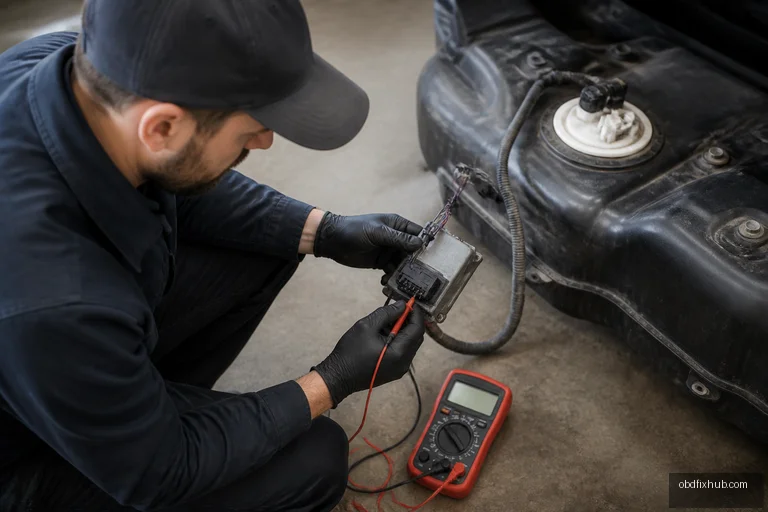
U016C lost communication with secondary fuel pump module means another control unit can no longer exchange data with the vehicle’s secondary fuel pump control module over the communication network. The fault is usually caused by a power, ground, CAN wiring, connector, or module problem—not automatically by a failed fuel pump. Diagnose the network and module supply circuits before replacing expensive parts.
What Does U016C Mean?
Diagnostic trouble code U016C is a network communication code. It is set when a vehicle control module, such as the powertrain control module (PCM), body control module (BCM), or gateway, stops receiving expected messages from the secondary fuel pump module.
The word secondary is important. Some vehicles use more than one fuel pump, a primary and secondary pump module, or a separate controller for a high-pressure or auxiliary fuel delivery system. The exact configuration varies by manufacturer, engine, and fuel system design. Always confirm the code definition and module location using the vehicle-specific service information.
U016C is also different from U0109, which generally refers to lost communication with the fuel pump control module. The two codes may appear together if the vehicle has a common power supply, ground, gateway, or CAN bus problem.
Common Symptoms of U016C
A vehicle with this code may start normally, start intermittently, or fail to start altogether. In many cases, the symptoms depend on whether the secondary pump is required during startup, high engine load, low fuel level, or certain emissions operating conditions.
- Extended cranking or a no-start condition
- Engine stalling, hesitation, or reduced power
- Low fuel pressure or unstable fuel pressure
- Check Engine, service engine, or fuel system warning light
- Fuel pump that does not run during key-on or commanded testing
- Multiple U-codes caused by a wider CAN network interruption
- Intermittent operation after rain, vibration, or temperature changes
A useful workshop clue is whether the code is current or history-only. If U016C returns immediately after clearing, the module is probably still offline. If it returns only after driving over bumps or filling the tank, inspect the connector, ground, and harness near the fuel tank before condemning the controller.
What Causes Lost Communication With the Fuel Pump Control Module?
The most common cause is loss of electrical power or ground at the module. A blown fuse, overheated fuse-box terminal, corroded ground point, or poor battery connection can make a perfectly healthy module appear defective.
- Blown fuel pump module, ignition, or powertrain fuse
- Open, shorted, or corroded CAN high and CAN low wiring
- Loose, water-damaged, or fuel-contaminated module connector
- Weak module ground or excessive voltage drop under load
- Low battery voltage, charging-system problems, or a recent battery failure
- Failed secondary fuel pump control module
- Aftermarket alarm, remote-start, immobilizer, or wiring modification
- Gateway or PCM software fault, in less common cases
On vehicles where the module is mounted near the tank, road salt and water intrusion deserve special attention. A connector can look clean from the outside while the terminals inside have lost tension. Lightly tug each wire at the connector; a terminal that moves independently of the housing is a strong warning sign.
How to Diagnose U016C Correctly
Do not begin by replacing the fuel pump. A scan tool that can access all modules is far more useful than a basic code reader because it shows whether the secondary fuel pump module responds to identification, live data, and actuator commands.
- Record every code. Scan all modules before clearing anything. A low-voltage code or gateway communication code may explain U016C.
- Check battery voltage. A healthy battery should normally measure close to 12.6 volts with the engine off and approximately 13.5–14.8 volts while charging, depending on the vehicle.
- Verify fuses with a test light or meter. Testing only the visible fuse element is not enough; check for power on both sides with the circuit loaded.
- Test module power and ground. Measure voltage at the module connector and perform a voltage-drop test on the ground while the circuit is operating. A ground can pass a continuity test yet fail under load.
- Inspect CAN wiring. With the ignition off and the vehicle asleep, many conventional CAN systems measure about 60 ohms across CAN-H and CAN-L. This is a guide, not a universal rule; follow the manufacturer’s procedure before interpreting the reading.
- Check network activity. A scope is the most reliable way to identify a shorted or distorted CAN signal. Disconnecting modules one at a time may locate a device pulling the network down, but use the factory isolation procedure.
- Command the pump system. If the module communicates but the pump does not operate, the problem may be the pump, driver circuit, pressure sensor, or fuel delivery wiring rather than communication.
Never back-probe fuel pump circuits carelessly around an open fuel system. Use insulated test equipment, avoid sparks, and follow the manufacturer’s fuel-system safety instructions.
How to Fix U016C
The correct repair depends on the failed test. Replace a blown fuse only after finding why it opened; repeatedly installing a larger fuse can damage the harness or create a fire risk. Repair damaged wiring with the correct wire size, sealed splices, and proper routing away from heat, sharp edges, and the fuel tank.
Clean corroded terminals only when the terminal fit remains tight. If the plating is badly damaged or the connector has overheated, replace the terminal or connector housing. Restore module grounds to clean, bare metal and protect the finished connection against moisture.
If power, ground, CAN wiring, and network termination are correct but the module will not communicate, the secondary fuel pump control module may have failed. Some vehicles require module programming, configuration, or a security relearn after replacement. A new module that has not been programmed may still produce communication or fuel-system codes.
How Do I Reset a Fuel Pump Control Module?
There is no universal reset procedure. On many vehicles, switching the ignition off, allowing the vehicle to enter sleep mode, and then clearing codes with a capable scan tool is sufficient after the fault is repaired. Some systems also provide a fuel pump module reset, initialization, or relearn function in the scan tool’s special-functions menu.
Disconnecting the negative battery cable may reset temporary values on some older vehicles, but it does not repair a wiring fault and may erase radio settings, learned fuel trims, window memory, or anti-theft information. It can also create additional low-voltage codes. Use the factory procedure whenever possible, then cycle the ignition and rescan all modules.
What Happens If the Fuel Pump Control Module Goes Bad?
A failed module may stop the pump from receiving the correct voltage or pulse-width command. The result can be a no-start, stalling, low fuel pressure, reduced engine power, or an engine that runs only when the module happens to operate. Some vehicles use a fallback strategy, so the engine may continue running while the secondary pump remains unavailable.
Continuing to drive is risky if fuel pressure is unstable. Lean operation under load can cause misfires and catalytic-converter damage, while an unexpected stall can create a safety hazard. If the engine stalls, pressure is very low, or the pump is silent, have the vehicle diagnosed rather than relying on repeated restarts.
How to Fix Fuel Pump Secondary Circuit Low
Fuel pump secondary circuit low is usually associated with a separate power-output code, commonly P0231 on many vehicles; it is not the same as U016C. It indicates that the control circuit voltage is lower than expected, which can result from a shorted pump, poor ground, high resistance in the power wire, a failing relay, or a defective driver inside the module.
Compare commanded and actual voltage at the pump and at the module. A significant voltage drop between those points identifies wiring or connector resistance. If voltage is low at the module output even with a known-good load and good power and ground, the controller or its driver may be defective. Do not install a pump before checking amperage draw: a pump that draws excessive current can make a good controller look bad.
Practical Diagnostic Example
In one common pattern, U016C appears together with a no-start after heavy rain. The secondary pump module has battery power, but its ground voltage drop is excessive because the ground eyelet is corroded behind the rear seat. Cleaning and tightening the ground restores communication immediately; replacing the pump would not have solved the problem.
In another pattern, the vehicle has U016C and several unrelated communication codes after an aftermarket remote-start installation. Restoring the CAN wires to the original twisted-pair routing resolves the fault. This is why code context, wiring history, and module communication status matter more than the code description alone.
U016C Repair Checklist
- Scan every control module and save freeze-frame information.
- Confirm battery condition and charging voltage.
- Check every related fuse and relay under load.
- Verify module power, ground, and voltage drop.
- Inspect connectors and CAN wiring near the fuel tank.
- Test the pump’s current draw and fuel pressure.
- Program or initialize a replacement module when required.
- Clear codes, perform a drive cycle, and rescan for returning faults.
Frequently Asked Questions
Can a weak battery cause U016C?
Yes. Low system voltage can make the secondary fuel pump module shut down or stop communicating. Confirm battery and charging performance before diagnosing network wiring.
Does U016C always mean the fuel pump module is bad?
No. Power loss, poor ground, connector corrosion, CAN wiring faults, and aftermarket accessories are often responsible. Replace the module only after its electrical and network circuits test correctly.
Can I drive with U016C?
Only if the vehicle runs normally and fuel pressure is stable, and even then the fault should be diagnosed soon. A failing module can cause stalling or a no-start without warning.
Is U016C the same as P0231 fuel pump secondary circuit low?
No. U016C identifies a communication failure with the secondary fuel pump module. P0231 generally indicates low voltage in a fuel pump secondary control circuit. They can occur together but require different tests.
What is the fastest way to fix U016C?
The fastest reliable route is an all-module scan followed by power, ground, fuse, connector, and CAN testing at the fuel pump module. This prevents unnecessary pump or controller replacement.
Bottom line: Treat U016C as a communication and electrical diagnosis first. Check voltage, grounds, CAN wiring, connector condition, and fuel pressure in that order. Once the underlying fault is repaired, clear the code with a capable scan tool, complete the required relearn or drive cycle, and confirm that the secondary pump module communicates normally.




