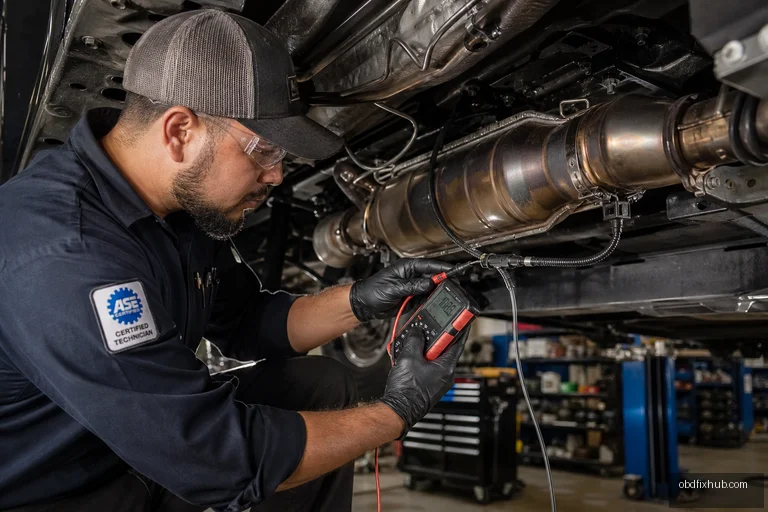
U019D Lost Communication With Ozone Reduction Catalyst Sensor: Meaning, Causes, Symptoms & Fix
U019D means the vehicle has lost network communication with the Ozone Reduction Catalyst Sensor. In most cases, the fault is caused by a power supply problem, damaged wiring, poor ground, CAN-bus interference, or a failed sensor—not automatically by the catalyst itself. A proper diagnosis should begin with voltage and communication checks before any parts are replaced.
This is an informational and diagnostic search query: drivers usually want to understand whether the vehicle is safe to drive, what caused the warning, and how much work may be involved. The exact sensor design varies by manufacturer, so always confirm the circuit layout and testing values in the vehicle’s factory service information.
What Does U019D Mean?
U019D is a manufacturer-specific or enhanced OBD-II communication code associated with the Ozone Reduction Catalyst Sensor. The sensor or its control circuit exchanges data with another module through the vehicle’s communication network, commonly a Controller Area Network (CAN) bus.
When a control module expects a valid message but does not receive it for a defined period, it stores U019D. The code describes a communication failure; it does not prove that the ozone reduction catalyst has physically failed. This distinction is important because replacing an expensive emissions component will not repair an open CAN wire or a blown sensor fuse.
What Is an Ozone Reduction Catalyst Sensor?
An ozone reduction catalyst is part of an emissions-control system designed to reduce ozone or manage related exhaust chemistry. Depending on the vehicle, the sensor may monitor catalyst operation, temperature, pressure, gas conditions, or the status of a dedicated catalyst control module.
Some vehicles use a separate smart sensor with its own power, ground, and network circuits. Others integrate the monitoring function into an aftertreatment module. Therefore, the same U019D code can require different tests on a passenger vehicle, diesel truck, hybrid, or commercial platform.
Common Symptoms of U019D
The symptoms depend on whether the vehicle has lost only sensor data or whether the communication failure affects the entire emissions network. A vehicle may still start and drive normally, especially during the early stages of the fault.
- Check Engine Light or emissions warning illuminated
- Stored U019D code, sometimes accompanied by other U-codes
- Reduced engine power or a restricted-performance mode
- Incorrect exhaust or aftertreatment readings on a scan tool
- Increased emissions, poor fuel economy, or an emissions test failure
- Cooling fans, warning messages, or unusual regeneration behavior on some diesel applications
- Intermittent symptoms that appear after rain, vibration, or temperature changes
If the vehicle is running roughly, overheating, producing smoke, or showing a red warning message, do not assume U019D is the only problem. Scan every module and inspect the vehicle before continuing to drive.
U019D Causes: Why Communication Is Lost
The most common barriers to communication in an automotive network are electrical rather than mechanical. The following causes are the ones I would check first in a workshop:
- Blown fuse or missing ignition-switched power at the sensor
- Loose, corroded, pushed-back, or water-contaminated connector terminals
- Open circuit, short to ground, or short to power in the CAN wiring
- Damaged twisted-pair CAN wires near the exhaust, frame, or heat shields
- Weak ground connection caused by corrosion or a loose ground bolt
- Low battery voltage or unstable charging-system output
- Failed Ozone Reduction Catalyst Sensor or integrated sensor module
- Another faulty module interfering with the CAN bus
- Aftermarket wiring, remote starters, trackers, or emissions-related modifications
- Software, calibration, or module configuration problems after a replacement
Heat is a particularly overlooked cause. Exhaust-mounted harnesses can look intact from above while insulation has hardened, melted, or rubbed through against a bracket. A fault that appears only when the exhaust warms up often points to wiring expansion, connector resistance, or heat damage rather than a permanently failed sensor.
How to Diagnose U019D Correctly
1. Record all codes and freeze-frame data
Use a scan tool capable of accessing more than the engine computer. Record U019D, the modules that set it, battery voltage, and any additional communication or low-voltage codes. If several modules report lost communication, diagnose the main network or power supply before focusing on the ozone sensor.
2. Check battery voltage and system power
A weak battery can create several misleading U-codes during starting. With the vehicle at rest, check battery voltage according to the manufacturer’s specifications; then verify charging voltage with the engine running. Inspect the relevant fuses with a test light or meter on both sides—visual inspection alone can miss a poor fuse connection.
3. Inspect the sensor and harness physically
Locate the sensor using the vehicle’s wiring diagram, not only a generic internet description. Look for melted loom, oil or water inside the connector, green corrosion, broken locking tabs, stretched wires, and harnesses touching the exhaust or driveshaft. Carefully move the harness while monitoring the scan tool; an intermittent change can reveal a broken conductor inside the insulation.
4. Test power, ground, and CAN circuits
With the connector unplugged as instructed by the service manual, verify sensor power under load and perform a voltage-drop test on the ground circuit. A ground can show continuity with an ohmmeter yet fail when the sensor draws current, so a load test is more meaningful.
For CAN testing, use the manufacturer’s pinout and procedures. On many systems, resistance across the network with the vehicle powered down is approximately 60 ohms, but this is not a universal rule and should never replace the service manual procedure. Incorrect probing can damage terminals or create a new network fault.
5. Determine whether the sensor or another module is blocking communication
If power, ground, and wiring are correct, check whether the sensor responds to a capable scan tool. Compare live data with expected values and inspect network status. Disconnecting modules one at a time may identify a device shorting the bus, but this should be done carefully because some vehicles require a prescribed shutdown and wake-up procedure.
6. Program or replace only after testing
If the sensor is confirmed defective, replacement may require initialization, configuration, or software programming. Clear the codes, cycle the ignition, and complete the manufacturer’s drive cycle or emissions-system verification. A code that returns immediately after a new sensor is installed strongly suggests a power, ground, network, configuration, or compatibility issue.
U019D Repair Options
The repair depends on the test result. A corroded connector may need terminal repair rather than simple contact spray. A damaged CAN wire should be repaired with the correct wire type, splice method, shielding, and routing; twisting the wires incorrectly can create future interference.
- Replace a blown fuse only after finding the reason it opened.
- Repair broken wires and secure the harness away from heat and moving parts.
- Clean or replace damaged connector terminals and restore weather sealing.
- Repair loose engine, chassis, or sensor grounds.
- Replace and program the sensor or related module when testing proves it has failed.
- Update software when a manufacturer service bulletin identifies a communication issue.
Can You Drive With U019D?
Short-distance driving may be possible if the vehicle has no severe symptoms and the warning is only an amber check-engine light. However, continued driving can cause an emissions-system failure, reduced-power event, or a failed inspection. Avoid towing, long trips, and heavy loads until the fault is diagnosed, particularly on diesel vehicles with complex aftertreatment systems.
Why Clear Communication Matters in Vehicle Diagnostics
In everyday communication, the purpose is to transfer information accurately so another person or system can respond correctly. In a vehicle network, that same principle is literal: modules exchange messages about sensor readings, temperatures, and emissions operation. Clear communication allows coordinated control, accurate fault detection, lower emissions, and safer fallback strategies.
Examples of communication skills in automotive diagnosis include listening carefully to the driver’s timeline, documenting when the warning appears, reading wiring diagrams, interpreting scan-tool data, and explaining test results without guessing. Common barriers include vague symptoms, incomplete repair history, low battery voltage, corroded connectors, electrical noise, and replacing parts before identifying the failed circuit.
The benefits of clear communication are practical: fewer unnecessary parts, faster diagnosis, better repair records, and a more accurate estimate of repair time. When speaking with a technician, mention whether the fault began after battery replacement, engine work, underbody impact, water exposure, or exhaust repairs. Those details can reduce diagnostic time significantly.
Frequently Asked Questions About U019D
Is U019D a serious code?
It can be. The vehicle may drive normally at first, but the emissions system may be unable to verify catalyst operation. If reduced power, multiple U-codes, or red warning messages appear, arrange diagnosis promptly.
Does U019D mean the ozone reduction catalyst must be replaced?
No. U019D indicates lost communication with the sensor or its network. Check power, ground, fuses, connectors, CAN wiring, and related modules before condemning the catalyst or sensor.
Can a weak battery cause U019D?
Yes. Low voltage during starting or unstable charging can interrupt module communication and store U-codes. Battery and charging-system testing should be part of the initial diagnosis.
Will clearing U019D fix the problem?
Clearing the code only removes the stored record temporarily. If the electrical or communication fault remains, U019D will return after the vehicle detects the missing message again.
What is the best first repair step?
Scan all modules, check battery voltage, and inspect the sensor connector and nearby exhaust harness. These steps are inexpensive and often reveal the problem before advanced CAN testing or sensor replacement is needed.
Final Takeaway
U019D is a communication fault, not a diagnosis that automatically condemns the ozone reduction catalyst. Start with a complete module scan, battery and fuse checks, then inspect power, ground, connectors, and CAN wiring near the exhaust. If those circuits pass, test the sensor and confirm whether programming is required. A structured electrical diagnosis is usually faster and cheaper than replacing emissions components by guesswork.




