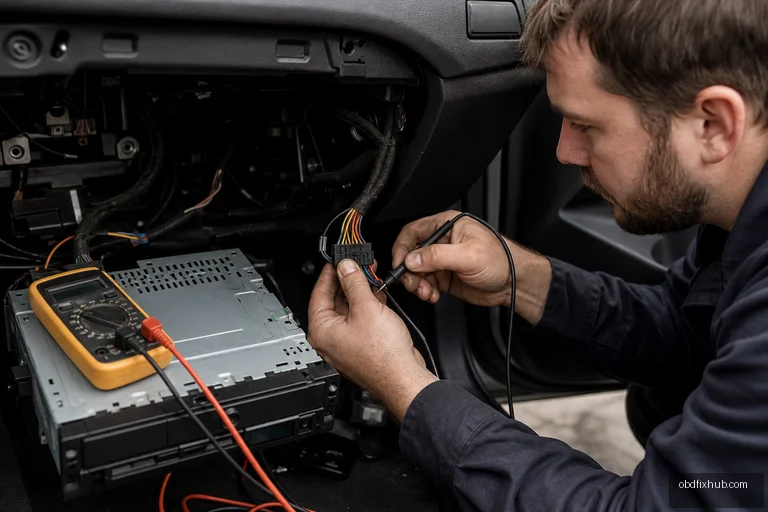
U0195 Lost Communication With Subscription Entertainment Receiver: Meaning, Causes, Symptoms & Fix
U0195 means that another vehicle control module has lost communication with the subscription entertainment receiver, usually the satellite radio or SDARS module. On Dodge, Ram, Chrysler, Jeep, and other vehicles, this code is commonly linked to a failed satellite receiver, a blown fuse, low system voltage, a damaged CAN-bus wire, or corrosion at a connector. It does not automatically mean the ECM is defective, and replacing the radio before testing the network can waste money.
What Does the Dodge DTC Code U0195 Mean?
U0195 is a generic OBD-II network communication code. The vehicle’s CAN network allows modules such as the radio, body control module, instrument cluster, and ECM to exchange data. When the expected messages from the subscription entertainment receiver disappear for a defined period, the vehicle stores U0195.
The subscription entertainment receiver is normally the module responsible for satellite radio services. Depending on the model year, it may be built into the radio head unit or installed as a separate receiver behind the dashboard. A vehicle can continue to drive normally with U0195, because the fault usually affects entertainment features rather than engine control.
Common U0195 Symptoms
The symptoms depend on whether the problem is a complete module failure or an intermittent network dropout. In real-world diagnosis, an intermittent fault is especially common after a weak battery, jump-start, remote-start installation, or dashboard water leak.
- Satellite radio shows an unavailable, loading, or subscription error message.
- The radio displays a blank screen, resets, or takes a long time to start.
- Steering-wheel audio controls work intermittently or stop responding.
- Several communication codes appear together in a full-module scan.
- The U0195 code returns after being cleared, sometimes only after the vehicle warms up.
- Other infotainment functions, hands-free calling, or navigation may also become unavailable.
If the only complaint is that one satellite channel is missing, check the subscription and antenna signal first. A true U0195 indicates a communication problem, not simply an expired radio subscription.
Most Likely Causes of U0195
1. Low battery voltage or a power interruption
A weak battery can cause infotainment modules to shut down during engine cranking. A vehicle may start normally while still producing enough voltage instability to set communication codes. Check battery voltage before deeper testing: approximately 12.4 to 12.7 volts with the engine off is typical for a fully charged battery, while charging voltage commonly falls near 13.5 to 14.8 volts with the engine running.
2. Blown fuse or missing module power
The entertainment receiver may have a dedicated fuse, or it may share power with the radio, amplifier, or body control system. Do not inspect only the fuse visually. Test for power on both sides of the fuse with the circuit loaded, because a poor fuse connection or an open power feed can look like a good fuse.
3. Damaged CAN-bus wiring
The CAN-H and CAN-L circuits can be damaged by aftermarket stereos, alarm systems, remote starters, seat movement, or water intrusion. A pinched wire may work when the dashboard is cold and open when vibration or heat changes the connection. A short to power, ground, or another circuit can take multiple modules offline.
4. Corroded or loose connectors
Inspect the receiver connector, radio connector, inline harness junctions, and nearby ground points. Green or white deposits, pushed-back terminals, moisture, and loose locking tabs are meaningful findings. Spraying contact cleaner into a connector without correcting terminal tension is not a permanent repair.
5. Failed subscription entertainment receiver or radio head unit
If power, ground, and CAN wiring are correct but the module never appears on a capable scan tool, the receiver itself may have failed. On some Dodge vehicles, the satellite receiver is integrated into the radio, so the correct repair may involve radio replacement and vehicle configuration rather than replacing a small separate box.
How to Diagnose and Fix U0195
- Scan every module, not just the engine computer. Record whether U0195 is current, stored, or intermittent. Note which modules report the code and whether U0184, U0198, or other U-codes are present.
- Check battery condition and charging voltage. If the code appeared after a dead battery or jump-start, charge and test the battery first. Clear the code and perform a normal road test before condemning a module.
- Verify the receiver’s fuses, power, and ground. Use a wiring diagram for the exact year and trim. Test the ground with a voltage-drop measurement while the module is operating; visual inspection alone can miss a high-resistance ground.
- Inspect the network wiring. With the ignition off and the modules asleep, a healthy high-speed CAN network often measures close to 60 ohms across CAN-H and CAN-L. This test must be performed correctly; measuring resistance with power applied can produce misleading results or damage equipment.
- Check whether the receiver is visible to the scan tool. If it communicates, review live data and configuration. If it has power and ground but remains completely absent, suspect the module or a network connection directly at that module.
- Repair wiring and configure replacement parts. A replacement radio or receiver may require VIN writing, anti-theft pairing, proxy alignment, or configuration with a factory-level tool. A physically correct part can still generate new communication faults if it is not programmed.
One practical diagnostic rule is to disconnect aftermarket accessories before replacing factory modules. A poorly installed remote starter or audio interface can interrupt CAN communication and make an undamaged receiver appear defective.
How to Fix Lost Communication With the ECM
When a scan tool reports lost communication with the ECM, the usual code is U0100, not U0195. The repair process is similar: test battery voltage, ECM fuses, grounds, ignition feeds, CAN wiring, and connector condition before replacing the ECM.
Start by scanning all available modules. If many modules simultaneously report that they cannot communicate with the ECM, look for a shared power supply, ground, or CAN-bus short. If only one module cannot reach the ECM, the fault may be local to that module’s wiring. Never replace an ECM solely because a communication code is present.
What Does the U0198 00 Code Mean?
U0198 generally refers to lost communication with the telematics control module. Telematics manages connected-vehicle features such as cellular communication, emergency assistance, vehicle tracking, or remote services, depending on the vehicle. The 00 suffix is a status or failure-information byte used by many scan tools; it does not, by itself, identify a specific failed component.
U0198 00 can be caused by a low battery, telematics fuse, poor antenna or cellular connection, CAN wiring trouble, or a failed telematics module. If U0195 and U0198 appear together, investigate shared network power and CAN wiring before replacing either entertainment or telematics hardware.
How Do I Fix the U0184 Code?
U0184 means lost communication with the radio. Begin with the radio fuse, battery voltage, radio power and ground, and the radio’s CAN wiring. If the radio has power and ground but is absent from the scan tool, the radio head unit or its internal network circuit may have failed.
U0184 and U0195 can occur together because the satellite receiver may be integrated into the radio or connected directly to it. In that situation, diagnose the shared radio module and connector rather than treating the codes as two unrelated failures. After repair, clear all modules and confirm that the radio communicates during a cold start and a road test.
When Is Professional Diagnosis Necessary?
Professional testing is advisable when multiple U-codes are present, the vehicle has intermittent electrical faults, or the receiver requires programming. A basic code reader may display U0195 but cannot access the infotainment module, view network topology, or perform configuration procedures.
Stop driving and seek immediate help if communication faults are accompanied by loss of engine control, steering, braking, airbag warnings, or repeated stalling. U0195 alone is usually not an emergency, but a broader CAN-bus failure can affect safety-related systems.
Summary: The Correct Repair Strategy for U0195
U0195 identifies a communication failure with the subscription entertainment receiver, not proof that the ECM or radio must be replaced. Check voltage, fuses, grounds, connectors, CAN resistance, and aftermarket wiring in that order. If the receiver has reliable power and ground but will not communicate, module repair or replacement may be necessary, followed by programming or configuration.
Best next step: obtain a complete vehicle scan, record every communication code, and use the exact factory wiring diagram for the vehicle’s year and trim before disconnecting or replacing any module.
Frequently Asked Questions
Can I drive with a U0195 code?
Usually, yes, if the vehicle runs normally and no safety-related warning lights are present. The code commonly affects satellite radio or connected entertainment functions, but multiple communication codes require prompt diagnosis.
Does U0195 mean my ECM is bad?
No. U0195 concerns the subscription entertainment receiver. An ECM communication problem is more commonly associated with U0100, and the ECM should only be replaced after power, grounds, CAN wiring, and connector tests are completed.
Will disconnecting the battery clear U0195?
It may erase a temporary code, but it does not repair the underlying fault. If the receiver loses communication again, the code will return. Disconnecting the battery can also erase learned settings or create additional initialization requirements.
Why do U0195, U0184, and U0198 appear together?
These codes can share a cause such as low voltage, a failed fuse, a CAN-bus short, water intrusion, or a faulty gateway connection. Diagnose the shared power and network circuits first instead of replacing several modules at once.




