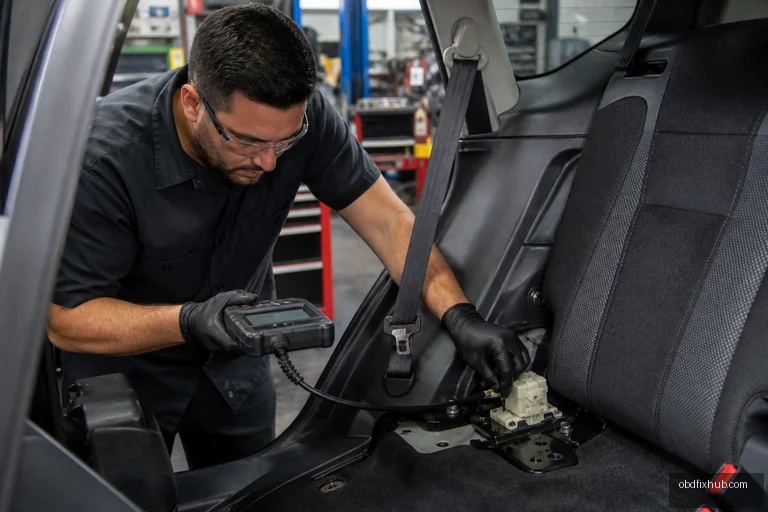
B0051 First Row Center Seat Belt Sensor usually means the restraint control module has detected a fault in the center seat belt sensor circuit. On Chevy, GMC, Buick, and Cadillac vehicles, this can turn on the airbag or seat belt warning lamp and may prevent part of the Supplemental Inflatable Restraint system from operating correctly. The exact component varies by model, so the safest repair starts with identifying the vehicle-specific B0051 definition rather than replacing a sensor at random.
This is an informational search query: most drivers want to understand the warning, diagnose the cause, and find out whether the code can be cleared without creating a safety risk. The sections below explain the meaning, symptoms, common failures, proper testing procedure, and the limits of free code-reset services.
What Does Chevy Code B0051 Mean?
Chevy code B0051 is commonly described as a fault involving the first-row center seat belt sensor. In GM service information, the code may be further defined as an open circuit, short to ground, short to voltage, incorrect resistance, or communication problem. The wording shown by an aftermarket scanner may be abbreviated or slightly different from the factory description.
The “first row center” position generally refers to a center seating position in the front row, such as a front center seat belt on a bench seat. On some vehicles, however, the restraint system’s terminology can differ from the physical layout. Always confirm the code with a GM-capable scan tool and the vehicle’s service information before ordering a buckle, belt assembly, or airbag module.
What B0051 Does Not Prove
- It does not automatically prove that the airbag itself is defective.
- It does not identify the failed part without additional testing.
- It does not mean that disconnecting the battery has repaired the SRS system.
- It does not guarantee that every vehicle with a B0051 code uses the same sensor or wiring arrangement.
Common Symptoms of a B0051 Seat Belt Sensor Fault
The most visible symptom is an illuminated airbag or SRS warning lamp. You may also see a seat belt reminder that remains on, an incorrect passenger or center-belt status on the instrument cluster, or a warning message such as “Service Airbag.” Some vehicles store the code as current, while others record it as history after a temporary wiring interruption.
A B0051 fault may appear after a seat has been moved, interior trim has been removed, carpeting has been cleaned, or an object has pulled on the belt or buckle. In real-world diagnostics, a loose connector under the seat is often more likely than a failed sensing element. If the warning started immediately after seat work, inspect that area first—but do not handle SRS wiring with the battery connected.
Most Likely Causes of B0051
- Loose or partially disconnected connector: Vibration, seat movement, or previous repairs can leave a connector latched but not fully seated.
- Damaged wiring: Wires routed beneath or beside the seat can be pinched by the seat track, stretched, or cut by a sharp bracket.
- Corrosion or contamination: Moisture from a spill or damp carpet can increase resistance at terminals and create an intermittent fault.
- Failed seat belt buckle or sensor: The internal switch or belt-status sensor can wear out, especially in a high-use center position.
- Seat belt pretensioner circuit damage: Depending on the model, B0051 may be associated with a restraint device or pretensioner circuit rather than a simple reminder switch.
- Previous collision damage: A deployed pretensioner, damaged belt assembly, or crash-affected wiring may require replacement and module diagnosis.
- Faulty SDM or restraint control module: This is possible, but it should be considered only after the circuit, connectors, and component have been tested.
How to Diagnose B0051 Properly
Because the SRS system contains pyrotechnic devices, diagnosis should follow the factory procedure. A generic OBD-II reader can often display B0051, but it may not show the accompanying subcode or live data needed to identify the failed circuit. A professional scan tool that communicates with the GM SDM is a much better starting point.
1. Record all restraint codes
Scan the Sensing and Diagnostic Module, not only the engine computer. Write down B0051 and every related code before clearing anything. A second code may identify the side, connector, resistance condition, or communication fault that the basic B0051 description does not reveal.
2. Check for recent work or impact
Ask what changed before the lamp appeared. Seat removal, upholstery work, a battery replacement, spilled liquid, a minor crash, or an object trapped under the seat can provide a useful direction. An intermittent code that appears when the seat is moved strongly suggests a harness or connector issue.
3. Disable the SRS system safely
Before disconnecting any yellow SRS connector or removing a belt assembly, follow the vehicle’s service manual. The normal procedure may include switching off the ignition, disconnecting the negative battery cable, and waiting the specified time for the reserve power supply to discharge. Do not rely on a guessed waiting period, and never probe a yellow connector with a test light or ordinary ohmmeter unless the manufacturer specifically allows that test.
4. Inspect the harness and terminals
Look for stretched wires, crushed insulation, bent terminals, water marks, or a connector that is not fully locked. Compare the harness routing with the seat track: the wire should not be pulled tight at the seat’s forward or rearward limit. Do not use electrical contact cleaner or force a terminal into position unless the connector manufacturer and service procedure permit it.
5. Test the specified component
With the SRS disabled and the connector separated as directed, a technician can test the sensor or belt assembly using the resistance specification in the service manual. A reading that is open, shorted, or outside the published range indicates a component or harness problem. Never install a resistor or “airbag bypass” device to make the light go out; that can hide a genuine safety fault and may prevent proper deployment.
6. Clear the code and perform a self-test
After the repair, the SDM must be scanned again. Some current faults will not clear until the circuit returns to its correct electrical range. If the code returns immediately after clearing, the fault is still present or the module has recorded a separate event, such as a crash or deployment-related lockout.
Can a Bad Seat Belt Sensor Make the Airbag Light Come On?
Yes. The seat belt sensor is part of the restraint system, so a detected circuit problem can illuminate the airbag or SRS warning lamp even when no airbag has deployed. The module monitors belt status and, on some models, uses that information to control pretensioner and airbag deployment strategy.
However, the lamp can also be caused by a passenger-presence sensor, steering wheel clock spring, impact sensor, pretensioner, low-voltage event, or a separate SDM fault. The warning lamp tells you that the restraint system needs attention; it does not identify the failed part by itself.
How Do I Reset the Seat Belt Airbag Light?
The correct reset method is to repair the underlying fault and clear the SRS code with a scan tool that supports the restraint control module. Disconnecting the battery may erase temporary electrical settings, but it usually does not clear a stored B0051 code and does not repair an open or shorted circuit.
- Have the SRS system diagnosed and repair the confirmed fault.
- Reconnect every restraint connector exactly as specified.
- Turn the ignition on and verify that nobody is near an exposed airbag or pretensioner.
- Use an SRS-capable scanner to clear the code.
- Confirm that the airbag lamp performs its normal bulb check and goes out.
If the light returns, do not keep clearing it. A returning warning indicates that the module still sees a fault, or that a crash record or internal SDM problem needs specialist attention.
Will AutoZone Reset the Airbag Light?
Usually, no. AutoZone and similar parts stores commonly offer free engine-code scans, but those scans are generally aimed at the powertrain computer. Airbag and seat belt faults are stored in the SRS or SDM, which requires a compatible safety-system scanner and trained handling.
Policies vary by location, and a store may be able to read certain manufacturer-specific systems, but you should not assume it can safely clear B0051. Call ahead and ask specifically whether the location can access the GM SDM/SRS module. A dealership, qualified independent repair shop, or automotive electrician with GM-capable equipment is more likely to diagnose and reset this code correctly.
Repair or Replace the Seat Belt Sensor?
If the wiring and connector test correctly and the component is outside specification, replacement is normally more reliable than attempting to repair the internal sensor. Use the correct belt or buckle assembly for the vehicle identification number; visually similar parts may have different resistance values, pretensioners, or connector pinouts.
After a collision, do not install a used restraint component without verifying its condition and compatibility. A belt that looks normal can contain a deployed pretensioner or hidden damage. Seat belt assemblies and SRS components are safety-critical parts, so the repair should be documented and followed by a complete system scan.
When to Stop Driving
An illuminated SRS lamp does not always mean the vehicle will suddenly deploy an airbag, but it does mean the system may not protect occupants as designed. If the warning appeared after a crash, there is visible belt damage, smoke or heat damage near a connector, or more than one restraint code is present, arrange professional inspection before normal use.
Do not remove seats, unplug yellow connectors, or test pyrotechnic circuits casually. A qualified technician can isolate the circuit without creating an accidental deployment risk.
Key Takeaway
B0051 means the GM restraint system has detected a problem associated with the first-row center seat belt sensor or its circuit. The most common practical causes are loose connectors, damaged under-seat wiring, corrosion, and a failed buckle or belt assembly, but the exact definition depends on the vehicle. Diagnose the SDM with the right scan tool, repair the measured fault, and clear the code only after the system passes its self-test.
Frequently Asked Questions
What is the fastest way to fix B0051 on a Chevy?
There is no safe universal shortcut. Scan the SDM for the full code description, inspect the center belt wiring and connector, test the specified component, and then clear the repaired fault with an SRS-capable scanner.
Can low battery voltage cause B0051?
Low voltage can create temporary restraint-system codes, particularly during a weak-battery start or battery replacement. Confirm battery and charging voltage, but do not assume the code is harmless if it returns after normal voltage is restored.
Is B0051 the same on every Chevy, GMC, Buick, and Cadillac?
No. The general description may be similar, but connector locations, belt designs, subcodes, and diagnostic procedures vary by model year and platform. The factory wiring diagram and vehicle-specific service information take priority.
Can I drive with the airbag light on?
You may be able to move the vehicle to a repair facility, but the SRS may not deploy correctly in a collision. Have the warning diagnosed promptly, especially after an impact or seat-related repair.




