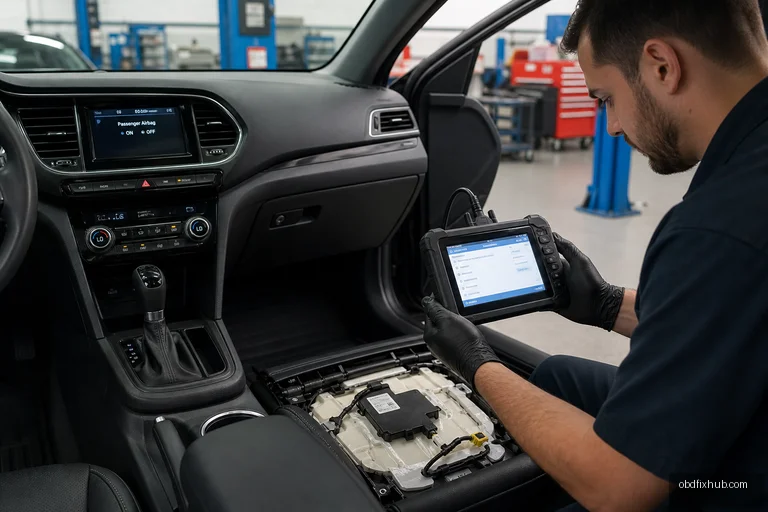
If the passenger seat belt light is flashing with no passenger, the vehicle is usually detecting weight on the passenger seat, a latched-or-unlatched buckle signal, or a fault in the occupant classification system. The B00D1 Passenger Seat Belt Indicator code points to the passenger restraint warning circuit, but the exact failure depends on the complete DTC suffix and the vehicle manufacturer.
This is not normally an engine-management problem. It belongs to the body restraint or SRS system, so a basic engine-code reader may not display it. A proper scan tool that can access the airbag, occupant detection, and body control modules is often required.
What Does the B00D1 Passenger Seat Belt Indicator Code Mean?
B00D1 is a standardized base diagnostic trouble code associated with the passenger seat belt indicator circuit. In practical terms, the restraint control module has detected an unexpected signal from the passenger seat belt warning system or its related inputs.
Those inputs may include the passenger buckle switch, occupant detection mat, seat wiring, seat-position information, and the warning lamp or instrument-cluster communication network. A code such as B00D1-13, B00D1-2A, or B00D1-xx may add the information needed to identify whether the problem is an open circuit, short circuit, invalid signal, or communication issue.
Because manufacturers assign different subcode meanings, do not replace the buckle or occupancy sensor based on “B00D1” alone. The factory service information for the specific year, make, model, and seat configuration matters.
Why Is My Passenger Seat Belt Light Flashing With No Passenger?
The most common reason is a false occupancy signal. The passenger seat sensor may interpret a laptop bag, tool case, groceries, or even pressure from a folded seat cover as a person. Some vehicles also trigger the warning when a child seat, heavy coat, or water bottle is left on the cushion.
- Object on the seat: Remove everything, including items tucked under the cushion or behind the seat belt buckle.
- Occupancy sensor drift: The pressure mat may be out of calibration or beginning to fail.
- Buckle switch fault: The buckle may report “unfastened” even when the belt is inserted.
- Loose wiring: Seat movement can stretch, pinch, or partially disconnect the harness beneath the passenger seat.
- Moisture or corrosion: Spilled drinks and damp carpets can affect low-voltage seat circuits.
- Seat replacement or removal: A disconnected connector can set a restraint code after the seat has been moved or removed.
- Low battery voltage: A weak battery or jump-start event can create temporary body-module faults.
Start with a simple test: clear the seat completely, switch the ignition off, close the doors, and restart the vehicle. If the light goes out, an object or temporary signal was probably responsible. If it returns immediately, the system needs diagnosis rather than repeated resets.
Common Symptoms Associated With B00D1
The warning may appear in several ways. Some vehicles illuminate the passenger seat belt icon continuously; others flash the icon and produce a chime. The passenger airbag status may also display “OFF,” remain unavailable, or change unexpectedly when someone moves on the seat.
- Passenger seat belt warning light remains on with an empty seat
- Warning light flashes intermittently over bumps or during turns
- Seat belt chime sounds without a passenger
- Passenger airbag indicator does not match the occupant or seat condition
- SRS, airbag, or restraint warning lamp is illuminated
- B00D1 returns immediately after code clearing
An intermittent light that changes when the seat is moved is especially useful evidence. It often points to a damaged harness, loose terminal, or connector under the seat rather than a defective instrument cluster.
How to Diagnose the B00D1 Passenger Seat Belt Indicator
- Record all restraint codes. Scan the SRS and occupant classification modules, not just the powertrain computer. Write down the full B00D1 code and any related codes before clearing anything.
- Check the seat area visually. Look for trapped objects, spilled liquid, crushed wiring, and connectors that have been pulled tight by moving the seat forward or backward.
- Verify the symptom. With the seat empty, observe the passenger airbag and belt indicators. Then place a known, safe weight on the seat only if the manufacturer’s diagnostic procedure permits it.
- Inspect live data. A capable scan tool may show passenger occupancy status, buckle status, seat calibration state, and sensor voltage. Compare the displayed status with what is physically happening.
- Test the circuit according to the service manual. Measure resistance, continuity, and reference voltage only with the correct procedure and connector disconnected where specified.
- Perform calibration or zero-point reset. Some vehicles require an occupant classification system reset after seat removal, cushion replacement, battery work, or sensor replacement.
Do not use a test light or randomly probe yellow SRS connectors. Airbag circuits can contain stored energy, and an incorrect test can deploy a restraint or damage the control module. Disconnect the battery only when the manufacturer’s procedure requires it, and wait the specified time before working near restraint wiring.
How to Fix B00D1
The correct repair depends on the failed input. Removing an object and completing a required calibration may solve a false occupancy warning. A loose connector can sometimes be repaired with the approved terminal and harness procedure, but twisting wires together or fitting an ordinary electrical connector is not an acceptable SRS repair.
If the buckle switch is defective, the buckle assembly may need replacement. If the pressure mat or occupant classification sensor has failed, many manufacturers require replacement of the seat cushion, sensor mat, or complete approved component followed by calibration. A damaged seat harness should be repaired or replaced using the manufacturer’s parts and routing instructions.
Clearing the code without fixing the cause is not a solution. The light may return immediately, and in some vehicles a restraint fault can affect passenger airbag deployment strategy. After repair, scan the system again, clear the code, cycle the ignition, and confirm that the indicator behaves correctly with both an empty seat and a properly buckled passenger.
Can You Drive With B00D1?
The vehicle may remain drivable, but the restraint system should not be treated as fully operational until the fault is diagnosed. If the airbag warning lamp is also on, passenger airbag availability may be changed or disabled depending on the vehicle’s design. Keep the passenger seat empty until the warning is repaired if the airbag status is uncertain, and arrange professional diagnosis promptly.
Summary: The Safest Next Step
B00D1 usually indicates a problem with the passenger seat belt warning circuit or one of the occupancy and buckle signals that control it. First remove every object from the seat and inspect for visible damage. If the warning remains, obtain the complete manufacturer-specific code and have the SRS system scanned with a restraint-capable tool. Avoid guessing, bypassing the sensor, or probing airbag connectors; accurate diagnosis is safer and often cheaper than replacing unrelated parts.
Frequently Asked Questions
Can a heavy bag cause the passenger seat belt light to flash?
Yes. A bag, box, laptop, or other object can place enough pressure on the occupant sensor to make the vehicle classify the seat as occupied. Remove the object and restart the vehicle. If the warning remains, the sensor may require calibration or testing.
Will disconnecting the battery clear B00D1?
It may erase a temporary fault in some vehicles, but it will not repair a failed buckle switch, occupancy mat, or damaged wire. The code can also return immediately, and battery disconnection may create additional module or window-memory issues.
Can I replace the passenger seat belt buckle myself?
Replacement may be mechanically straightforward, but the buckle is part of the restraint system. The correct part, torque specification, connector handling, and post-repair scan are important. Follow the vehicle service manual or use a qualified technician.
Does B00D1 always mean the passenger airbag is bad?
No. B00D1 is related to the passenger belt indicator and associated signals, not automatically a failed airbag module. The actual cause may be a buckle switch, occupancy sensor, wiring fault, calibration issue, or communication problem.
Why does the warning appear only over bumps?
A warning that changes over bumps commonly suggests an intermittent connection, loose terminal, or harness that moves with the seat. Do not deliberately shake the wiring while the system is powered; have it inspected using the manufacturer’s SRS safety procedure.




