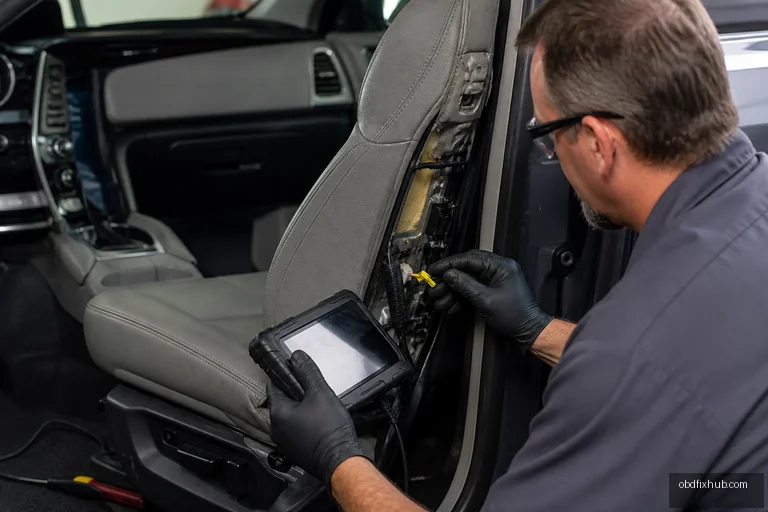
B00C0 Passenger Seat Occupant Classification Sensor A means the airbag control system has detected a fault in the passenger-seat occupant classification system. This system determines whether the seat is empty, occupied by a child, or occupied by an adult so the vehicle can control the passenger airbag correctly. In most cases, the problem is a damaged seat sensor, a loose connector, wiring damage, incorrect seat calibration, or low system voltage—not automatically a bad airbag module.
What Is an Occupant Classification Sensor?
An occupant classification sensor, commonly called an OCS sensor, is part of the passenger-seat restraint system. Depending on the vehicle, it may be a pressure-sensitive mat inside the seat cushion, a weight sensor attached to the seat frame, or an electronic sensor unit connected to several seat-mounted components.
The OCS system sends occupant information to the SRS or airbag control module. Its job is to help determine whether the passenger airbag should deploy and which deployment strategy is appropriate. That is why manufacturers treat B00C0 as a safety-critical fault rather than an ordinary check-engine code.
B00C0 Passenger Seat Occupant Classification Sensor A: Common Causes
The exact definition of B00C0 can vary slightly by manufacturer and by the final code suffix. A complete scan result may show additional information such as an open circuit, short to ground, abnormal voltage, invalid signal, or communication failure. Always record the complete code before clearing anything.
- Loose passenger-seat connector: Objects stored under the seat, seat movement, or previous repairs can partially disconnect the wiring.
- Damaged wiring: Wires may be pinched by the seat rails or stretched when the seat is moved forward and backward.
- Failed pressure mat or sensor: The sensing element inside the cushion can deteriorate, especially after years of use.
- Incorrect OCS calibration: Calibration may be lost after seat removal, seat-cover replacement, cushion repair, or battery-related electrical work.
- Modified or replacement seats: Racing seats, aftermarket upholstery, and non-original seat cushions may not support the original classification system.
- Moisture or contamination: Spilled drinks can reach connectors or sensor components beneath the cushion.
- Low battery voltage: A weak battery or poor ground can create misleading SRS sensor codes during starting.
- Faulty SRS control module: This is possible, but it should be considered only after power, ground, wiring, and sensor operation have been verified.
Symptoms of a B00C0 Fault
The most obvious symptom is an illuminated airbag or SRS warning lamp. Many vehicles also display a message such as “Passenger Airbag Off,” “Restraint System Service,” or “Occupant Sensor Fault.” The warning may appear permanently or only when someone sits in the passenger seat.
Some vehicles will disable the passenger airbag when B00C0 is active. Others may use a fixed backup strategy, but you should never assume that the system is operating normally while the SRS light is on. The vehicle can also fail an inspection because the warning lamp does not complete its normal self-test.
How to Diagnose B00C0 Correctly
A basic OBD reader often cannot access airbag modules. Use a scan tool that supports the vehicle’s SRS system and can display live data, fault subcodes, and OCS calibration functions. The most useful diagnostic information is not simply “B00C0 present,” but whether the module sees an open circuit, an implausible weight reading, or a communication problem.
- Confirm the full code. Record the manufacturer, suffix, freeze-frame data, and any companion codes.
- Check battery voltage. Low voltage during cranking can generate temporary restraint faults. Test the battery and charging system before replacing parts.
- Inspect the area under the seat. Look for trapped objects, stretched wires, water damage, aftermarket wiring, and connectors that are not fully locked.
- Follow the safety procedure. Disconnect the battery according to the manufacturer’s instructions and wait the specified time before working near yellow SRS connectors. Never probe an airbag circuit with a test light or ordinary multimeter.
- Check live OCS data. With the seat empty, the scanner should show a stable empty-seat status. Weight readings that jump, remain implausible, or change when the harness is moved point toward a sensor or wiring fault.
- Perform the required zero-point calibration. The passenger seat must usually be completely empty, dry, and free of objects. Follow the exact scan-tool and service-manual procedure.
- Clear the code and retest. If B00C0 returns immediately, do not repeatedly erase it. The underlying electrical or sensor fault remains active.
How to Reset the Passenger Seat Airbag Sensor
There is no universal button sequence for resetting an OCS sensor. The proper reset is normally an occupant classification system zero-point calibration performed with a compatible diagnostic scan tool. Remove everything from the seat, place the vehicle on level ground, ensure the battery voltage is stable, and follow the vehicle-specific calibration instructions.
Disconnecting the battery may clear temporary memory in some vehicles, but it does not repair a failed sensor or restore lost calibration. It can also create additional window, radio, or body-control settings that require relearning. Never sit in the seat or place tools on it during calibration unless the service instructions specifically require it.
If the seat was recently removed, reupholstered, or replaced, calibration is especially important. A replacement seat may also require transferring the original OCS components or installing a manufacturer-approved sensor assembly.
What Does Code B00A0 Mean on a Ford Airbag?
On many Ford vehicles, B00A0 is associated with the passenger sensor unit or passenger occupant classification system. A description such as “Passenger Sensor Unit: Abnormal Voltage” indicates that the restraint control module is seeing a voltage outside the expected range. The final two digits or suffix can identify the specific failure type, so a generic scanner description may be incomplete.
B00A0 and B00C0 can involve related passenger-seat components, but they are not interchangeable codes. B00A0 often points toward a sensor-unit voltage or circuit issue, while B00C0 commonly identifies the occupant classification sensor circuit or its signal. Diagnose the exact code stored in the Ford RCM rather than replacing parts based on a shortened description.
How Can You Tell If the SRS Module Is Bad?
A single B00C0 code does not prove that the SRS module has failed. The module is more likely to be defective when it has verified power and ground, communicates inconsistently or not at all, stores internal memory or processor faults, and continues to report implausible data after the sensor circuit and calibration have been confirmed.
Before condemning the module, a technician should check the RCM fuses, grounds, connector pins, CAN communication lines, battery condition, and all related restraint codes. Water intrusion, crash history, and prior deployment can also damage or lock the module. Some vehicles require module configuration or crash-data handling after replacement, so installing a used unit without programming may create another fault.
Can You Drive With B00C0?
The vehicle may remain mechanically driveable, but it should not be treated as fully safe. An illuminated SRS lamp means at least one restraint function may be disabled or operating with limited information. Avoid carrying a child in the affected passenger position until the fault is diagnosed, and arrange professional repair as soon as possible.
Practical Repair Advice
Do not bypass the OCS sensor with a resistor or install an airbag emulator. Such devices can hide the warning light while preventing the system from identifying the passenger correctly, and they may interfere with deployment decisions. The reliable repair is to restore the original wiring, replace the failed sensor or approved seat component, complete calibration, and verify that the SRS performs its self-test without returning faults.
When booking the repair, tell the technician whether the seat was recently moved, wet, removed, reupholstered, or replaced. That history often identifies the failure faster than the code alone.
Key Takeaway
B00C0 points to a passenger-seat occupant classification fault, not automatically a defective airbag module. Start with the complete code, battery voltage, under-seat wiring, connector condition, and OCS live data. If calibration does not restore normal operation, use the manufacturer’s wiring tests and replace only the confirmed failed component. Because the system controls passenger-airbag behavior, SRS diagnosis should be performed with the correct safety equipment and a scan tool designed for restraint systems.
Frequently Asked Questions
How do I reset the passenger seat airbag sensor?
Use a compatible SRS scan tool to perform the manufacturer-specified OCS zero-point calibration with the passenger seat empty. Battery disconnection alone is not a dependable reset and will not fix a failed sensor.
What does B00C0 mean on a car?
B00C0 generally identifies a fault involving the passenger seat occupant classification sensor or its circuit. The exact failure—such as an open circuit, abnormal signal, or calibration problem—depends on the vehicle and code suffix.
What does B00A0 mean on a Ford airbag?
On many Ford models, B00A0 relates to the passenger sensor unit and may indicate abnormal voltage. Confirm the complete Ford RCM code and test the circuit before replacing the passenger-seat sensor.
Can a bad SRS module cause B00C0?
Yes, but it is less common than a wiring, connector, sensor, calibration, or voltage problem. The module should be considered only after its power, ground, communication, and sensor inputs have been tested.




