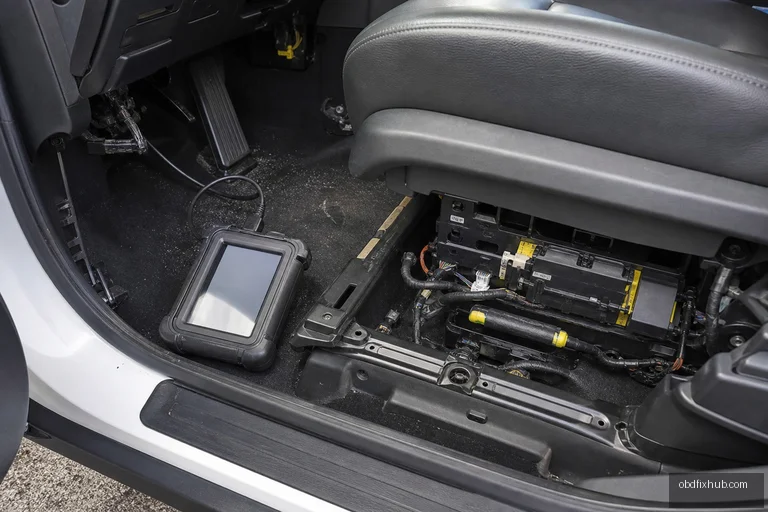
B00B5 Driver Seat Track Position Restraints Sensor: Meaning, Causes, Symptoms & Fix
B00B5 Driver Seat Track Position Restraints Sensor means the airbag control module has detected a fault with the sensor that reports the driver seat’s position on its track. The most common causes are a loose connector under the seat, damaged wiring, a failed track-position sensor, or a seat that has been moved, removed, or repaired without completing the required calibration. This is an SRS fault, so it should not be treated like a harmless check-engine code.
The exact wording and test procedure vary by vehicle manufacturer, but the practical diagnosis is similar: confirm the code with an SRS-capable scan tool, inspect the seat wiring without disturbing airbag circuits, test the sensor and its signal, then clear and verify the repair.
What Does B00B5 Mean?
The driver seat track position sensor is part of the vehicle’s restraint system. It tells the airbag control module whether the seat is closer to or farther from the steering wheel. During a collision, that information can help the module select an appropriate airbag deployment strategy.
B00B5 generally indicates that the sensor signal is missing, outside its expected range, intermittent, or inconsistent with the seat’s actual position. On some vehicles, the code may be stored as a current fault; on others, it may remain as a history code after a temporary connection problem.
A B00B5 code does not automatically prove that the sensor itself is defective. In real workshop diagnostics, the sensor is often blamed first, even though the actual failure is a stretched wire, a connector that was not fully latched, or a seat rail that damaged the harness during adjustment.
Common Symptoms of a B00B5 Fault
The most obvious symptom is an illuminated SRS, airbag, or restraint warning light. Some vehicles also display a message such as “Airbag System Fault,” “Service Safety Restraint System,” or “Occupant Protection Unavailable.”
- The airbag warning light stays on after the engine starts.
- The warning appears after moving the driver’s seat forward or backward.
- The code returns immediately after being cleared.
- Other restraint-system codes are stored alongside B00B5.
- A scan tool shows an implausible or fixed seat-position value.
In many vehicles, the warning light means the airbag system has disabled one or more protective functions until the fault is repaired. The vehicle may still start and drive normally, but normal drivability does not mean the restraint system is operating normally.
Most Likely Causes of B00B5
1. Damaged wiring under the driver’s seat
The harness beneath a power seat moves, flexes, and can rub against the seat frame or floor. A wire may be pulled tight when the seat reaches its rearmost position, then develop an intermittent open circuit. Look for crushed insulation, exposed copper, abrasion marks, or wiring trapped in the seat track.
2. Loose or contaminated connector
Connectors under the seat can be disturbed during carpet work, audio installation, seat replacement, or vacuuming. Yellow connectors usually belong to the SRS system, although color conventions differ. Never force, back-probe, or disconnect an airbag connector while the battery is connected.
3. Failed seat track position sensor
The sensor may wear internally or develop dead spots as the seat moves through its travel. A useful clue is a fault that appears only at one seat position or after repeated adjustment. If the wiring and connector are sound but the sensor output does not change smoothly, sensor or track replacement may be necessary.
4. Lost calibration or incorrect seat installation
Some vehicles require a seat-position initialization after seat removal, replacement, battery-related work, or SRS module service. A sensor can be electrically connected and still report an invalid position if the control module has lost its learned reference.
5. Low voltage or a related SRS fault
A weak battery, jump-start event, or low system voltage can create several restraint codes at once. If B00B5 appears with voltage, communication, or other airbag codes, diagnose the power supply and the primary code before replacing the seat sensor.
How to Diagnose and Fix B00B5 Safely
- Read all SRS codes. Use a scan tool that can communicate with the airbag control module. A basic OBD-II reader may not access SRS data and may show no code at all.
- Record freeze-frame and live data. If available, monitor the driver seat position while moving the seat slowly. A value that suddenly drops out or jumps indicates a signal problem.
- Inspect the seat movement path. Move the seat through its full range and watch for a harness being stretched, pinched, or caught on the rail. Do not reach under a powered seat while it is moving.
- Disable the SRS system correctly. Follow the manufacturer’s service procedure, normally involving ignition-off battery disconnection and a specified waiting period. The service manual takes priority because backup power designs differ.
- Inspect connectors and wiring. Check for bent terminals, corrosion, loose locks, and damaged insulation. Do not measure resistance across an airbag or pretensioner squib with a standard multimeter.
- Test the sensor according to the service manual. Some sensors are evaluated by resistance, others by voltage, digital signal, or scan-tool data. Do not substitute generic resistance values from another vehicle.
- Repair, calibrate, and verify. After the physical repair, perform the required seat-position or SRS calibration, clear the code with the SRS scan tool, cycle the ignition, and confirm that B00B5 does not return.
A particularly useful diagnostic habit is to move the seat while monitoring live data after the system has been safely reactivated. If the signal fails only at the front or rear limit, the problem may be a harness that is being pulled by the rail rather than a permanently failed sensor.
Can You Drive With a Bad Airbag Sensor?
You may be able to drive the vehicle mechanically, but driving with an active SRS fault is not considered safe. The airbag warning light can indicate that an airbag, seat-belt pretensioner, or related deployment strategy may not function correctly in a crash. Avoid unnecessary driving and arrange a prompt diagnosis, especially if the vehicle is used to transport children or passengers.
Do not rely on disconnecting the battery to make the warning disappear. That may erase temporary electrical information on some vehicles, but it does not repair the fault and will not reliably clear a stored SRS code.
How to Reset the Passenger Seat Airbag Sensor
B00B5 concerns the driver seat track position sensor, not normally the passenger-seat occupant classification sensor. A passenger-seat airbag warning is commonly related to the occupant detection mat, seat wiring, buckle sensor, or calibration procedure.
To reset a passenger seat airbag sensor, first repair the cause, then use a manufacturer-compatible SRS scan tool to clear the fault and run the required occupant-classification or zero-point calibration. The exact procedure can require an empty seat, a specified ignition sequence, or a calibration weight. Battery disconnection alone is not a proper reset.
Where Is the Passenger Seat Airbag Sensor Located?
The passenger occupant detection sensor is usually integrated into the passenger seat cushion, beneath the upholstery and foam. Its wiring runs through the seat base to the SRS connector under the seat. This is different from the B00B5 driver seat track sensor, which is generally mounted on or near the driver’s seat rail or track mechanism.
Because seat-mounted SRS components can include airbags, pretensioners, and sensitive classification electronics, removing the upholstery or probing connectors without the factory procedure can create a new fault or an accidental deployment risk.
How Can You Tell if an Airbag Sensor Is Bad?
You cannot reliably identify a failed airbag sensor by looking at the dashboard light alone. The strongest evidence comes from the combination of a confirmed SRS code, correct power and ground, intact wiring, a secure connector, and a sensor signal that fails the manufacturer’s test.
- Scan the SRS module rather than guessing from the warning light.
- Check whether the fault is current or historical.
- Compare live data while the seat moves through its travel.
- Inspect wiring for movement-related damage.
- Complete calibration after replacement when the vehicle requires it.
Final Takeaway
B00B5 points to a problem with the driver seat track position signal, but the sensor is only one possible cause. Start with a proper SRS scan, inspect the under-seat harness and connectors, avoid unsafe electrical testing, and complete the required calibration after repair. If the code returns immediately or multiple airbag codes are present, an SRS-qualified technician is the safest and most efficient next step.
Frequently Asked Questions
What does B00B5 mean on a vehicle?
It generally indicates a fault in the driver seat track position restraint sensor circuit or signal. The exact definition and repair procedure depend on the vehicle manufacturer.
Can a loose seat connector cause B00B5?
Yes. A loose, corroded, or partially latched connector under the driver’s seat can interrupt the sensor signal and trigger B00B5, particularly after seat movement or interior work.
Will disconnecting the battery reset B00B5?
Usually not reliably. Even if the light temporarily goes out, the underlying fault remains and the SRS module may store the code again as soon as it detects the problem.
Is B00B5 related to the passenger seat sensor?
Normally no. B00B5 refers to the driver seat track position sensor. Passenger-seat faults more commonly involve occupant classification or passenger-seat wiring, although code descriptions vary by manufacturer.
Should I replace the driver seat sensor immediately?
No. Confirm the wiring, connector, power supply, and live sensor data first. Replacing the sensor without testing can waste money when the real problem is a damaged harness or missing calibration.




