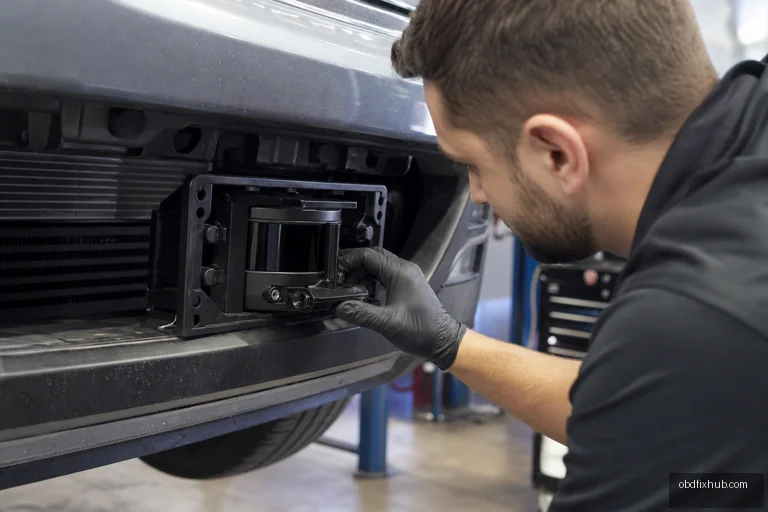
B0106 LIDAR Washer Actuator A is a body or driver-assistance system fault indicating that the vehicle has detected an electrical or performance problem in the actuator that operates a washer or cleaning mechanism for the LIDAR sensor. It is not a universal code across every manufacturer, so the exact definition depends on the vehicle, control module, and scan-tool database. Before replacing a part, confirm the code in the correct module and check whether the vehicle also has a separate washer-pump, wiring, or sensor communication fault.
What Does B0106 LIDAR Washer Actuator A Mean?
The actuator identified as “A” is usually an electrically controlled device that moves a nozzle, shutter, cover, brush, or similar cleaning mechanism near a LIDAR sensor. Its purpose is to keep the sensor’s optical surface clear of mud, salt, dust, insects, and road spray so the driver-assistance system can measure the road accurately.
The letter “A” does not necessarily mean the first actuator physically installed on the vehicle. It is normally a designation used by the manufacturer to distinguish one actuator circuit or assembly from another. The same B0106 number may have a different description on another make or model, which is why generic code lists should be treated as a starting point rather than a repair instruction.
B0106 LIDAR Washer Actuator A Symptoms
A failed actuator may not affect the engine or transmission, but it can disable or restrict advanced safety functions. In many vehicles, the warning appears only after the system commands a cleaning cycle or performs a self-test.
- An ADAS, LIDAR, sensor-cleaning, or driver-assistance warning on the instrument cluster.
- The LIDAR cleaning nozzle, cover, or mechanism does not move when commanded.
- No washer fluid reaches the LIDAR area, or fluid sprays in the wrong direction.
- A clicking, buzzing, grinding, or completely silent actuator during a commanded test.
- Adaptive cruise control, automatic emergency braking, lane assistance, or parking features becoming unavailable.
- B0106 returning immediately after clearing the code.
A dirty LIDAR window can produce similar driver-assistance warnings without a failed actuator. If the warning follows heavy rain, road salt, or an off-road trip, inspect and clean the sensor area before assuming the actuator itself is defective.
Common Causes of the B0106 Fault
- Open or shorted wiring: Wiring near the front bumper can be damaged by impact, vibration, water, or previous body repairs.
- Corroded connectors: Moisture inside a low-mounted connector can increase resistance or interrupt the actuator’s power and ground.
- Seized mechanical parts: Ice, dried washer fluid, dirt, or a bent bracket can prevent the actuator from reaching its expected position.
- Low fluid or a blocked line: A washer system that cannot build pressure may be interpreted as an actuator or cleaning-system fault.
- Failed actuator or pump: The motor, solenoid, position sensor, or internal gearing may be defective.
- Software or module problems: A calibration error, incomplete software update, or communication fault can create a false or secondary code.
- Previous bumper or sensor replacement: Incorrect routing, an unplugged connector, or missing calibration is a common real-world cause after collision work.
How to Diagnose B0106 Correctly
Do not begin by ordering a washer actuator based solely on the code description. Professional diagnosis starts by identifying the vehicle’s exact code definition and the module that stored it. A generic OBD reader may display an incomplete translation, while a manufacturer-level scan tool can show actuator commands, feedback values, and related communication faults.
- Record all codes and freeze-frame data. Note whether B0106 is current, intermittent, or history-only. Scan the ADAS, body, and gateway modules—not just the engine computer.
- Inspect the sensor area. Look for mud, ice, cracked covers, displaced brackets, blocked nozzles, and signs of bumper damage. Use the manufacturer-approved cleaning method; aggressive polishing can damage optical surfaces or coatings.
- Check fluid and mechanical movement. Confirm the correct washer fluid level and inspect the hose for kinks or leaks. Never force a powered mechanism by hand unless the service procedure specifically allows it.
- Test the actuator with a bidirectional scan tool. Command the actuator on and off while listening and observing its movement. A silent unit may have lost power or ground, whereas a noisy unit may be mechanically jammed.
- Test voltage, ground, and continuity. Back-probe the circuit using the wiring diagram. A voltage reading with no load can be misleading; a voltage-drop test while the actuator is commanded is more reliable.
- Verify repair and calibration. Clear the code, repeat the functional test, and perform any required LIDAR or ADAS calibration. A replacement component may work electrically but still require aiming or initialization.
A useful practical clue is whether the fault changes when the bumper harness is gently moved during testing. If the actuator cuts in and out, suspect a broken conductor or loose terminal rather than immediately condemning the actuator.
Repair Options and Typical Cost Factors
The repair may be as simple as clearing a blocked nozzle or repairing a corroded terminal, or it may require an actuator, pump, harness, sensor washer assembly, or module programming. Cost depends heavily on vehicle design and whether the LIDAR unit is integrated into the bumper or grille.
Ask the repair facility to identify the failed test—not merely quote a part based on B0106. Aftermarket parts may lack the correct position feedback or connector configuration, and some manufacturers require a software reset, actuator initialization, or ADAS calibration after installation.
Important: Do Not Confuse This Code With a Maytag Washer Shift Actuator
“Washer actuator” can also refer to a household washing machine’s shift actuator. That is a different component and a different diagnostic situation. A Maytag washer shift actuator moves the transmission between agitation and spin, often by operating a cam or mode mechanism. B0106 is an automotive-style body code and should not be used as a Maytag appliance fault number without checking the appliance’s model-specific service documentation.
How to Tell If a Maytag Washer Shift Actuator Is Bad
Typical signs include a washer that fills and drains but will not agitate, will not spin, remains stuck in one mode, or makes repeated clicking from underneath. The basket may spin by hand in one cycle state but fail to engage correctly during an actual wash cycle. However, a bad actuator can look like a failed capacitor, lid-lock problem, motor fault, damaged splutch, or control-board issue.
To test it, unplug the appliance, access the actuator according to the model’s service procedure, inspect the connector and harness, and measure resistance only against the specification for that exact model. A service diagnostic cycle can often command the actuator and reveal whether it reaches both positions. Never work beneath a washer that is connected to power, and do not bypass the lid-lock safety circuit.
Bottom Line
B0106 should be treated as a vehicle-specific LIDAR washer-actuator fault until the manufacturer’s service information proves otherwise. Inspect contamination, fluid delivery, wiring, connectors, actuator movement, and ADAS calibration in that order. If you actually mean a Maytag washing machine, use the appliance model number and its service code instead—the automotive B0106 description does not diagnose a household washer.
Frequently Asked Questions
How can I tell if a washer actuator is bad?
Use a manufacturer-level scan tool to command the actuator and check movement, power, ground, and feedback. No movement with correct power and ground strongly suggests a failed or seized actuator, but a blocked mechanism or damaged linkage must be ruled out first.
What are the signs that my shift actuator is faulty?
On a household washer, common signs are no agitation, no spin, a cycle that remains in one mode, or clicking from beneath the tub. The same symptoms can come from the motor, transmission, splutch, wiring, or control board, so a model-specific test is essential.
What does the actuator do in a washer?
In a vehicle LIDAR cleaning system, it moves or controls the mechanism that cleans the sensor. In a Maytag appliance, the shift actuator changes the transmission between agitation and spin. These are unrelated components despite the similar word “washer.”
How do I tell if the shift actuator is bad on a Maytag washer?
Run the model’s service diagnostic cycle and observe whether the actuator changes position. With power disconnected, inspect the harness and compare resistance or continuity with the official specification. Do not replace it solely because the washer will not spin, since lid-lock, motor, splutch, and control faults can cause the same symptom.




