B0100 Sensor Cleaning Air Blower Actuator A generally means that a vehicle control module has detected a problem with the actuator or electrical circuit used to clean a sensor with air. It is a body-related diagnostic trouble code, not a conventional engine or transmission code. On a 2005 Chevy Silverado, however, the exact meaning must be confirmed with the complete code, suffix, reporting module, and a scan tool that supports GM-specific data.
What Does GM Error Code B0100 Mean?
In GM-oriented code databases, B0100 is commonly translated as Sensor Cleaning Air Blower Actuator A. The vehicle is attempting to operate a small blower or air actuator that helps keep a sensor clear of dust, moisture, or contamination, but the expected electrical response is missing or outside the programmed range.
The word “actuator” does not necessarily mean the blower motor itself is defective. The fault may be caused by a blown fuse, poor ground, corroded connector, damaged wiring, a blocked air passage, low system voltage, or a control module that cannot command the unit correctly. The letter “A” identifies one of the actuator circuits; it does not indicate that the vehicle has multiple identical parts that can be exchanged without testing.
Why B0100 Can Be Misleading on GM Vehicles
Unlike a P-code such as P0300, a B-code is handled by a body, restraint, lighting, or convenience-related module. Generic code readers often display a short database description that is technically incomplete or even mismatched to a particular GM platform.
Before replacing anything, record these details:
- The complete code, including any suffix such as “00,” “ symptom byte,” or module-specific extension.
- The module that stored the code, such as the BCM, instrument panel module, or another body controller.
- Whether the code is current, historical, or intermittent.
- The scan tool’s vehicle and software coverage.
This step is especially important when a low-cost scanner reports B0100 on an older truck. The displayed text may come from a generic translation rather than the exact GM service description.
What Does B0100 Mean on a 2005 Chevy Silverado?
On a 2005 Chevy Silverado, B0100 should not be treated as a guaranteed diagnosis based only on the code number. Some Silverado configurations do not have a separate sensor-cleaning air blower actuator matching the generic description. If the truck has no equipment associated with that function, the code may be incorrectly decoded by the scan tool, stored in a different module, or related to a platform-specific GM definition.
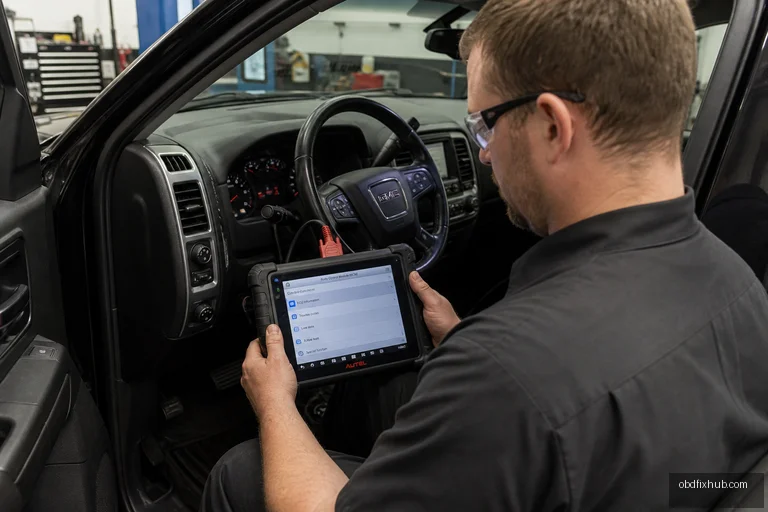
For that reason, the correct procedure is to rescan the truck with a GM-capable tool, preferably a Tech 2 or a professional equivalent, and identify the module that reported the fault. A repair manual or GM service information for the truck’s VIN should then be used to confirm the circuit. Do not buy an actuator solely because an inexpensive scanner printed “Sensor Cleaning Air Blower Actuator A.”
Common Causes of the B0100 Code
- Open or shorted wiring: Wires routed near the windshield, grille, dashboard, or body hinges can rub through or break internally.
- Corroded connectors: Water intrusion, road salt, and poorly sealed terminals can create high resistance or an intermittent connection.
- Blown fuse or poor power supply: A fuse may have opened because of a shorted actuator, but replacing it without finding the cause can create another failure.
- Blocked air duct or intake: Dust, leaves, insects, or a displaced filter can prevent the blower from producing the expected airflow.
- Failed blower or actuator: The motor may be seized, electrically open, noisy, or drawing excessive current.
- Low battery voltage: A weak battery, poor ground strap, or charging problem can cause a body module to set misleading actuator codes.
- Control-module or software problem: This is less common than a wiring fault and should be considered only after power, ground, and actuator tests pass.
- Incorrect code interpretation: The scanner may be using a generic description that does not apply to the specific Silverado configuration.
Symptoms You May Notice
The symptoms depend on which module stored B0100 and whether the system is used continuously or only during a cleaning cycle. Possible signs include a check-engine light on some scan systems, a body or service warning, an inoperative sensor-related feature, or a fault that appears only after rain, washing the vehicle, or cold starts.
Some drivers notice no obvious operating problem at all. That is common with body codes: the module can detect an electrical failure during a self-test even though the vehicle still starts, drives, and shifts normally. A code that returns immediately after clearing is more significant than one stored once during a low-voltage event.
How to Diagnose B0100 Correctly
- Verify the code. Scan every accessible module and save the freeze-frame or failure-record information before clearing anything.
- Confirm the application. Compare the code description with the vehicle VIN, installed options, and the module’s factory service information.
- Check battery voltage. Inspect battery terminals, grounds, and charging voltage. A stable electrical supply is essential before testing body electronics.
- Inspect the circuit visually. Look for loose locks, pushed-out terminals, water marks, rodent damage, chafing, and aftermarket accessory splices.
- Test power and ground under load. A circuit can show 12 volts with a meter and still fail when the blower demands current. A test light or loaded voltage-drop test is more revealing.
- Command the actuator with a scan tool. If the module can command the device but current draw or feedback is abnormal, test the blower and air path. If it cannot command the unit, concentrate on the module inputs, outputs, and communication network.
- Test the actuator directly only when permitted. Use the factory wiring diagram and the correct voltage. Applying power to the wrong terminal can damage a small motor or control circuit.
- Repair, clear, and retest. After the repair, operate the vehicle through the conditions that originally set the code and rescan for pending or current faults.
Repair Options and Typical Cost Factors
The least expensive repair may be cleaning a connector, repairing one broken wire, replacing a fuse after correcting a short, or removing debris from an air passage. If the blower or actuator has failed, replacement is usually straightforward once its location is confirmed. Module replacement is a last resort because many GM modules require programming, setup, or theft-deterrent procedures.
Labor cost varies more than the part price. Access behind the dashboard, windshield trim, or an interior panel can turn a simple electrical fault into a time-consuming repair. Always diagnose the circuit before ordering parts; replacing an actuator will not correct a damaged ground or a scanner translation error.
Can You Drive With B0100?
In many cases, the vehicle remains drivable because B0100 concerns a body or sensor-cleaning function rather than basic engine operation. Nevertheless, driving should be limited if the code is associated with a visibility, safety, or driver-assistance sensor. If the warning appeared together with multiple electrical faults, flickering gauges, or starting problems, address the battery and charging system promptly.
Key Takeaway
B0100 usually points to a sensor-cleaning air blower actuator circuit, but the printed description is not enough to identify the failed component—particularly on a 2005 Chevy Silverado. Confirm the reporting module and complete GM code, check voltage and wiring, and use bidirectional testing before replacing an actuator. A GM-capable scan tool is often the difference between a correct repair and an unnecessary parts purchase.
Frequently Asked Questions
Is B0100 an engine code?
No. B0100 is a body-related code. It may be displayed alongside engine codes, but it does not identify a typical fuel, ignition, or emissions problem.
Will disconnecting the battery fix B0100?
Disconnecting the battery may erase a temporary code, but it does not repair an open circuit, failed blower, corrosion, or incorrect module configuration. If the fault remains, B0100 will return after the next self-test.
Can a generic OBD2 scanner diagnose B0100?
It may read the code number, but many basic scanners cannot access every GM body module or perform actuator commands. A GM-capable scan tool is recommended for confirmation and testing.
Why does B0100 keep coming back after I clear it?
A recurring code usually means the module detects the same electrical or mechanical fault during its next test. Check power, ground, connector condition, wiring continuity, actuator current draw, and the exact factory definition for the vehicle.




