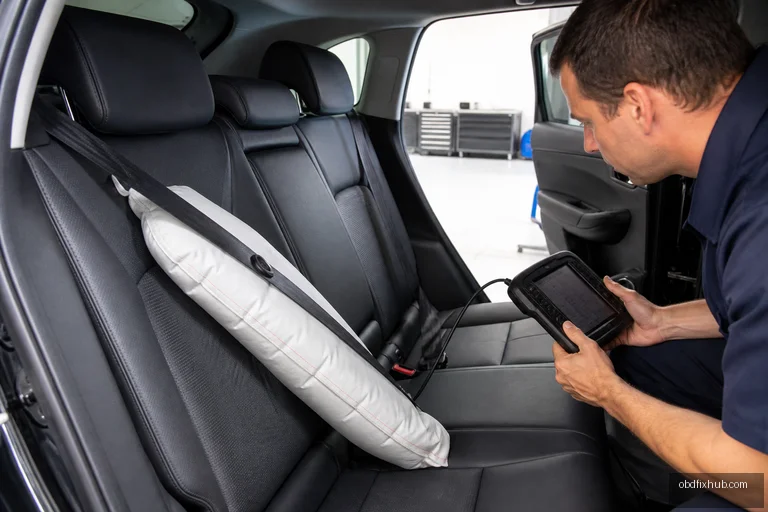
B00F2 Second Row Left Inflatable Seat Belt Deployment Control: Meaning, Causes, Symptoms & Fix
B00F2 means the restraint control module has detected a fault in the deployment control circuit for the second-row left inflatable seat belt. The problem may be a damaged connector, wiring issue, failed seat belt pretensioner or inflator, low system voltage, or a restraint control module fault. Because this is an SRS safety-system code, it should be diagnosed with a proper scan tool rather than cleared repeatedly.
This is an informational search query: most drivers want to understand the warning before deciding whether they need a workshop. The exact repair depends on the vehicle manufacturer, model year, and the additional codes stored alongside B00F2.
What Does B00F2 Mean?
B00F2 is an airbag and supplemental restraint system diagnostic trouble code. Its description generally identifies the second-row left inflatable seat belt deployment control. In a left-hand-drive vehicle, this is commonly the rear seat belt behind the driver, although the exact location label can vary by manufacturer and market.
An inflatable seat belt is more than a normal belt. Depending on the vehicle, it can contain a pretensioner and a belt-mounted inflator designed to deploy in a serious collision. The restraint control module monitors the circuit for correct resistance, continuity, and electrical behavior. If the measured value falls outside the permitted range, it stores B00F2 and usually switches on the airbag warning lamp.
Common Symptoms of a B00F2 Fault
The code may be present even when the rear belt looks perfectly normal. SRS faults are often electrical and can hide beneath trim or under a seat. Typical symptoms include:
- Airbag or SRS warning light illuminated on the instrument cluster
- Seat belt pretensioner or restraint-system warning message
- B00F2 stored as a current, intermittent, or history code
- Other airbag, seat belt, or occupant protection codes appearing at the same time
- Inflatable belt deployment disabled until the fault is repaired
The vehicle may still start and drive normally. That does not mean the restraint system is safe. A warning light indicates that at least one monitored protection function may not operate as designed in a crash.
Why Is My Seat Belt and Airbag Light On?
When both lights are on, the restraint control module has usually detected a fault that affects the airbag, pretensioner, inflatable belt, or its monitoring circuit. For B00F2, the focus is the second-row left belt, but a shared power, ground, communication, or module problem can cause several restraint codes together.
A common real-world example is a rear seat that has been folded, removed, or pulled sharply during interior work. The belt connector may become partially unlatched, a wire may be trapped under the seat bracket, or a terminal may be pushed backward inside the plug. Water intrusion under the carpet can create similar symptoms, particularly after a spill, blocked drain, or flood exposure.
Most Common Causes of B00F2
- Loose or damaged connector: A restraint connector may not be fully locked after seat movement or upholstery work.
- Open or shorted wiring: Harnesses can be pinched by seat tracks, damaged by sharp metal edges, or stretched during folding.
- Failed inflatable seat belt assembly: The belt-mounted inflator or pretensioner can develop an internal electrical fault.
- Low battery voltage: A weak battery, jump-start, or charging-system problem can produce multiple SRS codes, although low voltage alone should not be assumed to be the cause.
- Previous collision damage: A belt may have deployed or been exposed to crash forces even if the vehicle was repaired cosmetically.
- Water or corrosion: Moisture can corrode terminals and create an intermittent high-resistance connection.
- Restraint control module fault: This is possible, but it should be considered only after the belt circuit, power supply, grounds, and related codes have been tested.
How to Diagnose B00F2 Correctly
A basic engine-code reader may not access the airbag module. Use an SRS-capable scan tool that can display live fault status, freeze-frame information, and manufacturer-specific codes. The code description should be confirmed using the vehicle’s service information because circuit naming differs between brands.
- Record every restraint code. Do not diagnose B00F2 in isolation. Codes for low voltage, communication, deployment loops, or crash data may change the repair order.
- Inspect the left second-row belt and harness. Look for crushed wiring, pulled connectors, missing locks, corrosion, aftermarket accessories, and signs of water entry.
- Check battery voltage and grounds. A charging fault should be repaired before judging a restraint component.
- Follow the manufacturer’s circuit test. This may involve approved breakout leads and a specified resistance test procedure. Never substitute a resistor or test lamp for a pyrotechnic component.
- Test the belt assembly and module circuit. If wiring and connections are correct, the inflatable belt or pretensioner may require replacement. A module fault or crash-record issue must be verified separately.
- Clear the code only after the repair. If B00F2 returns immediately as a current fault, the original problem remains or a second issue was overlooked.
How to Fix a Pretensioner Seat Belt Fault
The correct fix depends on the failed part. A loose connector may be repaired by restoring the terminal and locking the plug correctly. Damaged wiring should be repaired according to the manufacturer’s SRS wiring procedure; ordinary twisting, household crimping, or unapproved solder repairs can alter circuit resistance and create another deployment risk.
If the inflatable seat belt or pretensioner has an internal fault, the usual remedy is replacement of the complete approved belt assembly. Some vehicles require calibration, a restraint-module reset, or crash-data clearing after deployment. These procedures are manufacturer-specific, and a replacement belt from a salvage vehicle may already be deployed or incompatible.
Can Seat Belt Pretensioners Be Reset?
Usually, a deployed pretensioner cannot be safely reset and reused. It is a pyrotechnic safety device, so deployment normally requires replacement. Some non-deployment diagnostic faults can be cleared after the underlying wiring or voltage problem is repaired, but clearing a code does not restore a damaged pretensioner.
Some specialist services advertise SRS module “resets” after a crash. Whether that is legal, safe, and supported depends on the vehicle and local regulations. The belt assembly itself should never be bypassed with a resistor or modified to extinguish the warning light.
Safety Precautions Before Inspection
Do not probe yellow SRS connectors with a test light, multimeter, or improvised jumper unless the manufacturer specifically provides a safe procedure and equipment. Accidental current through a pyrotechnic circuit can cause deployment and serious injury.
- Keep hands, tools, and occupants away from suspected deployed components.
- Follow the factory battery-disconnection and waiting-time procedure.
- Do not remove trim around the belt or airbag without knowing where the components are located.
- Use only the specified replacement belt and connector parts.
- Have a qualified SRS technician perform testing if the code is current or the vehicle has collision history.
Can You Keep Driving With B00F2?
The vehicle may remain drivable, but the warning should not be ignored. The affected inflatable belt or pretensioner may not provide its intended protection, and other restraint functions could also be disabled. Arrange diagnosis promptly, especially if the vehicle carries children or rear passengers.
Final Takeaway
B00F2 points to an electrical or component fault involving the second-row left inflatable seat belt deployment circuit. Start with a full SRS scan, battery and ground checks, and a careful inspection of the rear belt connector and harness. Do not bypass the circuit or assume that clearing the code is a repair; pyrotechnic belt components require correct testing and, when deployed or defective, replacement.
Frequently Asked Questions
What does it mean if the airbag system and seat belt pretensioner system are malfunctioning?
It means the restraint control module has detected a fault in one or more monitored safety circuits. The vehicle may still drive normally, but the affected airbag or pretensioner may not operate correctly during a crash.
Can a B00F2 code be caused by a low battery?
Yes, unstable or very low voltage can trigger SRS faults, particularly after a failed battery or jump-start. However, voltage should be verified and the B00F2 circuit should still be inspected if the code returns.
How much does it cost to fix B00F2?
Cost ranges from a diagnostic fee or connector repair to the price of a complete inflatable belt assembly and module programming. Labor and parts vary considerably by vehicle, so the exact code list and model-specific test results are necessary for a reliable estimate.
Will disconnecting the battery clear B00F2?
Normally, no. Disconnecting the battery may erase temporary data on some vehicles, but SRS modules commonly retain fault memory, and a current fault will return. Battery disconnection is not a substitute for diagnosis.
Should I replace the pretensioner or the whole seat belt?
Follow the manufacturer’s parts procedure. On many vehicles the pretensioner or inflator is integrated into the belt assembly, making complete seat belt replacement the approved repair. Do not separate or rebuild a pyrotechnic assembly unless the manufacturer specifically allows it.




