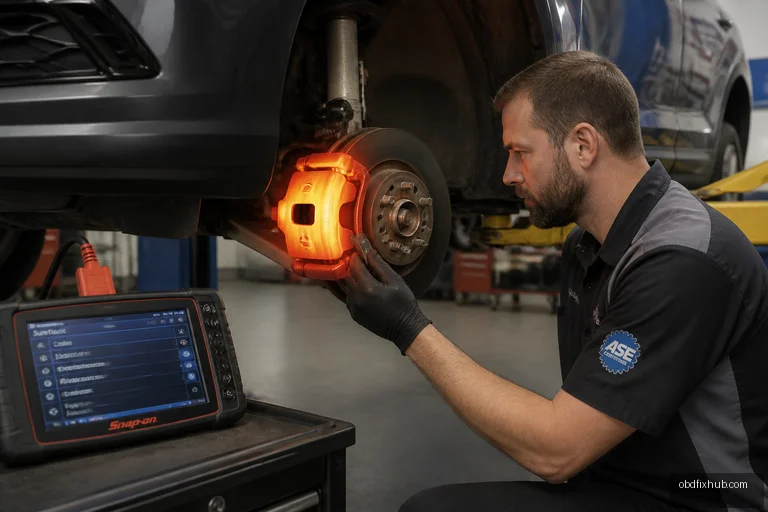
C0012 Left Front Hydraulic Release Too Long means the ABS or electronic brake control system detected that hydraulic pressure at the left-front brake did not fall quickly enough when it was commanded to release. In practical terms, the left-front brake may be dragging, or the ABS hydraulic control unit may be unable to vent pressure correctly. Because this fault can affect braking balance and wheel temperature, it should be diagnosed rather than cleared and ignored.
This is normally a chassis or ABS code, not a conventional engine fault. The exact wording and subcode can vary by manufacturer, so the vehicle identification number, scan-tool data, and factory service information are important before replacing parts.
What Does C0012 Left Front Hydraulic Release Too Long Mean?
During normal braking, the ABS module can increase, hold, or release pressure at each wheel through valves inside the hydraulic control unit. When the module commands the left-front circuit to release, it expects pressure to drop within a calibrated time. C0012 is stored when that pressure release takes too long or the measured wheel response does not match the expected result.
The code does not automatically prove that the ABS module is defective. The restriction may be downstream in the brake hose, caliper, hard line, or mechanical hardware. A sticking caliper piston can create the same real-world symptom even when the hydraulic unit is operating correctly.
Common Symptoms of C0012
Some vehicles store the code after a brief ABS self-test without obvious braking symptoms. Others develop noticeable brake drag, especially after several minutes of driving. Look for these signs:
- ABS, traction control, stability control, or brake warning lights
- The vehicle pulling to one side during or after braking
- A left-front wheel that is much hotter than the right-front wheel
- Burning brake odor, smoke, or premature pad wear on one side
- A brake pedal that feels unusual, particularly after the brakes heat up
- Reduced fuel economy caused by constant rolling resistance
- Intermittent ABS activation or wheel-lock concerns on slippery surfaces
A useful field check is to compare the left-front and right-front wheel temperatures after a short drive with minimal braking. An infrared thermometer can reveal a significant difference, but never touch a suspected hot rotor or caliper with bare hands.
Most Likely Causes
Restricted or internally collapsed brake hose
A flexible brake hose can fail internally and act like a one-way valve. Pressure reaches the caliper when the pedal is pressed, but returns slowly when the pedal is released. The outside of the hose may look perfect, which is why visual inspection alone is not enough.
Sticking left-front caliper
Corrosion around the piston, contaminated brake fluid, damaged piston seals, or seized slide pins can keep the pad against the rotor. This produces heat and drag even if hydraulic pressure is released normally. Uneven pad wear often points toward this mechanical cause.
ABS hydraulic control unit valve problem
A sticking outlet valve, contamination inside the hydraulic modulator, or an internal electrical fault can prevent pressure from being released at the correct speed. This becomes more likely when the code returns during an ABS actuator test and the caliper, hose, and line pass isolation tests.
Damaged brake line or contaminated fluid
A kinked steel line, incorrect aftermarket fitting, or moisture-laden brake fluid can restrict flow. Fluid contaminated with rubber particles may also interfere with small ABS valve passages. Recent brake work is an important clue, particularly if the code appeared immediately afterward.
Electrical or sensor-related faults
The ABS module may interpret a wheel-speed signal incorrectly if the left-front sensor, tone ring, bearing, wiring, or connector is damaged. This does not usually create genuine hydraulic drag, but it can cause the module to report a release-time problem. A wheel-speed graph during a road test is more useful than simply checking whether the sensor has continuity.
How to Diagnose C0012 Correctly
- Confirm the code and vehicle application. Use a scan tool that can access the ABS module, not only the engine computer. Record all stored, pending, and history codes along with freeze-frame data.
- Inspect the left-front brake. Check pad wear, rotor discoloration, caliper slide movement, piston dust boot condition, hose routing, and signs of fluid leakage.
- Compare wheel temperatures. After a controlled drive, compare both front wheels. A hot left-front rotor supports a dragging-brake diagnosis, although temperature alone cannot identify the failed component.
- Test for trapped pressure. If the wheel is locked or difficult to rotate, a technician can carefully check whether opening the bleeder releases pressure. If pressure is trapped, the problem is likely upstream of the caliper; if it is not, inspect the caliper and mechanical components.
- Use ABS actuator commands. With the correct scan tool, command the left-front inlet and outlet valves while monitoring pressure or wheel response. Follow the manufacturer’s safety and bleeding procedure because some systems require a pressure bleeder or automated bleed routine.
- Verify the wheel-speed signal. Compare left-front and right-front speed readings from a stationary sensor check through a road test. Look for dropouts, erratic readings, or a speed that differs from the other wheels.
Do not condemn the ABS hydraulic control unit simply because replacing the caliper does not immediately clear the code. A professional diagnosis separates a hydraulic restriction from a valve-control problem. That distinction can prevent an expensive module replacement when a comparatively inexpensive hose is the real failure.
Repair Options
The correct repair depends on the test result. A collapsed hose should be replaced with a quality, vehicle-specific part, followed by a complete brake bleed. A sticking caliper may require replacement or rebuilding, new hardware, and inspection of the rotor and pads for heat damage.
If the ABS hydraulic modulator has a confirmed valve or internal circuit fault, it may need professional repair or replacement. Some vehicles require coding, calibration, and automated brake bleeding after installation. Clearing the code without completing these procedures can leave air in the system or prevent the stability-control system from operating correctly.
Brake fluid should never be chosen by color alone. Use the specification listed on the reservoir cap or manufacturer documentation, and avoid introducing silicone or petroleum-based products into a system designed for glycol-based fluid.
Can You Drive With C0012?
Short-distance driving may be possible if the pedal is firm, the vehicle stops straight, and there is no overheating or severe warning message. However, the ABS and stability-control functions may be disabled or limited while the code is active. Do not continue driving if the vehicle pulls, the pedal changes, a wheel becomes extremely hot, or brake fluid is leaking; arrange a tow instead.
How to Prevent the Code From Returning
- Flush brake fluid at the interval recommended for the vehicle and climate.
- Inspect flexible hoses whenever pads, calipers, or wheel bearings are serviced.
- Keep ABS connectors securely mounted away from tire and suspension movement.
- Use the correct bleeding sequence after hydraulic or ABS component replacement.
- Repair wheel-speed sensor wiring before intermittent faults damage the ABS diagnosis.
Frequently Asked Questions
Is C0012 an engine code?
No. C0012 is generally a chassis or ABS-related code. The exact definition can vary, so it should be read with an ABS-capable scan tool and checked against the vehicle manufacturer’s documentation.
Can low brake fluid cause C0012?
Low fluid can trigger other brake or ABS faults and may introduce air, but it is not the most direct explanation for a delayed left-front pressure release. Inspect for leaks and diagnose the hydraulic circuit rather than assuming a fluid top-up will fix it.
Will replacing the left-front caliper fix the code?
It will fix C0012 only if the caliper is causing the drag or failing to release mechanically. A restricted brake hose or ABS modulator valve can produce similar symptoms, so pressure testing should come before parts replacement.
Why is only the left-front wheel affected?
The fault may be isolated to that wheel’s hose, caliper, line, sensor, or ABS valve channel. Individual wheel control is a normal feature of modern ABS systems, so a single-corner fault is entirely possible.
Bottom Line
C0012 Left Front Hydraulic Release Too Long indicates that the left-front brake circuit is not releasing pressure within the expected time. Start with wheel temperature, pad and caliper inspection, and a trapped-pressure test before suspecting the ABS module. If braking performance has changed or the wheel is overheating, treat the vehicle as unsafe and have the brake system inspected promptly.




