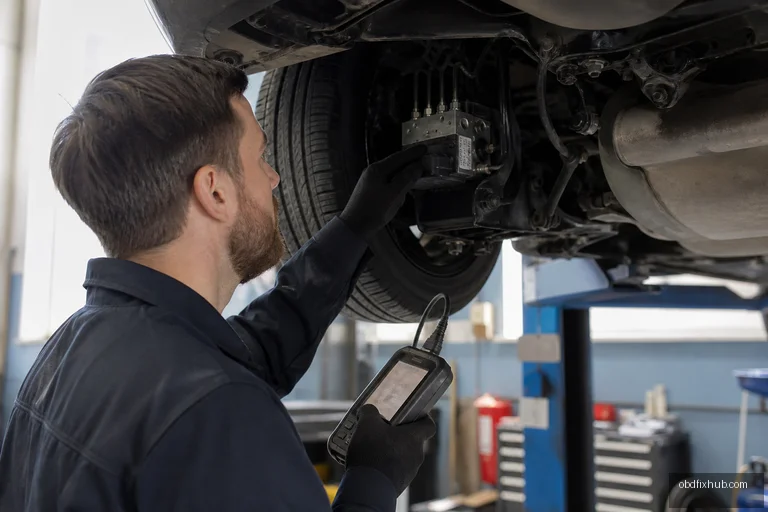
C0019 Left Rear Outlet Control indicates a fault in the circuit or operation of the left-rear brake outlet control, usually within the ABS or electronic brake control system. The most common causes are damaged wiring, a poor connector, a failed hydraulic modulator solenoid, or a problem with the ABS control module. Because the exact definition and sub-code vary by vehicle, the correct diagnosis starts with scanning the ABS module—not only the engine computer.
What Does C0019 Left Rear Outlet Control Mean?
Modern anti-lock braking systems use an electronic hydraulic control unit to regulate brake pressure at each wheel. Inside that unit, inlet and outlet solenoid valves open and close rapidly to prevent a wheel from locking during hard braking. C0019 generally points to the outlet-control side of the left-rear brake circuit.
The left-rear designation refers to the vehicle’s left side when sitting in the driver’s seat, not the left side when facing the vehicle from the front. On many vehicles, this is the rear driver’s-side wheel. Some manufacturers describe the code as Left Rear Outlet Control Circuit, while others shorten it to Left Rear Outlet Control.
A suffix may provide additional information, such as an open circuit, short to ground, short to voltage, or an internal solenoid fault. These suffixes are manufacturer-specific, so a factory service manual or reliable vehicle-specific scan-data source is essential.
Common Symptoms of C0019
You may notice the code during a routine scan, before any obvious braking problem develops. In other cases, the ABS system will disable some functions as soon as the fault is detected.
- ABS warning light illuminated
- Traction control or stability control warning light
- Brake warning message on the instrument cluster
- ABS, traction control, or stability control temporarily unavailable
- Longer stopping distance on wet, icy, or loose surfaces
- Unexpected ABS activation or pulsing through the brake pedal
- Stored or intermittent fault that returns after clearing
The service brake may still work normally because the hydraulic foundation brakes are separate from ABS intervention. That does not make the fault harmless. A vehicle with an inactive ABS system can lose its ability to maintain steering control during emergency braking.
Most Likely Causes
1. Damaged wiring near the rear wheel
The harness running to the rear wheel area is exposed to water, road salt, stones, suspension movement, and exhaust heat. A wire can break internally while its insulation looks intact, especially near a suspension arm or a retaining clip. On vehicles used in corrosion-prone regions, green corrosion inside the copper strands is a frequent finding.
2. Loose, contaminated, or damaged connector
A partially locked connector at the ABS hydraulic control unit can create an intermittent C0019. Water intrusion may leave white or green deposits on the terminals. Do not simply spray cleaner and reconnect it; inspect terminal tension and verify that each terminal is fully seated.
3. Failed left-rear outlet solenoid
The outlet valve is commonly integrated into the ABS hydraulic modulator. If the solenoid coil is open, shorted, or mechanically stuck, the electronic brake control module can set C0019. In many designs, the valve is not serviced separately, making the complete hydraulic modulator the repairable unit.
4. ABS control module fault
An internal driver failure in the electronic brake control module can prevent it from commanding the outlet valve correctly. This is less common than a wiring or connector issue, but it becomes more credible when power, grounds, wiring continuity, and solenoid resistance all pass testing.
5. Low voltage or previous brake-system work
A weak battery, poor ground, or jump-start event can produce misleading chassis-code symptoms. C0019 can also appear after an ABS modulator, brake line, rear axle, or suspension repair if a connector was left loose or the harness was pinched during reassembly.
How to Diagnose C0019 Correctly
A professional diagnosis should prove where the electrical fault is instead of replacing the ABS module based only on the code. The following sequence is efficient and avoids many unnecessary parts purchases.
- Confirm the code in the ABS module. Use a scan tool that can communicate with the electronic brake control module. A basic engine-code reader may not access this system at all.
- Record all related codes and freeze-frame data. Wheel-speed, voltage, communication, and other solenoid codes can change the diagnosis. Do not erase the evidence before recording it.
- Check battery voltage and grounds. Low system voltage can create false or secondary faults. Inspect the ABS module ground connection for looseness, paint, corrosion, or damaged threads.
- Inspect the harness physically. Follow the wiring from the module toward the left-rear brake area. Look for rubbing, stretching, melted insulation, crushed sections, and repairs made with unsuitable crimp connectors.
- Test the circuit with the wiring diagram. Check continuity end to end, short circuits to ground, and unwanted voltage. A continuity test alone is not enough; a wire may pass with no load but fail when current flows.
- Measure the solenoid circuit only as specified. Compare resistance with the manufacturer’s specification. Never apply battery power directly to an ABS valve unless the service procedure explicitly allows it, because the solenoid or control electronics may be damaged.
- Use an active test if available. A capable scan tool can command the left-rear outlet valve while monitoring current or hydraulic operation. Follow all safety instructions and use a pressure gauge only where the manufacturer provides a test procedure.
One useful workshop technique is a wiggle test while monitoring live ABS data or the valve circuit. Move the harness through its normal suspension range rather than pulling aggressively. If the fault appears when the harness bends at one particular point, the location can often be isolated before removing expensive components.
Repair Options and Typical Fixes
If the problem is a broken wire, repair it with automotive-grade wire of the correct gauge, sealed splices, and proper harness protection. Route the repaired section exactly as the original, leaving enough slack for suspension movement but keeping it away from the tire, rotor, and exhaust.
For connector damage, replace the affected terminal or connector body rather than forcing a loose terminal tighter. If water entered through a seal, identify how it got there; replacing the connector without correcting the sealing problem often leads to a repeat code.
A failed hydraulic modulator or ABS control module normally requires a vehicle-specific replacement, brake bleeding, and a scan-tool initialization or calibration procedure. Some vehicles require an automated ABS bleed that cycles the valves. A conventional pedal bleed may not remove trapped air from the modulator.
After the repair, clear the ABS code, perform the required calibration, and road-test the vehicle in a safe location. Confirm that the ABS and stability-control lamps remain off and that the code does not return during low-speed and moderate braking tests. Never test ABS operation on public roads by intentionally locking the brakes.
Can You Drive With C0019?
If the brake pedal is firm and the red brake warning light is not illuminated, a short drive to a repair facility may be possible, but the ABS and stability features may be disabled. Drive slowly, increase following distance, and avoid wet, icy, or loose roads. Stop driving and arrange a tow if the pedal is soft, the vehicle pulls during braking, brake fluid is leaking, or multiple brake-system warnings appear.
How Much Does C0019 Repair Cost?
The cost depends heavily on the failed component. A damaged wire or connector may be a relatively small repair, while an ABS hydraulic modulator can be substantially more expensive and may require programming or a specialized bleed. Diagnosis matters because replacing a module when the real fault is a corroded connector can turn a simple repair into an unnecessary major expense.
Key Takeaway
C0019 is not a generic engine fault; it is a chassis or ABS-related code involving left-rear brake pressure control. Start with an ABS-capable scan tool, inspect the wiring and connector carefully, verify power and grounds, and test the outlet-control circuit against the vehicle’s wiring diagram. Repair the confirmed fault, then complete any required bleeding, calibration, and road testing before returning the vehicle to normal use.
Frequently Asked Questions
Is C0019 a serious code?
It can be serious because ABS, traction control, or stability control may be disabled. The basic brakes may still operate, but emergency stopping performance on slippery surfaces can be reduced.
Can a wheel-speed sensor cause C0019?
A wheel-speed sensor normally sets a different code, but related sensor or communication faults can appear at the same time. Scan all modules and diagnose the complete fault set rather than assuming every warning has one cause.
Can I clear C0019 with a code reader?
You can clear it only with a scanner that accesses the ABS module, but clearing the code does not repair the fault. If the electrical problem remains, the warning will usually return as soon as the system performs its self-test.
Does replacing the ABS module always fix C0019?
No. Wiring damage, connector corrosion, poor grounds, and a failed valve can produce the same code. The module should be replaced only after circuit tests confirm that the external wiring and power supplies are correct.




