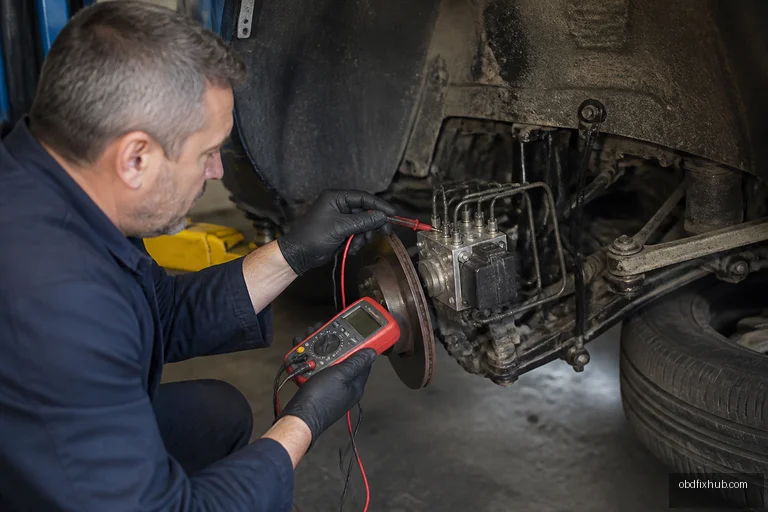
C001C Right Rear Inlet Control is an ABS or brake-control fault indicating a problem with the hydraulic inlet-control function for the right-rear wheel. In practice, the cause may be an open or shorted solenoid circuit, damaged wiring, poor connector contact, a contaminated valve, low system voltage, or an internal ABS hydraulic control unit failure. The code should be diagnosed with an ABS-capable scan tool before any parts are replaced.
What Does C001C Right Rear Inlet Control Mean?
The ABS hydraulic control unit regulates brake pressure independently at each wheel. During an ABS event, the inlet valve controls whether pressurized brake fluid can enter a wheel circuit. C001C means the ABS module has detected an abnormal electrical or functional condition in the right-rear inlet-control circuit.
The exact wording can vary between manufacturers. Some scanners display the code as a “right rear inlet control subfault,” while others describe it as an inlet solenoid electrical fault. The code is not the same as a generic engine-management code, so a basic OBD-II reader may not retrieve the complete diagnostic information.
Common Symptoms of C001C
The vehicle may still have normal friction braking, which is why this fault can be easy to underestimate. However, ABS and electronic stability functions may be disabled or limited until the problem is repaired.
- ABS, traction-control, or stability-control warning lights
- A brake-system warning message on the instrument cluster
- ABS activation that is unavailable during hard braking
- Unexpected pulsation, clicking, or buzzing from the ABS unit
- Longer stopping distances on wet, icy, or loose surfaces
- A code that returns immediately after clearing
- In some vehicles, cruise control or stability-control functions being disabled
A firm brake pedal does not prove the ABS system is healthy. It only suggests that the conventional hydraulic braking system may still be operating. Treat the warning as a safety-related fault, especially if the red brake warning lamp is also illuminated.
C001C Right Rear Inlet Control: Most Likely Causes
1. Damaged wiring near the right-rear wheel
The harness running toward the rear wheel is exposed to water, road salt, stones, suspension movement, and exhaust heat. A wire may be pulled tight, rubbed through against a bracket, or broken internally while its insulation still looks intact. Wiggling the harness during a continuity test often reveals an intermittent fault that a visual inspection misses.
2. Corroded or loose ABS connector
Moisture inside the ABS module connector can increase resistance or interrupt the solenoid circuit. Look for green corrosion, pushed-back terminals, damaged seals, and evidence that a connector was not fully latched after previous brake or suspension work. Do not force probes into sealed terminals; back-probe carefully or use the manufacturer’s terminal adapters.
3. Failed right-rear inlet solenoid
The inlet valve is an electromagnetic component. An open coil, shorted coil, or mechanically stuck valve can set C001C. Measuring resistance can identify a completely open or shorted coil, but a resistance reading within specification does not guarantee that the valve moves correctly under hydraulic pressure.
4. ABS hydraulic control unit fault
If the wiring, power supply, ground, and solenoid circuit test correctly, the fault may be inside the ABS modulator or electronic brake-control module. Internal driver-transistor failure and valve contamination are possible. This is where many unnecessary module replacements occur: the unit should not be condemned until the external circuit has been tested.
5. Low voltage or poor power supply
A weak battery, charging-system problem, blown ABS fuse, or poor ground can create misleading valve-control codes. Check battery voltage and charging voltage, then inspect the ABS module’s power and ground circuits under load. A static voltage reading alone may not expose a high-resistance ground.
How to Diagnose C001C Correctly
Professional diagnosis starts with the ABS module, not the engine ECU. Record all stored, pending, and history codes before clearing anything. Related wheel-speed, pump, voltage, or communication codes can change the diagnostic direction.
- Confirm the code with an ABS-capable scanner. Check the vehicle-specific description and any subcode or symptom byte. Generic code lists are useful starting points, not final repair instructions.
- Inspect the right-rear area. Follow the wiring from the ABS unit to the wheel, checking for abrasion, stretched sections, crushed conduit, water entry, and previous repairs.
- Check fuses, power, grounds, and voltage. Perform voltage-drop tests while the circuit is loaded. A clean-looking ground can still fail when current flows.
- Test the solenoid circuit according to the service manual. Compare resistance with the manufacturer’s specification and check for short-to-ground or short-to-power conditions. Never apply battery power directly to a valve unless the manufacturer specifically permits it.
- Use an actuator test when supported. A bidirectional scan tool may command the right-rear inlet valve. Listen for the valve response and compare it with the other wheel circuits, but remember that an audible click does not prove hydraulic performance.
- Inspect the ABS connector and module pins. Look for spread terminals, moisture, bent pins, and corrosion. Disconnect the battery only when the service procedure requires it, since some vehicles have specific airbag and brake-system precautions.
- Clear the code and road-test safely. After repair, confirm that the code does not return and verify live wheel-speed data on a controlled road test. Do not intentionally trigger ABS on public roads.
Repair Options for C001C
The correct repair depends on the failed part. A damaged harness should be repaired with automotive-grade wire, sealed splices, and proper strain relief. Avoid twisting wires together and wrapping them in ordinary electrical tape; that type of repair commonly fails again in a wet wheel-well environment.
Corroded terminals may require connector or terminal replacement rather than cleaning alone. If the inlet solenoid is integrated into the hydraulic modulator, the practical repair may be replacement or professional rebuilding of the ABS unit. Some vehicles require module coding, configuration, or a brake-pressure and ABS bleed procedure after installation.
After opening the hydraulic system, use the specified brake fluid and follow the correct bleeding sequence. Certain ABS units require a scan-tool-controlled automated bleed to remove air trapped inside the modulator. A normal pedal bleed may not be sufficient.
Can You Drive With C001C?
Short-distance driving may be possible if the brake pedal feels normal and only the amber ABS light is on, but the vehicle may not have anti-lock or stability assistance. Drive slowly, leave extra stopping distance, and avoid rain, snow, and emergency braking until the problem is diagnosed.
Stop driving and arrange professional assistance if the pedal is soft, the brake fluid is leaking, the red brake warning lamp is on, braking pulls strongly to one side, or the vehicle shows severe hydraulic symptoms. Those signs indicate a potentially more serious braking problem than an isolated electronic fault.
How Much Does a C001C Repair Cost?
Diagnostic cost is usually lower when the problem is a visible harness or connector issue, but ABS repairs vary widely by vehicle. A wiring repair may be relatively inexpensive, while a replacement or rebuilt hydraulic control unit can cost substantially more and may require programming and fluid bleeding.
Ask the repair shop for a written diagnosis that identifies the tested circuit, measured values, and reason for condemning the module. “The code says ABS module” is not enough evidence by itself. The most valuable cost-saving step is confirming whether the fault is external wiring or an internal valve driver before ordering an expensive unit.
Practical Tips That Prevent Misdiagnosis
- Do not replace the right-rear wheel-speed sensor solely because C001C mentions the right rear.
- Do not confuse the inlet valve with the outlet valve; they perform different pressure-control functions.
- Check for low voltage and shared ground faults before testing expensive ABS components.
- Use the vehicle’s wiring diagram because connector pin locations differ significantly.
- After repair, verify live wheel-speed readings and perform the required ABS initialization or calibration.
Summary: The Best Next Step
C001C points to the right-rear ABS inlet-control circuit, but the code alone cannot identify the failed component. Start with an ABS-capable scan, inspect the wheel-area harness and connector, test power and ground under load, and follow the manufacturer’s solenoid specifications. If those tests pass, then an ABS hydraulic control unit fault becomes a reasonable conclusion rather than a guess.
If the warning light is active, schedule a brake-system diagnosis promptly. Correct testing is usually cheaper—and safer—than replacing an ABS module based only on the code description.
Frequently Asked Questions
Is C001C the same as a wheel-speed sensor code?
No. C001C identifies a right-rear inlet-control fault in the ABS hydraulic system. A wheel-speed sensor may create related ABS codes, but it should not be replaced without checking its own wiring and live data.
Can a low battery cause C001C?
Yes. Low system voltage, a weak ground, or an interrupted ABS power supply can set valve-control faults. Verify battery, alternator, fuse, and ground performance before condemning the inlet solenoid or ABS module.
Will clearing C001C fix the problem?
Clearing the code only removes the stored warning temporarily. If the circuit fault remains, C001C will return, often immediately when the ABS module performs its self-test or during the next drive cycle.
Does replacing the ABS module require programming?
Often, yes. Depending on the vehicle, the replacement may need coding, configuration, steering-angle calibration, and an automated brake bleed. Follow the exact service procedure for that model.




