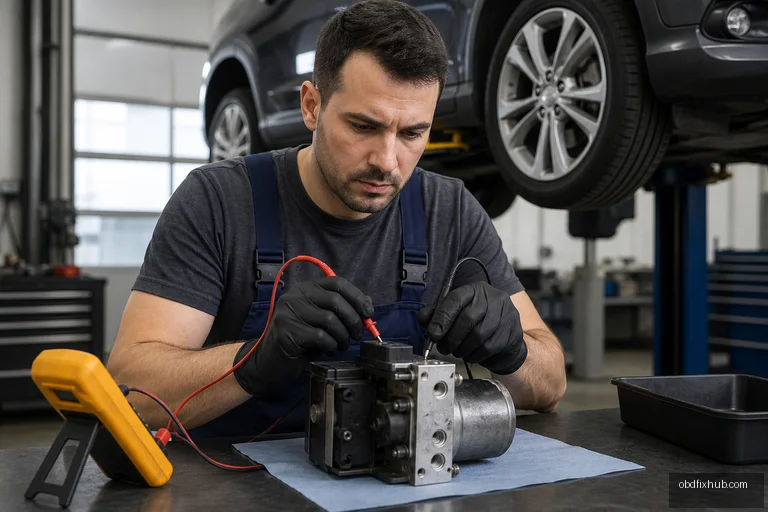
C0020 ABS Pump Motor Control means the ABS control system has detected a problem in the electrical circuit that operates the anti-lock brake pump motor. It is a chassis code, not an engine-performance code. The cause may be as simple as a blown fuse, corroded connector, weak battery voltage, or damaged wiring—or as expensive as a failed ABS hydraulic control unit. Do not replace the ABS module before testing the power supply, ground, motor circuit, and hydraulic unit.
What Does Code C0020 Mean?
C0020 is commonly defined as ABS Pump Motor Control Circuit or ABS Pump Motor Control. The exact wording and subcode can vary by manufacturer, but the basic fault is the same: the ABS module cannot operate or correctly monitor the electric motor that drives the hydraulic pump.
The pump does not normally run continuously. It operates when the ABS system needs to restore hydraulic pressure during an anti-lock event, traction-control intervention, or electronic stability-control correction. During its self-test, the module checks whether the motor receives the correct voltage and whether its current draw and feedback are plausible.
Although many people call C0020 an “engine code,” it is more accurately a chassis diagnostic trouble code. A basic engine-code reader may not access it at all. Diagnosis requires a scan tool that can communicate with the ABS or electronic brake control module.
Common Causes of C0020 ABS Pump Motor Control
- Low battery voltage or a charging-system problem
- Blown ABS pump fuse or a failed relay
- Open, shorted, or high-resistance wiring between the ABS module and pump motor
- Corroded, loose, wet, or heat-damaged ABS connector pins
- Bad ground connection near the ABS hydraulic unit
- Seized, worn, or internally shorted pump motor
- Failed ABS hydraulic control unit or integrated pump assembly
- Previous collision, water intrusion, incorrect jump-starting, or aftermarket wiring damage
A particularly common diagnostic mistake is blaming the wheel-speed sensors. A failed wheel-speed sensor can illuminate the ABS and traction-control lamps, but it does not usually create a pump motor control code by itself. If C0020 appears with a sensor code, diagnose both faults rather than assuming one caused the other.
C0020 Symptoms You May Notice
The most obvious symptom is an illuminated ABS warning light. Depending on the vehicle, the traction-control, stability-control, brake, or “service brake system” warning may appear at the same time. Some vehicles also display a message that disables ABS, traction control, or electronic stability control.
- ABS intervention is unavailable during hard braking
- Traction control or stability control stops working
- The brake pedal may feel normal during ordinary braking
- A pump may run briefly, run loudly, or fail to run during an ABS self-test
- Several warning lights may return immediately after clearing the code
A normal-feeling brake pedal does not prove that the ABS is functioning. The base hydraulic brakes can continue to stop the car while the anti-lock and stability features are disabled. Conversely, a low or spongy pedal, fluid leak, or major change in braking effort requires immediate attention and should not be treated as “just an ABS light.”
How to Diagnose C0020 Properly
Professional diagnosis starts with the vehicle’s complete ABS scan, not with parts replacement. Read all stored, pending, and history codes, record the freeze-frame data, and check whether the code returns immediately or only when the pump is commanded on.
- Check battery and charging voltage. A healthy battery is generally close to 12.6 volts with the engine off and approximately 13.5–14.8 volts while running, although vehicle specifications should take priority. Low system voltage can create misleading ABS faults.
- Inspect the fuse, relay, connector, and ground. Look for green corrosion, pushed-back terminals, water inside the connector, and melted plastic. A fuse that blows again indicates a short or an excessive motor load; installing a larger fuse is unsafe.
- Test voltage under load. A wire can show battery voltage with no load yet fail when the pump demands high current. A technician should perform voltage-drop tests on both the power and ground sides while commanding the pump with a capable scan tool.
- Command the pump motor. If the scan tool can activate the motor, listen for its operation and observe current draw. No sound with correct power and ground points toward a seized or failed motor. An unusually high current draw can indicate a mechanically tight pump or a shorted motor.
- Check the hydraulic unit and module separately when possible. Some vehicles use an integrated assembly, while others have a replaceable motor, pump, or electronic module. The service procedure depends on the exact make, model, year, and ABS system.
One useful workshop clue is the timing of the warning light. If C0020 appears immediately at key-on, suspect power, ground, wiring, or an internal module fault. If it appears only after a braking or traction-control event, a weak motor, excessive current draw, or a pump that fails under heat may be more likely.
How to Fix C0020
The correct repair depends on the failed part. A technician may replace a fuse or relay, repair a damaged wire, clean or replace terminals, restore a ground, or replace the pump motor. If the motor and electronic controller are integrated, the entire ABS hydraulic control unit may need replacement or professional rebuilding.
After the repair, the system should be scanned again, codes cleared, and the vehicle road-tested in a safe location. Some vehicles require ABS bleeding, a hydraulic pump initialization, steering-angle calibration, or a stability-control relearn. A repair is not complete merely because the warning light goes out after clearing the memory.
Avoid “bypassing” the ABS pump. Jumping wires, fitting an incorrect relay, or permanently disabling the warning light can remove essential brake protection and may create a dangerous loss of stability control. It can also make the vehicle fail inspection or complicate an insurance claim.
Can You Still Drive With a Faulty ABS Pump?
Usually, the conventional brakes may still work, but ABS, traction control, and stability control may be disabled. That means the car can lock its wheels during emergency braking, especially on rain, snow, gravel, or loose surfaces. Driving a short distance directly to a repair facility may be reasonable only when the pedal is firm, braking is even, there is no fluid leak, and the red brake warning light is not indicating a separate hydraulic problem.
Stop driving and arrange a tow if the pedal sinks, braking distance increases, the vehicle pulls to one side, brake fluid is leaking, the red brake warning remains on, or the pump and wiring show signs of overheating. Drive slowly, leave extra following distance, and do not test the ABS system on public roads.
How Much Does It Cost to Fix an ABS Pump?
Prices vary widely by vehicle and by whether the pump is separate from the ABS module. Typical U.S. repair ranges are:
- Diagnostic scan and electrical testing: $100–$200
- Fuse, relay, connector, or wiring repair: $150–$500
- ABS pump motor repair or replacement: $400–$1,200
- Replacement ABS hydraulic control unit or module: $800–$2,500 or more
- Dealer programming, bleeding, and calibration: an additional $150–$500 in some cases
Rebuilt ABS units can reduce the parts bill, often to roughly $250–$800, but compatibility, warranty coverage, shipping, and programming matter. Ask whether the quoted price includes brake bleeding, module coding, calibration, and a post-repair scan. A low quote that covers only the part may not be the final cost.
How Much Does It Cost to Fix ABS and Traction Control?
When the ABS and traction-control lights appear together, the repair may still be inexpensive if the cause is a wheel-speed sensor, wiring fault, or low voltage. A wheel-speed sensor repair commonly falls around $150–$450 per corner, while a more complicated ABS module or pump repair can exceed $1,000. The warning lights alone cannot identify the failed component; the stored ABS codes and live wheel-speed data are more valuable than guessing from the dashboard.
Final Takeaway
C0020 points to the ABS pump motor control circuit, but it does not automatically mean the entire ABS module is bad. Begin with a complete ABS scan, battery and charging checks, fuse and relay inspection, connector examination, and voltage-drop testing. Repair the electrical cause before condemning the pump, and treat any change in brake pedal feel or braking performance as an urgent safety issue.
Frequently Asked Questions
Is C0020 a serious code?
Yes. The vehicle may still have basic braking, but ABS and stability functions can be unavailable. The risk is greatest during emergency braking or on slippery roads.
Does C0020 always mean the ABS pump must be replaced?
No. A weak battery, blown fuse, failed relay, poor ground, or corroded connector can produce the same code. Electrical testing should come before pump replacement.
Can a regular OBD2 scanner diagnose C0020?
Many basic scanners read only powertrain codes and cannot access the ABS module. Use an ABS-capable scan tool that can display live data and, ideally, command the pump motor.
Will clearing C0020 fix the problem?
Clearing the code only erases the stored information. If the fault remains, the warning light will return—often as soon as the ABS performs its next self-test.
Is an ABS pump repair covered by warranty?
It depends on the vehicle’s age, warranty terms, and whether the failure is related to a recall or known service campaign. Check the VIN with the manufacturer before paying for a module or pump replacement.




