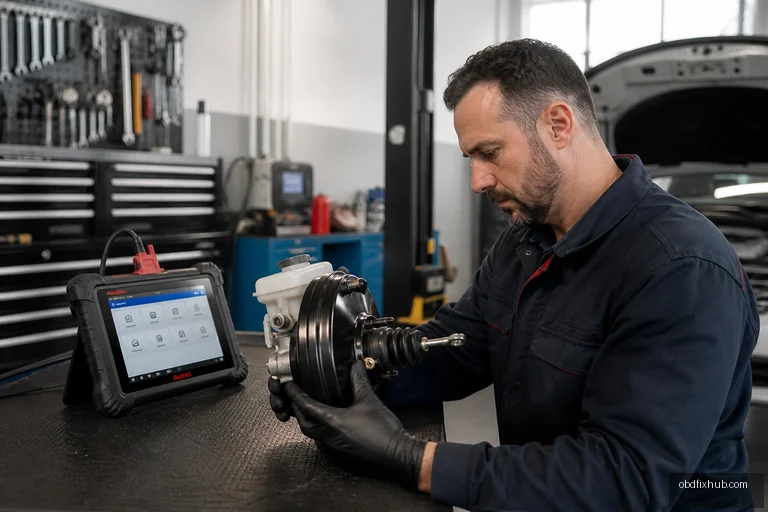
C0021 Brake Booster Performance means the vehicle’s brake control system has detected that the brake booster is not producing the expected assist or that its pressure/vacuum feedback does not match the command. The exact definition varies by manufacturer, but this is a safety-related fault: do not treat it like a minor check-engine-light code. A hard brake pedal, longer stopping distance, or an ABS/brake warning light means the vehicle should be inspected before normal driving.
What Does C0021 Brake Booster Performance Mean?
C0021 is usually stored by the ABS, electronic brake control, or stability-control module rather than the engine computer. The module compares brake pedal input with information from a booster pressure sensor, vacuum sensor, electric pump, or hydraulic pressure circuit. If the measured assistance is too low, too slow, unstable, or outside the expected range, it may set C0021 or a related subcode such as C0021-00.
There is no universal C0021 repair that applies to every vehicle. On a conventional vacuum-assisted system, the problem may be a leaking vacuum hose, failed check valve, low engine vacuum, or defective booster. On a newer vehicle with an electric brake booster, the likely causes can include a weak 12-volt battery, blown fuse, wiring fault, pressure sensor problem, electric motor failure, or a software/calibration issue.
Common Symptoms of a Failing Brake Booster
The most important clue is a change in pedal effort. A failed booster does not always remove braking completely, but it can make the driver need substantially more force to achieve the same braking effect.
- Hard or unusually firm brake pedal: The pedal feels difficult to push, especially during low-speed stops.
- Longer stopping distance: The vehicle may still stop, but it takes more pedal pressure and more road.
- Brake, ABS, ESC, or red warning lights: Multiple warning lamps can appear when the brake control module disables assisted functions.
- Hissing near the pedal or firewall: This commonly points to a vacuum leak, although some electric systems may make pump or motor noises instead.
- Engine idle changes when the brake is applied: A vacuum leak can allow unmetered air into the engine.
- Intermittent hard pedal after several stops: This can indicate a weak vacuum pump, restricted hose, leaking check valve, or low electrical voltage.
- Pedal pulsation or inconsistent assist: This may involve the electronic brake actuator or hydraulic control unit rather than the mechanical booster itself.
A soft pedal is not the classic symptom of a failed vacuum booster. A soft or sinking pedal more often suggests air in the hydraulic system, a fluid leak, a failing master cylinder, or a caliper problem. However, several faults can occur at once, so the pedal feel should be evaluated alongside fluid level, warning lights, and scan data.
Why C0021 Sets: The Most Likely Causes
Vacuum and mechanical causes
- Cracked, collapsed, disconnected, or oil-contaminated vacuum hose
- Faulty one-way check valve that cannot retain vacuum after the engine is switched off
- Low engine vacuum caused by an intake leak, camshaft timing issue, or engine fault
- Leaking vacuum brake booster diaphragm
- Defective vacuum pump on vehicles that use an auxiliary pump
Electrical and electronic causes
- Weak battery or low charging voltage
- Blown fuse, corroded connector, damaged wiring, or poor ground
- Incorrect brake booster pressure or position sensor signal
- Electric booster motor or hydraulic actuator failure
- ABS module software, calibration, or internal fault
One practical diagnostic clue is the timing of the fault. If C0021 appears after a dead battery, battery replacement, or jump-start, test system voltage and check for lost calibrations before condemning an expensive booster. If it returns immediately with a hard pedal, concentrate first on the booster supply, vacuum or electrical input, sensor data, and actuator operation.
How a Professional Diagnoses C0021
- Confirm the code in the correct module. A basic engine-code reader may not access the ABS or brake control module. Use a scan tool capable of reading chassis codes and manufacturer-specific subcodes.
- Record all related codes and freeze-frame data. Low-voltage, wheel-speed, pressure-sensor, and communication codes may explain why C0021 appeared.
- Inspect the brake fluid and hydraulic system. Fluid leaks, contaminated fluid, or a low reservoir must be addressed before testing electronic components.
- Test the vacuum system where applicable. A technician can measure vacuum at the booster, check whether it holds after shutdown, and test the check valve in both directions.
- Check electrical supply under load. Measuring battery voltage with the ignition off is not enough. The booster pump may expose a weak battery, high-resistance ground, or voltage drop that looks normal during a static test.
- Compare live data with commanded operation. The pressure sensor and booster response should change predictably as the brake pedal is applied. A sensor that stays fixed or jumps erratically should not be confused with a failed booster.
Do not replace the booster solely because the code name contains “brake booster.” On some vehicles, the actual repair is a vacuum check valve or wiring connector. On others, the booster and hydraulic control unit are integrated, making accurate module-level testing especially important.
How to Reset the Brake Booster or Clear C0021
There is normally no manual “brake booster reset” procedure that repairs the fault. First fix the underlying problem, then use a capable scan tool to clear C0021 from the ABS or brake control module. Some vehicles also require a brake pressure, pedal position, vacuum sensor, or booster calibration routine after component replacement.
Disconnecting the battery may erase temporary settings, but it usually does not solve a genuine booster fault and can create additional issues such as lost window settings or steering-angle calibration. After clearing the code, perform the manufacturer’s required initialization and a controlled road test in a safe area. If C0021 returns immediately, further diagnosis is required.
How Much Does It Cost to Fix a Brake Booster?
Repair prices depend heavily on the vehicle and booster design. Typical U.S. ranges are:
- Vacuum hose or check valve: approximately $50–$250 installed
- Vacuum pump: approximately $300–$900 installed
- Conventional brake booster: approximately $500–$1,200 installed
- Electric booster or integrated brake actuator: approximately $1,000–$3,000 or more
- Diagnosis and calibration: commonly $100–$250, depending on shop rates
Dealer pricing, labor access, required programming, and whether the master cylinder or ABS hydraulic unit is integrated can change the final bill. Ask the shop whether the estimate includes brake bleeding, calibration, software updates, and a post-repair scan.
Can You Still Drive With a Bad Brake Booster?
Driving is not recommended if the pedal is hard, stopping distance has increased, the red brake warning light is on, or the vehicle has lost brake assist. Even if the hydraulic brakes still function, emergency braking may require far more leg force than most drivers can apply quickly and consistently. Have the vehicle towed when pedal effort or braking performance has noticeably changed.
If the code is stored without any change in pedal feel, a shop may consider a short, cautious trip for diagnosis, but that decision depends on the vehicle and warning messages. Never test the vehicle in traffic after clearing the code simply to see whether the light returns.
Final Takeaway
C0021 Brake Booster Performance points to a mismatch between expected and actual brake assistance, not automatically to a failed booster. Start with the complete code scan, battery and charging tests, brake fluid inspection, and vacuum or actuator testing. Repair the verified cause, perform any required calibration, clear the code with a suitable scanner, and confirm normal pedal effort before returning the vehicle to regular service.
Frequently Asked Questions
What are the symptoms of a bad power brake booster?
The usual symptoms are a hard brake pedal, increased pedal effort, longer stopping distance, hissing from the booster area, engine idle changes when braking, and ABS or brake warning lights. A soft, sinking pedal usually points to a hydraulic issue instead.
How do I reset a brake booster?
You do not normally reset the mechanical booster itself. Repair the cause, then clear C0021 with an ABS-capable scan tool and complete the vehicle’s specified booster, pressure, or pedal calibration procedure if required.
How expensive is it to fix a brake booster?
A hose or check valve may cost $50–$250, while a conventional booster often costs $500–$1,200 installed. Electric or integrated brake actuators can exceed $3,000, especially when programming and hydraulic bleeding are required.
Can I still drive with a bad brake booster?
Do not drive normally with a hard pedal, longer stopping distance, or a red brake warning light. Brake assist may be reduced or unavailable, so towing the vehicle for diagnosis is the safest choice.




