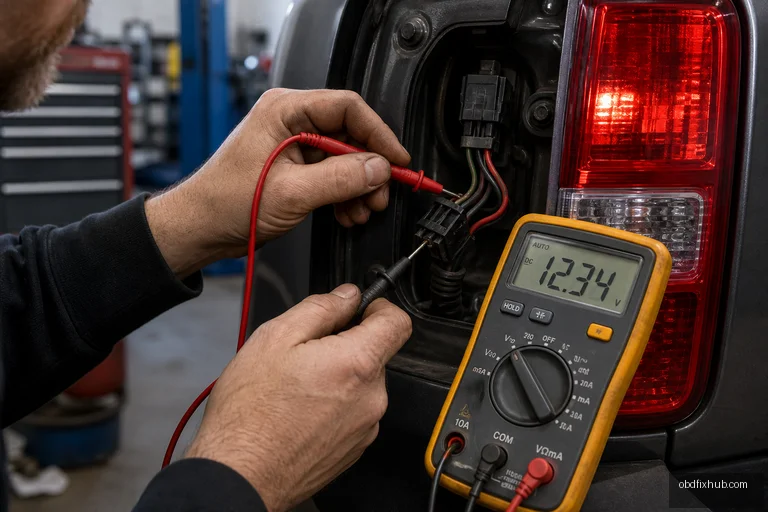
C0023 Stop Lamp Control generally means the vehicle has detected a fault in the brake-light control circuit. The problem may be a failed stop-lamp switch, blown fuse, damaged wiring, poor ground, incompatible LED bulbs, trailer wiring, or—less commonly—a body control or brake control module fault. Because C0023 is a chassis, manufacturer-specific code rather than a universal generic P-code, the exact definition and test procedure must be confirmed for your make, model, year, and scan-tool data.
This is not a code to ignore. Brake lights that stay on, fail to illuminate, or work intermittently can make the vehicle difficult for following drivers to judge. Start by checking the actual brake-light operation, then test the circuit logically instead of replacing the switch or module on guesswork.
What Does C0023 Stop Lamp Control Mean?
C0023 identifies an abnormal condition in the circuit that commands or monitors the stop lamps. On some vehicles, the code is stored by the ABS or brake control module; on others, it may be associated with the body control module or a dedicated lighting controller. The module may be detecting an open circuit, short to ground, short to voltage, implausible switch signals, or a disagreement between the brake-pedal input and the lamp output.
Modern vehicles often use two brake-switch signals. One signal tells the engine or transmission controller that the brake pedal is pressed, while another controls the rear lamps or confirms that the lamps responded. This explains why cruise control may be disabled or a transmission may behave normally even when one brake-light circuit is faulty.
Common Symptoms of C0023
- One or more brake lights do not illuminate.
- Brake lights remain on after the pedal is released.
- Brake lights work only when the pedal is pressed hard or moved sideways.
- ABS, traction control, brake, or check-engine warning lamps appear.
- Cruise control stops operating.
- The gear selector will not leave Park on vehicles that use the stop-lamp signal for shift interlock.
- A trailer’s brake lights operate incorrectly after a wiring or lighting modification.
- A battery becomes weak because the stop lamps remain illuminated overnight.
A useful first observation is whether all rear brake lights are affected. If every brake lamp is dead, inspect the fuse, pedal switch, power supply, and ground first. If only one side is out, a bulb, socket, local ground, or rear harness is more likely than the control module.
Most Likely Causes of C0023
1. Defective brake-pedal switch
The stop-lamp switch is mounted near the upper brake-pedal arm. Its contacts can wear, stick, or lose their adjustment. A switch that has been disturbed during a pedal, carpet, or dashboard repair may be installed too far from the pedal, causing the lamps to stay on or fail to switch reliably.
2. Blown fuse or poor power supply
A shorted bulb, trailer adapter, aftermarket alarm, or crushed wire can blow the stop-lamp fuse. Do not replace the fuse with a larger rating. If the replacement fails immediately, the circuit has a short that must be located before further testing.
3. Damaged wiring, terminals, or ground
Brake-light wiring commonly suffers where the harness passes through the trunk lid, tailgate, rear body, or trailer connector. Corrosion inside a bulb socket can create enough resistance to reduce lamp brightness and trigger a monitoring fault. A visual inspection should include loose terminals, green corrosion, melted plastic, and previous crimp repairs.
4. Incorrect LED bulbs or modifications
LED replacements draw far less current than original incandescent bulbs. Some monitoring systems interpret that lower load as an open circuit, particularly when the vehicle was not designed for LED lamps. Poorly installed load resistors can also overheat wiring; a vehicle-specific LED-compatible solution is safer than adding a resistor without calculating its heat load.
5. Trailer or accessory wiring
A trailer harness is a frequent source of repeat C0023 faults. Water entering a seven-pin connector, an incorrectly spliced converter, or a trailer with a shorted lamp can affect the vehicle’s stop-lamp circuit. Disconnect the trailer wiring temporarily and clear the code before condemning the vehicle-side controller.
6. Control module or communication fault
A body control module, ABS module, or network communication problem is possible, but it should be considered after the basic circuit passes testing. Replacing a module without confirming power, grounds, input signals, and output control is an expensive and often unsuccessful repair.
How to Diagnose C0023 Stop Lamp Control
- Confirm the complaint. With the ignition in the appropriate position, press and release the brake pedal while another person observes the lamps. Check the center high-mounted stop lamp separately from the left and right lamps.
- Read all stored codes. Use a scan tool that can access ABS and body modules, not only the basic engine computer. Record current, pending, and history codes before clearing anything.
- Check the fuse and bulbs. Use the vehicle’s fuse diagram and verify the correct bulb type. Inspect both contacts in each socket; replacing a bulb will not fix a socket that has lost its ground.
- Inspect the brake switch. Look for a loose mounting bracket, damaged connector, or a pedal that does not return fully. On a scan tool, compare the brake-switch data states while slowly pressing the pedal. The state should change cleanly, without flickering.
- Test voltage and ground. A multimeter or test light can confirm whether power reaches the switch and whether the output leaves the switch when the pedal is pressed. A voltage-drop test under load is more useful than measuring resistance alone, especially on corroded grounds.
- Inspect the rear harness and trailer connector. Flex the harness near hinges and entry points while monitoring the lamps. If the fault changes when the harness moves, the wiring—not the module—is the likely cause.
- Clear the code and perform a road test. After the repair, confirm normal lamp operation, verify that the code does not return, and check cruise control, shift interlock, ABS, and traction-control functions.
Practical Testing Tips That Prevent Misdiagnosis
Do not rely on a visual bulb check alone. A filament can break intermittently, and a socket may pass a no-load voltage check but fail when current flows. Testing the circuit with the lamps connected, or using a suitable load during voltage-drop testing, reveals faults that a simple continuity test can miss.
Also compare the two brake-switch signals in live data when available. If one changes and the other does not, the switch or its wiring is suspect. If both inputs change correctly but the module reports no lamp output, focus on the output circuit, rear harness, fuse supply, or module driver.
How to Fix C0023
The correct repair depends on the failed point. Common fixes include replacing and adjusting the brake-pedal switch, installing the correct bulbs, repairing a corroded socket, restoring a ground connection, replacing a damaged section of harness, or repairing an incorrectly wired trailer adapter. Aftermarket LED bulbs should be replaced with vehicle-compatible units if they are causing a bulb-monitoring fault.
If wiring and switch tests are correct, follow the manufacturer’s service information for module output testing and software updates. Some vehicles require a brake-switch relearn, calibration, or module initialization after replacement. This procedure is model-specific; clearing the code alone does not complete the repair.
Can You Drive With C0023?
Only drive the vehicle as necessary for diagnosis if the brake lights are not working, stay on, or operate unpredictably. A failed stop-lamp circuit is a safety issue and may also prevent the transmission from shifting out of Park. If the lamps remain on, disconnecting the battery temporarily may prevent battery drain, but it is not a substitute for repairing the circuit—and it can erase useful diagnostic data.
Summary
C0023 Stop Lamp Control points to a fault in the vehicle’s brake-light control or monitoring circuit, not automatically to a failed control module. Verify the exact manufacturer definition, inspect the fuse, bulbs, switch, wiring, grounds, and trailer connections, then confirm the repair with live data and a complete road test. Because the brake-light system is safety-critical, repair intermittent faults promptly rather than waiting for the code to become permanent.
Frequently Asked Questions
Is C0023 a generic OBD-II code?
No. C0023 is a chassis code whose meaning can vary by manufacturer. The phrase commonly relates to stop-lamp control, but the exact circuit and module involved must be checked in vehicle-specific service information.
Can a bad brake-light bulb cause C0023?
Yes, particularly on vehicles that monitor lamp current. A failed bulb, incorrect wattage, LED conversion, corroded socket, or poor ground can all make the module interpret the stop-lamp circuit as open or abnormal.
Why are my brake lights working if C0023 is stored?
The fault may be intermittent, affecting only one of two switch signals or occurring during a brief voltage drop. A scan tool’s history data and live brake-switch states can reveal a problem that is not present during a quick visual inspection.
Should I replace the brake switch first?
Only if testing supports it. The switch is a common and relatively inexpensive cause, but replacing it without checking the fuse, connector adjustment, wiring, and live data can leave the real fault untouched.




