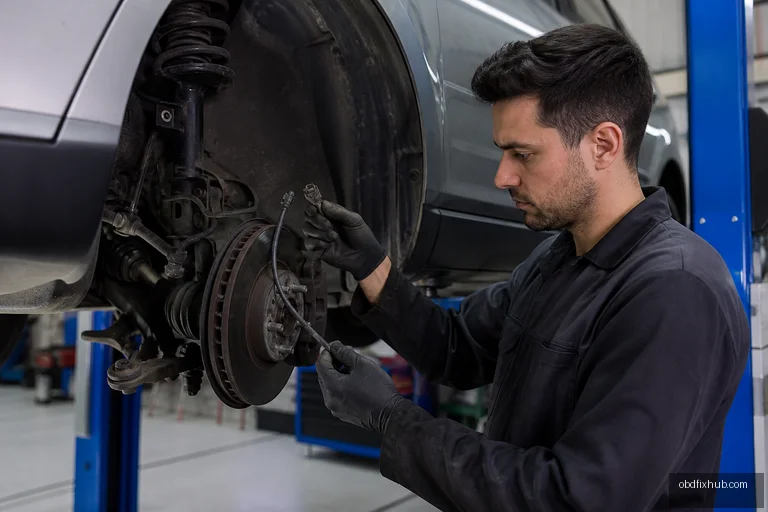
C0031 left front wheel speed sensor is a chassis fault code that usually indicates a problem with the left-front wheel speed sensor circuit. The sensor itself may be damaged, but the real cause can also be a broken wire, corroded connector, damaged tone ring, wheel bearing play, or an ABS control module issue. Because this sensor supplies wheel-speed data to the ABS, traction control, and stability control systems, accurate testing is more reliable than replacing the sensor immediately.
What Does C0031 Mean?
C0031 generally translates as Left Front Wheel Speed Sensor Circuit Malfunction. The ABS module monitors the signal from the sensor and compares it with the speeds reported by the other three wheels. If the left-front signal is missing, erratic, or implausible, the module stores C0031.
The exact wording and subcode can vary by vehicle manufacturer. Some vehicles display additional information such as an open circuit, short to ground, short to voltage, or an intermittent signal. Always verify the definition in the service information for the specific year, make, model, and ABS system before testing.
C0031 Left Front Wheel Speed Sensor Symptoms
The most obvious symptom is an ABS warning light, but C0031 often affects more than the anti-lock braking system. Depending on the vehicle, the traction control and electronic stability control warnings may illuminate at the same time.
- ABS, traction control, or stability control warning lights
- ABS intervention at low speed or on dry pavement
- Loss of traction control or stability control assistance
- Speedometer problems on vehicles that use wheel-speed data for vehicle speed
- Hill-start assist, adaptive cruise control, or automatic braking being disabled
- A stored code that returns immediately after clearing
A particularly useful clue is low-speed ABS activation. If the pedal pulses during the final few feet of a normal stop, the sensor may be reporting an artificially low wheel speed. This commonly occurs when a rust-damaged tone ring or a weak sensor signal creates a dropout below approximately 10 mph, although the exact threshold depends on the vehicle.
Common Causes of Code C0031
1. Failed or contaminated wheel speed sensor
The sensor can fail internally from moisture intrusion, impact, heat, or age. On some vehicles, metallic debris sticks to the magnetic tip and distorts the signal. A sensor that looks clean externally can still have an internal open circuit or an intermittent fault when the harness is moved.
2. Damaged wiring near the steering knuckle
The left-front harness flexes every time the steering turns and moves with suspension travel. It may rub against the tire, strut, control arm, or axle, then break internally while the insulation remains mostly intact. Pay special attention to the section between the sensor and the first retaining clip; this is a frequent failure point after suspension or brake work.
3. Corroded or loose connector
Water and road salt can enter the connector near the wheel well. Green corrosion, pushed-back terminals, poor pin tension, or a connector that is not fully latched can interrupt the signal. A visual inspection should include both sides of the connector, not just the outside shell.
4. Damaged tone ring or magnetic encoder
The sensor reads a tone ring, reluctor ring, or magnetic encoder built into the hub or wheel bearing. A cracked, rust-swollen, missing, or contaminated ring can produce a false sensor diagnosis. On many modern vehicles, the encoder is integrated into the wheel bearing, so replacing only the sensor will not solve the problem.
5. Wheel bearing movement
Excessive bearing play changes the air gap between the sensor and encoder. The result may be an intermittent C0031, a humming noise, or a live-data signal that drops out when the wheel is rocked. Do not overlook the bearing simply because there is no obvious grinding sound.
6. ABS module or power supply fault
Less commonly, the problem is a poor ABS module ground, low system voltage, damaged module connector, or an internal module failure. These possibilities should be considered only after the sensor, wiring, encoder, and power supplies have been tested.
How to Diagnose C0031 Correctly
A professional diagnosis starts with the ABS module, not just a basic engine-code scanner. Many inexpensive OBD readers cannot access chassis codes or display individual wheel-speed data.
- Confirm the code and scan all modules. Record every ABS, traction-control, steering, and network code before clearing anything. A communication or low-voltage code may be the primary fault.
- Check the live wheel-speed data. Drive slowly in a safe area or raise the vehicle using approved support equipment. Compare all four wheel-speed readings. The faulty corner may show zero, sudden dropouts, or a different speed from the others.
- Inspect the left-front sensor and harness. Look for stretched wires, tire contact, missing clips, water intrusion, damaged insulation, and a sensor that is not fully seated.
- Test the circuit according to sensor type. Passive two-wire sensors can often be checked for resistance and an AC voltage signal while the wheel turns. Active Hall-effect or magnetoresistive sensors require the correct power, ground, and signal tests; a resistance check alone may falsely condemn a good sensor.
- Inspect the encoder and bearing. Remove rust or debris where appropriate, check for a cracked reluctor ring, and measure bearing play. If the encoder is built into the hub, confirm its orientation before installation.
- Clear the code and perform a road test. After the repair, confirm that all four wheel-speed signals remain stable during acceleration, steady cruising, and braking. A code that does not return while parked may still reappear when the harness flexes on the road.
One practical diagnostic trick is a gentle wiggle test while watching live data. With the vehicle safely stationary and the scan tool connected, move the harness through its normal steering range. If the signal changes, the wiring or connector is more likely than the sensor element itself.
How to Fix C0031
The correct repair depends on the failed component. Replace the sensor if its signal, power, or internal circuit fails testing. Repair damaged wiring with sealed automotive-grade splices or replace the harness section; twisting wires together and covering them with ordinary electrical tape is not a durable wheel-well repair.
Clean lightly contaminated connectors with suitable electrical contact cleaner, but replace terminals that are loose or heavily corroded. If the tone ring is cracked or the magnetic encoder is damaged, replace the appropriate reluctor, hub, or wheel bearing assembly. Follow the manufacturer’s torque specifications, sensor routing instructions, and any required ABS calibration or steering-angle relearn procedure.
After installation, make sure the harness is clipped away from the tire, axle, and brake rotor. A correctly installed sensor can fail again within days if the cable is allowed to contact a rotating component.
Can You Drive With C0031?
The vehicle will usually still brake mechanically, but the ABS and stability systems may be disabled. That means the wheels can lock during hard braking, particularly on wet, icy, or loose surfaces. Drive only as far as necessary for diagnosis or repair, reduce speed, and treat an illuminated red brake warning light or abnormal brake pedal as a reason to stop driving and arrange professional assistance.
Repair Cost and Replacement Advice
Costs vary widely by vehicle. A simple wiring repair may be inexpensive, while a sealed hub assembly, difficult-to-remove sensor, or ABS module can cost substantially more. Before buying a replacement, identify whether the vehicle uses a separate sensor or a hub-integrated encoder and confirm the connector, sensor type, and mounting design.
Do not replace an ABS module solely because C0031 is stored. In real-world diagnosis, a damaged harness or corroded connector is considerably more common than a failed control module. Testing the circuit first prevents an expensive parts-swapping mistake.
Summary
C0031 points to a fault involving the left-front wheel speed signal, but it does not automatically prove that the sensor is bad. Check live data, inspect the harness and connector, test the correct sensor type, and examine the tone ring and wheel bearing before selecting a repair. Once the fault is corrected, clear the code and verify stable wheel-speed readings during a road test.
Frequently Asked Questions
Is C0031 always caused by a bad wheel speed sensor?
No. Wiring damage, connector corrosion, a damaged tone ring, a faulty wheel bearing, low voltage, and—in fewer cases—an ABS module problem can all trigger the code.
Can a bad wheel bearing cause C0031?
Yes. Bearing play can change the sensor air gap, while a damaged magnetic encoder inside the bearing can interrupt the wheel-speed signal. Check bearing condition before replacing a sensor blindly.
Will clearing C0031 fix the ABS warning light?
Clearing the code only removes the stored record temporarily. If the underlying fault remains, the ABS module will usually detect it again during the next drive cycle or immediately during its self-test.
Can I test the sensor with a multimeter?
Sometimes. Resistance and AC-output tests can help with passive sensors, but active sensors require voltage, ground, and signal testing. Use the vehicle’s wiring diagram and specifications because a generic resistance test may give a misleading result.
Does C0031 affect normal braking?
Normal hydraulic braking may remain available, but ABS, traction control, and stability control may be disabled. Avoid hard or emergency driving until the fault is diagnosed and repaired.




