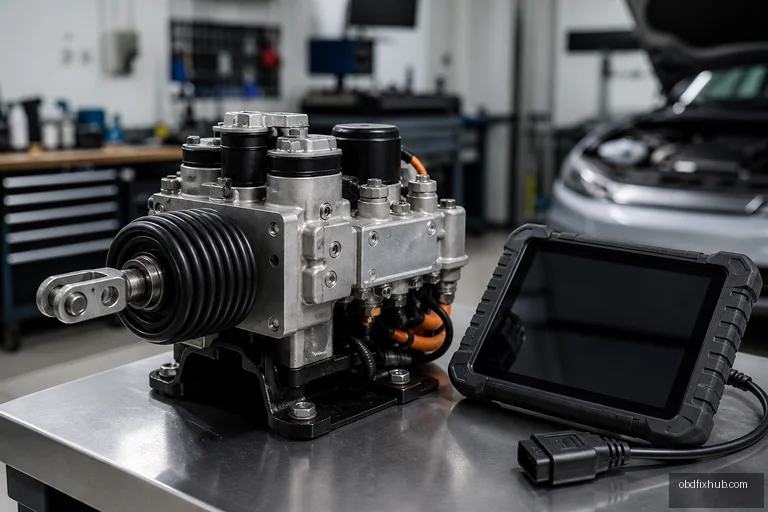
C05AB Brake Blending Separation Valve Performance: Meaning, Causes, Symptoms & Fix
C05AB brake blending separation valve performance indicates that the brake control module has detected a problem with the valve or system that manages the transition between regenerative braking and conventional hydraulic friction braking. It does not automatically prove that the valve itself is defective. Low 12-volt voltage, wiring faults, air in the hydraulic circuit, software issues, or a mismatch between commanded and actual brake pressure can all trigger this code.
What Does C05AB Mean?
C05AB is a chassis-related diagnostic trouble code associated with brake blending. The exact wording and test strategy vary by manufacturer, so the vehicle’s factory service information is more reliable than a generic code database. On hybrid and electric vehicles, the brake controller must coordinate motor regeneration with hydraulic braking to deliver consistent deceleration.
The separation valve is part of that control strategy. Depending on the design, it may help isolate, connect, or modulate hydraulic brake circuits when the system changes from regenerative braking to friction braking. The control module compares the valve’s requested position or pressure response with feedback from sensors. If the response is outside the permitted range, C05AB may be stored.
Why Brake Blending Matters
During light braking, an electrified vehicle may use the traction motor as a generator. This recovers energy and reduces friction-brake wear. When the battery is full, the vehicle is cold, traction is limited, or the driver demands more stopping force, the hydraulic brakes must take over smoothly.
A properly operating separation valve helps prevent an abrupt change in pedal feel or deceleration. A fault can therefore affect more than regenerative efficiency; it may compromise the smooth and predictable operation of the service brake system.
Common Causes of C05AB
- Low or unstable 12-volt supply: Weak auxiliary batteries and poor battery connections can cause valve actuators and brake modules to behave incorrectly, especially during startup.
- Wiring or connector damage: Corrosion, water intrusion, pushed-out terminals, rodent damage, or a broken wire near the valve can interrupt power or feedback signals.
- Contaminated or incorrect brake fluid: Moisture, debris, wrong fluid, or overdue fluid service may restrict valve movement or affect hydraulic pressure response.
- Air in the brake system: Air introduced during brake work can create a pressure response that does not match the controller’s expectations.
- Valve or actuator failure: An internal mechanical restriction, electrical coil fault, or failed position sensor can prevent the valve from reaching its commanded state.
- Hydraulic leaks or pressure faults: A leaking line, master-cylinder problem, accumulator issue, or abnormal pressure sensor reading can be interpreted as a valve performance problem.
- Software or calibration concerns: Some vehicles require a brake-control-module update, initialization, or valve relearn after hydraulic repairs or module replacement.
Symptoms You May Notice
The symptoms depend on whether the fault is intermittent or permanent and on how the manufacturer’s fail-safe strategy operates. Common signs include a brake warning light, ABS or traction-control warning, hybrid-system warning, or a message such as Brake System Fault.
- Reduced or disabled regenerative braking
- A harder, softer, or unusually long brake pedal
- Unexpected transition between regenerative and friction braking
- Longer stopping distance or reduced braking assistance
- ABS, stability control, or adaptive cruise control being unavailable
- Additional communication, voltage, pressure, or wheel-speed codes
An important practical clue is a change that appears only after the vehicle warms up or after several brake applications. That pattern can point toward an actuator sticking under temperature change rather than a simple open circuit.
How to Diagnose C05AB Correctly
Do not begin by replacing the separation valve. A competent diagnosis should identify whether the module is seeing an electrical, hydraulic, mechanical, or software-related performance problem.
- Record all codes and freeze-frame data. Scan every relevant module, not just the engine computer. Note battery voltage, vehicle speed, brake pressure, temperature, and whether the code is current or history.
- Check the 12-volt system first. Test the battery under load, inspect the terminals, and confirm charging voltage. A low-voltage event can create several misleading chassis codes.
- Inspect the valve and harness. Look for fluid contamination, damaged insulation, loose terminals, poor grounds, and connector corrosion. A visual inspection should include the harness routing near hot or moving components.
- Verify brake-fluid condition and hydraulic integrity. Check the fluid level, leaks, service history, and evidence of air. Follow the manufacturer’s specified bleeding procedure; many hybrid systems require a scan-tool-controlled bleed routine.
- Use bidirectional controls. With a suitable scan tool, command the separation valve through its available positions and compare commanded values with feedback, pressure change, and actuator current.
- Perform required initialization or relearn. If the valve, brake actuator, 12-volt battery, or control module has been replaced, the system may need calibration, zero-point learning, or a brake-pressure test.
- Confirm the repair. Clear the code only after correcting the root cause. Carry out the specified road test and verify that regenerative braking, hydraulic braking, warning lamps, and live-data values operate normally.
C05AB Brake Blending Separation Valve Performance: Repair Options
The repair depends on the test results. A corroded terminal may require terminal repair and connector sealing, while a weak 12-volt battery should be replaced and properly registered if the vehicle requires battery monitoring initialization. If air or contaminated fluid is responsible, use the correct fluid and the manufacturer’s complete bleed procedure.
A failed valve or integrated brake actuator may not be serviceable as an individual component. Some vehicles use a separate valve; others integrate it into a brake booster, electro-hydraulic actuator, or brake control assembly. After replacement, calibration and pressure verification are often mandatory. Installing a part without completing these procedures can leave the code active or create an unsafe brake-balance problem.
Is It Safe to Drive With C05AB?
Treat this code as a potential brake-system fault, not as an emissions-related warning. If the pedal feels soft, the vehicle pulls while braking, the stopping distance has increased, multiple brake warnings are illuminated, or the red brake warning lamp remains on, stop driving and arrange professional inspection or towing.
If the vehicle brakes normally and only a stored history code is present, a short trip to a qualified repair facility may be reasonable, but the vehicle should still be diagnosed promptly. Regenerative braking may be unavailable even when the friction brakes appear to work normally.
Practical Diagnostic Tip
Compare the moment the code was set with recent work. C05AB appearing immediately after a 12-volt battery replacement, brake-fluid service, actuator replacement, or collision repair strongly suggests a missed initialization, incomplete bleeding procedure, connector issue, or disturbed harness. That timing is often more valuable than replacing expensive brake hardware based on the code description alone.
Key Takeaway
C05AB means the brake blending separation function did not perform as expected; it is not a guaranteed valve replacement diagnosis. Start with the 12-volt supply, wiring, fluid, air, hydraulic pressure, and related codes, then use bidirectional testing and the manufacturer’s calibration procedure. Because brake blending affects stopping behavior, have the system inspected by a technician familiar with hybrid or electric vehicle brake controls.
Frequently Asked Questions
Can a weak 12-volt battery cause C05AB?
Yes. Low voltage during startup or brake-actuator operation can cause an incorrect valve position, communication failure, or invalid pressure reading. Test the battery and charging system before condemning the valve.
Does C05AB always mean the separation valve must be replaced?
No. The code describes a performance failure, not a confirmed failed component. Wiring faults, air in the hydraulic system, low voltage, pressure-sensor errors, software, and calibration problems can produce the same result.
Can I clear C05AB with a basic OBD scanner?
A basic scanner may erase the code but usually cannot run valve tests, brake bleeding routines, or calibration. If the underlying fault remains, the code will return and important brake functions may stay disabled.
Will C05AB disable regenerative braking?
Many vehicles reduce or disable regenerative braking as a safety measure when the blending system is unreliable. The friction brakes may remain available, but pedal feel and energy recovery can change significantly.
What should I do if the brake pedal feels different?
Stop using the vehicle until it has been checked if the pedal is soft, sinks, feels unusually hard, or produces inconsistent braking. A changed pedal feel is more urgent than the code alone and may indicate a hydraulic or brake-assistance fault.




