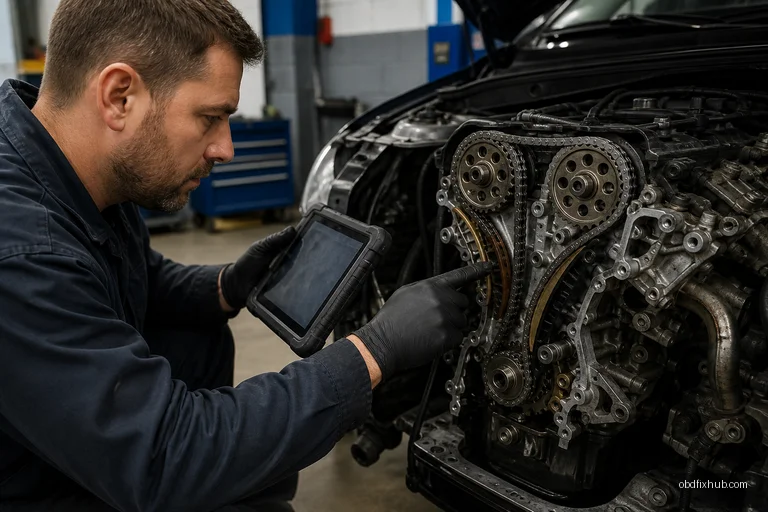
Search intent: informational. The P0016 code means the engine computer has detected that the crankshaft position and Bank 1 camshaft position are not synchronized as expected. In most vehicles, Sensor A refers to the intake camshaft position sensor on Bank 1, but the exact designation depends on the manufacturer. The fault may be caused by a stretched timing chain, incorrect valve timing, a faulty sensor, wiring trouble, low oil pressure, or a variable valve timing problem.
P0016 should not be treated as a simple sensor-replacement code. A new sensor will not correct a mechanically mistimed engine, and continuing to drive with a jumped or badly stretched timing chain can lead to severe internal engine damage.
What Does the P0016 Code Mean?
The engine control module compares the crankshaft position signal with the camshaft position signal to determine whether valve timing is occurring at the correct moment. The crankshaft controls piston position, while the camshaft controls the opening and closing of the valves. Their relationship must remain within a tightly controlled range.
When the control module sees a greater-than-expected difference between these signals, it stores Diagnostic Trouble Code P0016. The phrase Bank 1 identifies the side of the engine containing cylinder 1. On an inline four-cylinder engine there is only one bank, while on a V6 or V8, Bank 1 is vehicle-specific and should be confirmed in the service information.
Common Causes of P0016
- Timing chain stretch: Chain wear changes camshaft timing, especially during cold starts or acceleration.
- Jumped timing chain or belt: A failed tensioner, weak guide, or damaged belt tooth can move valve timing by one or more teeth.
- Faulty camshaft or crankshaft position sensor: Internal sensor failure can create an inaccurate or intermittent signal.
- Damaged wiring or connectors: Oil contamination, corrosion, loose terminals, or wiring rubbed against the engine can distort the signal.
- Variable valve timing malfunction: A sticking oil control valve, blocked oil passage, failed cam phaser, or incorrect oil level can prevent the camshaft from reaching its commanded position.
- Incorrect engine oil: Dirty, sludged, or incorrect-viscosity oil can interfere with hydraulic VVT operation.
- Reluctor or trigger-wheel damage: A damaged or displaced tone wheel can produce a plausible-looking but incorrect position signal.
- Previous repair error: Incorrect timing marks, an improperly installed sensor, or a replaced engine component may leave the engine mechanically out of phase.
P0016 Symptoms to Watch For
Some vehicles illuminate the check engine light without noticeable drivability problems. Others show clear timing or VVT symptoms, particularly when the fault is mechanical rather than electrical.
- Hard starting or extended cranking
- Rough idle, hesitation, or reduced acceleration
- Engine misfires or stalling
- Rattling from the timing-chain area, often during a cold start
- Reduced fuel economy
- Limited power or limp-home mode
- Additional camshaft, crankshaft, VVT, or misfire codes
A brief rattle at startup is particularly important. It can indicate that a chain tensioner is losing oil pressure overnight, allowing excessive chain slack before the engine builds pressure. If P0016 appears together with P0008, P0009, P0017, P0018, or cylinder misfire codes, mechanical timing should be investigated before replacing electrical parts.
How to Diagnose the P0016 Code Correctly
1. Check all stored and pending codes
Use a capable scan tool to record freeze-frame data, engine speed, coolant temperature, oil temperature, and battery voltage when the code was set. Do not clear the code before documenting this information. A fault that appears only during a cold start points toward different causes than one that occurs after the engine reaches operating temperature.
2. Inspect oil level and condition
Verify the oil level on a level surface and check for sludge, fuel dilution, or an obviously incorrect viscosity. If the service history is unknown and the oil is badly contaminated, an oil and filter service may be necessary, but it should not be used as a substitute for timing diagnosis. Inspect the removed oil filter for metallic debris if chain wear is suspected.
3. Inspect the sensors and wiring
Examine the Bank 1 Sensor A connector for oil intrusion, bent terminals, broken locks, and corrosion. Follow the harness by hand and look for stretched, melted, or chafed sections near the cylinder head and timing cover. Compare sensor power, ground, and signal circuits with the manufacturer’s wiring diagram rather than relying only on generic online pinouts.
4. Compare live data and commanded timing
Many professional scan tools display desired and actual camshaft position. If the actual cam angle is consistently offset, suspect mechanical timing, a cam phaser, or an oil-control problem. If the reading drops out or changes erratically, an electrical fault or failing sensor becomes more likely.
5. Confirm the signal with an oscilloscope
An oscilloscope can display the crankshaft and camshaft waveforms at the same time. This is often the fastest way to distinguish a weak sensor signal from a genuine correlation error. A stable but shifted waveform usually suggests mechanical timing, while a noisy, missing, or distorted waveform points toward a sensor, reluctor, wiring, or power-supply issue.
6. Verify mechanical timing
If electrical checks pass, remove the necessary covers and lock the engine at the specified reference position. Confirm that the crankshaft and camshaft timing marks align exactly and inspect chain slack, guides, tensioner travel, sprocket condition, and cam phaser operation. Do not rotate an interference engine with the timing components removed unless the service procedure specifically permits it.
How to Fix P0016
The correct repair depends on the test results. Possible repairs include replacing a damaged camshaft or crankshaft sensor, repairing wiring, cleaning or replacing an oil control valve, correcting the oil level, replacing a stretched timing chain kit, or repairing a failed cam phaser. If the chain has jumped, the valves and pistons may also require a compression or leak-down test before the repair is considered complete.
When replacing a timing chain, fitting only the chain is often false economy. A complete repair may require the chain, guides, tensioner, sprockets, seals, and related fasteners. Follow the exact torque sequence and use the manufacturer’s timing-locking tools where specified. After assembly, rotate the engine by hand through the required number of revolutions and recheck the timing marks before starting it.
Can You Drive With P0016?
Short, gentle driving may be possible if the engine runs smoothly and the check engine light is steady, but it is not risk-free. Avoid driving if the engine rattles, misfires, stalls, has very low power, or the check engine light is flashing. A timing failure can turn a relatively contained repair into bent valves, damaged pistons, or a replacement engine.
How Much Does P0016 Repair Cost?
Costs vary widely by vehicle and cause. A wiring repair or oil control valve may be relatively inexpensive, while a timing-chain or cam-phaser repair can require many hours of labor. The diagnostic process matters: paying for proper waveform and timing checks is usually cheaper than replacing multiple sensors without finding the underlying fault.
Final Takeaway
P0016 is a camshaft-to-crankshaft synchronization fault, not proof that one particular sensor has failed. Start with oil level, stored codes, wiring, live cam data, and signal testing, then verify mechanical timing if the evidence points in that direction. If there is chain noise, hard starting, or misfiring, arrange diagnosis promptly and avoid unnecessary driving.
Frequently Asked Questions
Is P0016 always caused by a bad camshaft sensor?
No. A faulty sensor is only one possibility. Timing-chain stretch, a jumped chain, VVT oil-pressure problems, wiring faults, and damaged reluctor components are also common causes.
Can an oil change fix P0016?
It can help when low oil, incorrect viscosity, or sludge is preventing the VVT system from operating correctly. However, an oil change will not repair a stretched chain, damaged phaser, failed sensor, or incorrect mechanical timing.
What is Bank 1 Sensor A?
Bank 1 is the engine side containing cylinder 1. Sensor A usually identifies the intake camshaft position sensor, but the exact location and naming convention should be confirmed using the vehicle’s service information.
Can P0016 cause engine damage?
Yes. If the code is caused by a jumped or severely stretched timing chain, valve-to-piston contact may occur, particularly on interference engines. Rattling, misfires, and hard starting require prompt attention.
Should I replace both camshaft and crankshaft sensors?
Not automatically. Test the power, ground, signal, wiring, and waveform first. Replacing both sensors without confirming the fault can waste money when the real problem is mechanical timing or VVT operation.




