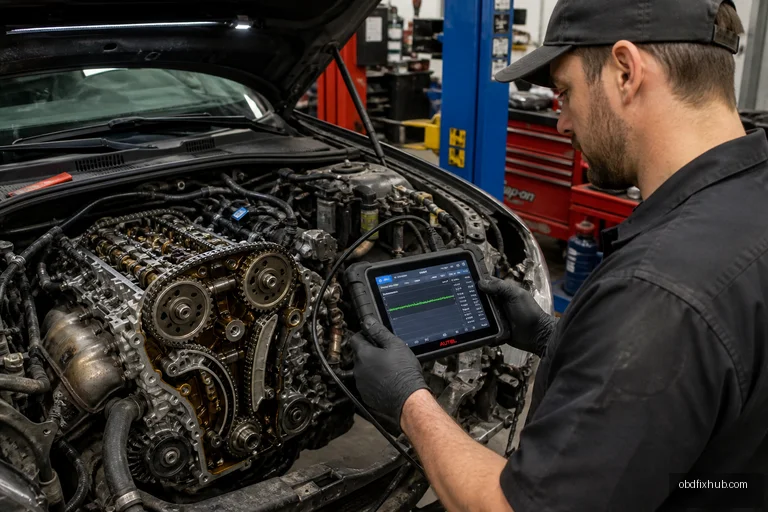
P0008 Engine Position System Performance Bank 1 means the engine control module has detected an incorrect relationship between the crankshaft and camshaft positions on Bank 1. In practice, the fault is often related to stretched timing chains, a failed variable valve timing system, poor oil control, or a cam/crank sensor signal problem—not necessarily a bad sensor. Because incorrect valve timing can lead to poor running or internal engine damage on some engines, P0008 should be diagnosed rather than simply cleared.
What Does P0008 Mean?
The P0008 diagnostic trouble code is a generic OBD-II code describing an engine position system performance problem on Bank 1. Bank 1 is the side of the engine containing cylinder number one. On an inline-four or inline-six engine, there is normally only one bank, so the bank designation can be less confusing. On V6 and V8 engines, Bank 1 must be identified using the vehicle’s service information because its location varies by engine design.
The engine computer compares crankshaft position with the position of one or more camshafts. It expects the relationship to remain within a calibrated range. If the camshaft appears retarded, advanced, or unstable compared with the crankshaft, the ECM may store P0008 and illuminate the check engine light.
Common Symptoms of P0008
Some vehicles will still drive reasonably well when P0008 first appears, while others develop hard starting and severe power loss. The symptoms depend on how far the valve timing has moved and whether the problem is mechanical or electrical.
- Check engine light or malfunction indicator lamp
- Extended cranking or difficult starting
- Rough idle, misfires, or engine hesitation
- Reduced acceleration and poor fuel economy
- Rattling from the timing chain area, especially during cold starts
- Engine stalling or intermittent no-start conditions
- Additional cam/crank correlation codes such as P0016, P0017, P0018, or P0019
A brief rattle at startup is particularly important. It may indicate a worn chain tensioner or a variable valve timing actuator that is not holding oil pressure overnight. Continuing to drive for months with that symptom can allow the chain to jump timing.
Most Likely Causes of P0008
1. Stretched timing chain or worn guides
Chain stretch is one of the most common mechanical causes. The chain does not usually stretch like a rubber belt; instead, wear develops at the pins, rollers, guides, and tensioner. The accumulated slack changes cam timing enough for the ECM to recognize a performance error.
2. Low, dirty, or incorrect engine oil
Many modern engines use oil pressure to control camshaft phasers. Low oil level, sludge, a restricted pickup, the wrong viscosity, or a collapsed oil filter can prevent the cam phaser from reaching its commanded position. Always verify oil level and condition before replacing timing components.
3. Faulty variable valve timing components
A sticking VVT oil control valve, damaged camshaft actuator, weak actuator spring, or blocked oil passage can create the same cam timing error as a worn chain. The fault may be intermittent and often becomes worse when the engine is hot.
4. Camshaft or crankshaft position sensor problems
A failing sensor, damaged reluctor wheel, excessive sensor air gap, or metal debris on the sensor tip can distort the position signal. However, a sensor should not be condemned just because P0008 is present. A good sensor signal cannot correct mechanically incorrect timing, and replacing sensors first is a common way to spend money without solving the fault.
5. Wiring, connectors, or control-module issues
Oil contamination in a connector, chafed wiring near the timing cover, poor engine grounds, or an intermittent power supply can interrupt the cam or crank signal. These faults often set several unrelated codes or appear after engine work, water intrusion, or a recent timing repair.
How to Diagnose P0008 Correctly
A professional diagnosis starts with evidence, not parts replacement. The exact test values vary by engine, but the following sequence is effective on most vehicles.
- Scan all modules and record freeze-frame data. Note engine speed, coolant temperature, oil pressure data if available, and whether the code appeared during startup, idle, or acceleration.
- Check for related codes. Cam actuator, oil pressure, misfire, and cam/crank correlation codes can identify the affected circuit or bank.
- Inspect the oil. Confirm the level, correct specification, service history, and signs of sludge or metallic debris. If the oil filter contains plastic or metal fragments, suspect guide or chain wear.
- Check the VVT system. Test the oil control solenoid, inspect its screen, and compare commanded cam angle with actual cam angle using a capable scan tool.
- Test the sensor circuits. Inspect connector pins, reference voltage, grounds, signal wiring, and harness routing. A lab scope is more reliable than a basic code reader for viewing cam and crank waveforms.
- Verify mechanical timing. If actual cam position remains offset or the waveform shows a consistent error, remove the necessary covers and check chain alignment, guides, tensioner operation, and phaser position according to the manufacturer’s procedure.
One useful diagnostic clue is consistency. A mechanical timing error often produces a stable offset between the cam and crank signals, while a wiring or sensor fault may create dropouts, noise, or an intermittent waveform. Comparing commanded and actual cam angles at idle and during a controlled engine-speed increase can prevent an unnecessary timing-chain replacement.
How to Fix P0008
The repair depends on the confirmed cause. Possible repairs include correcting the oil level and specification, replacing a clogged filter, cleaning or replacing a VVT solenoid, repairing damaged wiring, replacing a camshaft or crankshaft sensor, or replacing a timing chain kit with guides and tensioners.
If the chain has jumped or the engine is an interference design, do not continue driving it. A slipped chain can cause piston-to-valve contact, turning a timing repair into a cylinder-head or complete engine repair. After mechanical work, the technician should verify timing marks, clear the codes, perform the required relearn procedure, and confirm that camshaft angles remain within specification during a road test.
Can You Drive With P0008?
Short-distance driving may be possible if the engine runs smoothly and the code is intermittent, but it is not a code to ignore. Stop driving and arrange a proper inspection if there is chain rattle, severe misfire, hard starting, stalling, low oil pressure, or a flashing check engine light. A flashing light can indicate an active misfire capable of damaging the catalytic converter.
Do not rely on clearing the code as a repair. If the underlying timing error remains, P0008 will usually return after the ECM completes its monitoring test—sometimes within a single cold start.
Repair Cost Expectations
Costs vary widely because an oil service or wiring repair is far less involved than timing-chain work. Sensor and VVT-solenoid repairs are commonly moderate-cost jobs, while a complete chain, guide, tensioner, and phaser replacement can be expensive because of labor and the number of components involved. The most valuable step is paying for accurate diagnosis before authorizing parts.
Frequently Asked Questions
Is P0008 always caused by a timing chain?
No. A stretched chain is common, but low oil pressure, a blocked VVT passage, faulty actuator, damaged wiring, or an inaccurate position sensor can also trigger the code.
Can an oil change fix P0008?
It can if the problem is caused by low oil, incorrect viscosity, sludge, or a restricted filter. An oil change will not repair a stretched chain, damaged phaser, or failed sensor.
What is Bank 1 on my vehicle?
Bank 1 is the engine side containing cylinder number one. Its physical location differs by engine, so use the manufacturer’s service information rather than guessing from the front of the vehicle.
Should I replace the camshaft sensor first?
Not automatically. Test the sensor signal, wiring, oil-controlled VVT system, and mechanical timing first. Blindly replacing a sensor is a frequent and avoidable mistake with P0008.
Is P0008 a serious code?
It can be. If the engine has timing-chain noise, misfires, hard starting, or low oil pressure, stop driving and have it inspected promptly to reduce the risk of major engine damage.
Bottom Line
P0008 identifies a camshaft-to-crankshaft position problem on Bank 1, but the code alone does not tell you which part failed. Start with oil condition, related codes, VVT operation, sensor waveforms, and then verify mechanical timing. A methodical diagnosis is usually cheaper—and far more reliable—than replacing sensors or timing parts at random.




