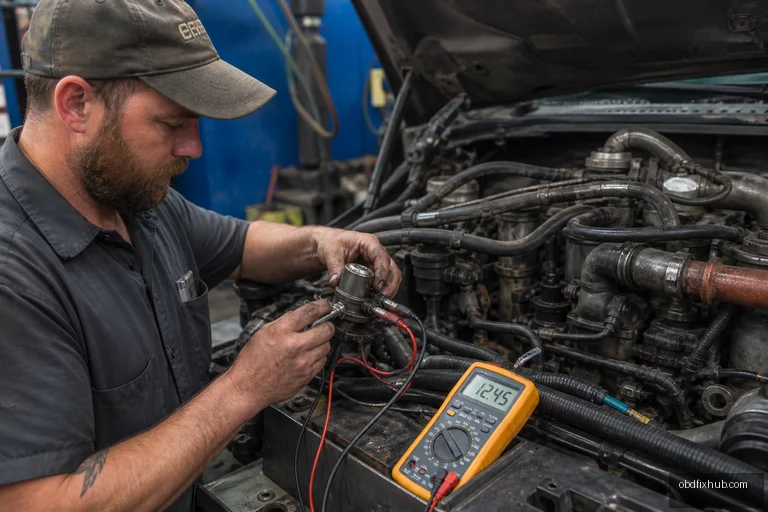
P0001 Fuel Volume Regulator A Control Circuit/Open means the engine control module has detected an open circuit, excessive resistance, or a loss of electrical control in the fuel volume regulator circuit. The fault is especially common on diesel engines with common-rail injection, where the regulator meters fuel entering the high-pressure pump. It should not be treated as proof that the fuel pump itself has failed; wiring, connectors, power supply, and the regulator valve must be tested first.
What Does P0001 Mean?
The P0001 diagnostic trouble code is a generic OBD-II powertrain code. The phrase Fuel Volume Regulator A usually refers to the inlet metering valve, fuel quantity control valve, or suction control valve mounted on or near the high-pressure fuel pump.
The engine control module, often called the PCM or ECM, adjusts this valve using an electrical command. By controlling how much fuel reaches the high-pressure pump, the system can maintain the required rail pressure without constantly pumping more fuel than the engine needs. When the module sees an open circuit or an implausible electrical response, it stores P0001 and may activate the check engine light.
The exact component name and location vary by manufacturer. On one vehicle it may be called a fuel metering valve; on another, a fuel pressure regulator or fuel quantity regulator. Always use the wiring diagram and manufacturer service information for the specific vehicle.
P0001 Symptoms You May Notice
The symptoms depend on whether the regulator has failed open, failed closed, or simply lost its electrical connection. A vehicle may still start and drive normally at first, particularly if the fault is intermittent, but drivability often worsens as fuel demand rises.
- Illuminated check engine light or service engine warning
- Extended cranking or a no-start condition
- Engine stalling, especially after starting or during deceleration
- Hard starting when the engine is hot or cold
- Reduced power and poor throttle response
- Rough idle or hesitation under acceleration
- Reduced fuel economy
- Limp-home mode and limited engine speed
- Additional fuel rail pressure codes, such as P0087, P0088, or P0191
On a common-rail diesel, a sudden open circuit can prevent the system from building enough rail pressure to start. In that situation, replacing the battery or repeatedly cranking the engine will not solve the underlying electrical fault and can overheat the starter.
Common Causes of P0001 Fuel Volume Regulator A
1. Damaged wiring or an open circuit
The most direct cause is a broken wire between the regulator and the ECM. Harnesses routed near the high-pressure pump, engine mount, or exhaust components are exposed to vibration, heat, and oil contamination. A wire can look intact externally while its copper strands are fractured inside the insulation.
2. Loose or corroded connector
A connector that is not fully locked can create an intermittent open circuit. Water intrusion, green corrosion on the terminals, bent pins, or fuel and oil contamination can increase resistance enough to trigger P0001. Pulling on the connector during inspection is not sufficient; the terminals need to be checked for proper tension.
3. Failed fuel volume regulator
The valve may have an internally open solenoid coil, a shorted coil, or a mechanically stuck pintle. Metal debris from a deteriorating high-pressure pump can also restrict the valve. A failed regulator is possible, but it should be confirmed electrically before parts are ordered.
4. Missing power or ground
Some systems provide battery voltage to the regulator and control the ground side with the ECM. Others use a different control strategy. A blown fuse, damaged relay, poor engine ground, or an ECM power supply problem can therefore appear as a regulator circuit fault.
5. Incorrect previous repairs
After engine, fuel pump, or injector work, the harness may be pinched, routed against a sharp bracket, or left disconnected. This is a practical clue: if P0001 appeared immediately after recent service, inspect disturbed wiring before condemning an expensive pump.
How to Diagnose P0001 Correctly
Do not begin by replacing the high-pressure fuel pump. A structured electrical test is usually faster and avoids unnecessary expense.
- Record all stored codes and freeze-frame data. Note engine speed, battery voltage, fuel pressure, and whether the code is current or pending. Related rail pressure codes can help identify whether the fault is electrical or hydraulic.
- Inspect the regulator and harness. Look for damaged insulation, stretched wires, oil-soaked connectors, missing terminal locks, and signs of contact with the pump or engine bracket. Check the connector with the ignition off and avoid forcing test probes into small terminals.
- Check fuses, relay output, power, and ground. Use a wiring diagram rather than assuming the valve receives power in the same way on every vehicle. A multimeter should be used under load where possible; a circuit can show voltage with no load yet fail when current is demanded.
- Measure regulator resistance. Compare the reading with the manufacturer specification. An infinite reading usually indicates an open coil, while an extremely low reading can indicate an internal short. Resistance alone does not prove that the valve moves correctly.
- Perform a wiggle test. With the scan tool monitoring the circuit or live fuel pressure, gently move the harness near the connector and high-pressure pump. If the signal or pressure changes, the wiring fault may be intermittent.
- Use a scan tool for an actuator test. A capable diagnostic tool may command the fuel volume regulator through different duty cycles. Watch commanded and actual rail pressure. A professional oscilloscope can reveal a missing control signal, electrical noise, or an abnormal current ramp that a basic code reader cannot see.
- Check the fuel system for contamination. If the regulator is blocked by metallic debris, replacing only the valve may provide a temporary improvement. The pump, fuel filter, rail, and injectors may require a contamination assessment according to the manufacturer procedure.
High-pressure diesel fuel systems can reach dangerous pressures even after the engine is switched off. Never loosen a common-rail pipe or injector line to test for pressure. Use the specified scan-tool data, mechanical test ports, or manufacturer-approved equipment instead.
How to Fix P0001
The correct repair depends on the test results. If the circuit is open because of a broken wire, repair it with the correct automotive-grade wire, sealed splices, and proper heat protection. Do not twist wires together and cover them with ordinary household tape; vibration and moisture will often bring the fault back.
- Clean lightly corroded terminals only when the terminals are still serviceable, then restore connector sealing.
- Replace loose, spread, or heat-damaged terminals instead of merely spraying contact cleaner.
- Replace the fuel volume regulator when its coil or mechanical operation fails testing.
- Repair blown fuses or missing grounds only after finding why they failed.
- Address fuel contamination or high-pressure pump damage if metal particles are present.
- Clear the code and perform a road test while monitoring commanded and actual fuel pressure.
After the repair, verify the fault under the same conditions shown in the freeze-frame data. For example, an intermittent open that occurs only during engine movement may not return during a stationary idle test. A proper road test with live data is often the difference between a lasting repair and a repeat comeback.
Can You Drive With P0001?
Short-distance driving may be possible if the engine runs normally, but it is not advisable to ignore the code. The vehicle can stall without warning, fail to restart, or enter reduced-power mode in traffic. If the engine is difficult to start, repeatedly stalls, or shows severe loss of power, have it diagnosed rather than continuing to drive.
P0001 Repair Cost
Repair cost varies widely because the code can be caused by a connector, a short section of wiring, the regulator valve, or contamination involving the high-pressure fuel system. A wiring repair is usually far less expensive than a fuel pump replacement. Diagnosis is worth paying for because replacing a pump without proving pump failure can turn a minor harness fault into a very costly repair.
Final Takeaway
P0001 identifies a problem in the electrical control circuit for Fuel Volume Regulator A, not automatically a failed fuel pump. Start with the connector, harness, fuse, power supply, ground, and regulator resistance before testing the high-pressure fuel system. If the vehicle is a common-rail diesel, treat hard starting and stalling seriously, and never open high-pressure fuel lines as a home diagnostic test.
Best next step: retrieve all codes, compare actual fuel pressure with commanded pressure, and test the regulator circuit against the vehicle-specific wiring diagram before replacing any component.
Frequently Asked Questions
What is the most common cause of P0001?
A damaged or disconnected wire, corroded connector, or failed fuel volume regulator is commonly responsible. The exact cause varies by vehicle, so visual inspection and circuit testing are more reliable than replacing parts based only on the code.
Is P0001 the same as a bad fuel pressure regulator?
Not always. P0001 refers to the control circuit for a fuel volume regulator, often located at the high-pressure pump. Some manufacturers use different names for similar components, while others separate fuel volume and fuel pressure control functions.
Can a weak battery cause P0001?
Low system voltage can create misleading fuel-control faults, particularly during cranking. Check battery voltage, charging voltage, grounds, and related power supply codes, but do not assume the battery is the only cause if the regulator circuit remains open.
Will clearing P0001 fix the problem?
Clearing the code only removes the stored warning temporarily. If the open circuit or regulator fault remains, P0001 will return, often during the next start or under higher fuel demand.
Should I replace the high-pressure fuel pump for P0001?
No. Test the wiring, connector, regulator coil, control signal, and fuel system contamination first. A pump should be replaced only when testing confirms inadequate pump output or internal damage.




