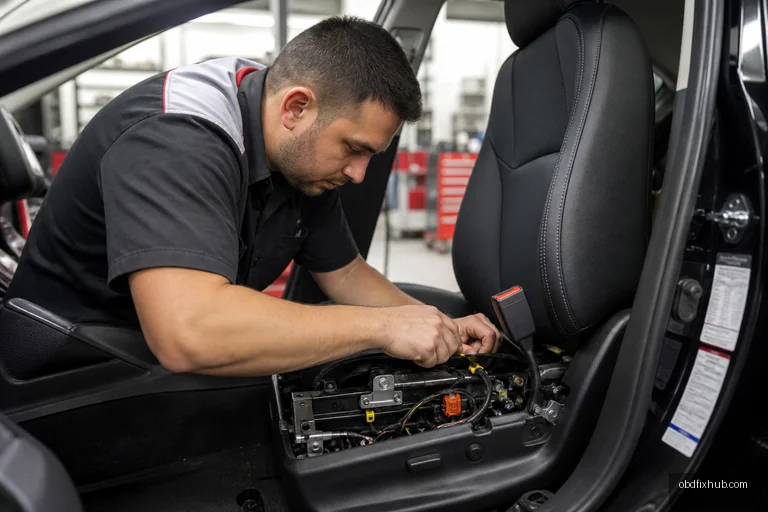
B0082 passenger seat belt load limiter is an SRS (Supplemental Restraint System) fault related to the passenger-side seat belt deployment circuit. It usually means the airbag control module has detected an open circuit, short, incorrect resistance, wiring problem, or a failed pretensioner/load-limiter assembly. Because this circuit is part of the crash-protection system, do not bypass it or continue treating the vehicle as safe until the fault is properly diagnosed.
What Does B0082 Mean?
B0082 is a manufacturer-specific diagnostic trouble code, so its exact wording and test procedure can vary by vehicle make and model. In many applications, it identifies a problem with the first-row passenger seat belt load limiter deployment control circuit.
The load limiter works with the seat belt pretensioner during a collision. The pretensioner rapidly removes slack from the belt, while the load-limiting mechanism allows controlled belt movement when restraint forces become high. This helps reduce chest stress during a severe impact. Depending on the vehicle, the load limiter may be integrated into the retractor, buckle, or a combined seat belt assembly.
Common Symptoms of a B0082 Fault
The most obvious symptom is an illuminated airbag or SRS warning light. However, the vehicle may not show any visible problem with the belt itself. The restraint system can look normal while the control module has disabled part of the deployment circuit.
- Airbag, SRS, or “Service Restraint System” warning on the instrument panel
- B0082 stored as a current, history, or intermittent code
- Passenger seat belt warning behaving incorrectly
- Other seat belt or airbag codes stored at the same time
- Seat belt retractor locked after a crash
- A fault that appears after seat removal, interior work, or water intrusion
An SRS warning does not always mean the airbags will deploy unexpectedly. It does mean the system may not operate correctly in a collision. Some manufacturers disable a specific pretensioner, multiple restraints, or the entire airbag system when a deployment-circuit fault is detected.
What Causes B0082 Passenger Seat Belt Load Limiter Problems?
In real workshop diagnosis, the belt assembly itself is only one possible cause. Many B0082 cases are caused by disturbed wiring under the passenger seat, especially after carpet replacement, seat track repairs, audio work, or an object becoming trapped beneath the seat.
- Failed passenger seat belt pretensioner or load-limiter assembly
- Disconnected, loose, corroded, or damaged SRS connector
- Wire harness stretched by seat movement or pinched by a seat rail
- Short to ground, short to voltage, or an open circuit
- Water or cleaning fluid contamination beneath the seat
- Incorrect replacement seat belt fitted to the vehicle
- Previous collision with undeleted crash data in the SRS module
- Airbag control module or connector fault
- Incorrect resistance caused by an aftermarket resistor or poor repair
A useful clue is timing. If B0082 appeared immediately after the passenger seat was removed, start with the connector and harness routing. If it appeared after a crash, assume the restraint may have fired until proven otherwise; do not clear the code and return the car to service without inspecting the complete SRS system.
How to Diagnose B0082 Correctly
A basic engine-code scanner may display B0082, but it often cannot access the airbag module or show the detailed fault status. Proper diagnosis requires an SRS-capable scan tool and the service information for the exact vehicle.
1. Confirm the code and its status
Scan the airbag control module, not only the powertrain computer. Record whether B0082 is current, history, or intermittent, and note any companion codes for the passenger buckle, seat occupancy sensor, pretensioner, or low system voltage.
2. Inspect before testing resistance
Switch the ignition off and follow the manufacturer’s battery-disconnection and waiting procedure before working around yellow SRS connectors. Inspect the passenger seat harness without pulling on terminals. Look for partially seated locks, bent pins, chafing, crushed wires, and evidence of moisture.
Do not probe a live pretensioner circuit with a conventional test light or an unapproved ohmmeter. A restraint squib is an ignition device. The manufacturer may specify a particular breakout box, simulator, or test adapter for circuit checks.
3. Use a wiring diagram and pinpoint test
Check continuity, short-to-ground, short-to-voltage, and connector integrity only as the factory procedure permits. A visual inspection alone can miss a broken conductor inside insulation. Move the seat through its normal travel while monitoring the circuit only with approved equipment; a fault that changes when the seat moves often indicates harness damage.
4. Determine whether the component deployed
After a collision, look for deployment records, crash data, belt locking, damaged trim, and related restraint codes. Never assume that an electrically normal resistance reading proves a used pretensioner is safe. A fired or impact-damaged seat belt assembly generally requires replacement according to the manufacturer’s collision-repair instructions.
How Is B0082 Repaired?
The correct repair depends on the failed part, not on the code number alone. A loose connector may be repaired with an approved terminal or harness repair. A chafed wire may require a properly specified splice and protective routing. A failed pretensioner or load limiter normally requires replacement of the complete approved belt assembly.
After repairs, the technician should clear the SRS codes with a suitable scan tool, cycle the ignition, and rescan for current faults. If the code returns immediately, the circuit still has a problem or the module has retained crash-related data. Some vehicles also require passenger occupant classification calibration after seat or sensor work.
Can Seat Belt Pretensioners Be Reset?
Usually, no. A deployed pretensioner is a single-use pyrotechnic device and is not reset by clearing the diagnostic code or disconnecting the battery. Some specialist companies rebuild certain belt assemblies, but the legality, quality, and acceptance of that work vary by region and vehicle manufacturer.
For a crash-involved vehicle, the safest route is an OEM-approved replacement or a repair performed by a qualified restraint-system specialist. The airbag module, airbags, belt buckles, seat occupancy sensor, steering-wheel components, and wiring may also need inspection. Resetting only the module can leave a dangerous mismatch between the stored crash data and the physical components.
Can a Bad Seat Belt Sensor Make the Airbag Light Come On?
Yes. A seat belt buckle switch, pretensioner circuit, passenger occupancy sensor, or related wiring fault can turn on the airbag warning light. The warning lamp indicates that the SRS module has detected a problem somewhere in the restraint system; it does not identify the failed component by itself.
This is why replacing the part that seems to match the dashboard message can waste money. The scan tool’s detailed SRS code, live data, wiring diagram, and a physical inspection are needed to separate a buckle-switch problem from a deployment-circuit fault such as B0082.
My Airbags Deployed and the Seat Belt Is Locked—What Should I Do?
- Do not drive the vehicle unless an emergency situation makes movement unavoidable.
- Disconnecting the battery does not make deployed restraint components safe to reuse.
- Have the vehicle transported to a qualified collision-repair or SRS specialist.
- Replace deployed airbags and locked or fired belt assemblies with correct parts.
- Inspect the SRS module, impact sensors, wiring, seats, steering wheel, and occupant sensors.
- Complete the manufacturer’s post-collision scan, calibration, and system verification.
A locked belt after an impact is not merely an inconvenience. It can indicate that the retractor pretensioner activated or that the belt suffered crash loading. Cutting, forcing, or disassembling the belt can create another hazard and can also remove evidence needed for a correct repair.
How to Bypass a Seat Belt Pretensioner
Do not bypass a seat belt pretensioner with a resistor, jumper wire, modified connector, or software trick. These methods can suppress the warning light while leaving the occupant unprotected, and they may interfere with airbag deployment timing. They can also create a serious injury risk during electrical testing or a crash.
If the goal is to move a vehicle for diagnosis, use the manufacturer’s safe transport procedure and have the SRS fault repaired. A warning light that disappears after a bypass is not proof of a functioning restraint system. It is often proof that the control module has been prevented from detecting the real fault.
Can You Drive With B0082?
It is best not to drive with an active B0082 code. The vehicle may still start and the belt may buckle normally, but that does not confirm that the passenger pretensioner and load limiter will function in a crash. Arrange professional diagnosis promptly, especially if the light appeared after an accident, flooding, or seat removal.
Final Takeaway
B0082 identifies a passenger seat belt load-limiter deployment-control problem, but the code alone cannot tell you whether the belt, connector, wiring, SRS module, or crash data is responsible. Begin with an SRS-capable scan and a careful harness inspection, never bypass the pretensioner, and replace deployed restraint components rather than attempting an improvised reset. If airbags deployed or the belt locked, have the entire restraint system assessed before the vehicle returns to the road.
Frequently Asked Questions
Is B0082 always caused by a bad passenger seat belt?
No. A loose connector, damaged under-seat wiring, water intrusion, incorrect belt assembly, or SRS module issue can produce the same code. Testing the circuit is essential before buying parts.
Will disconnecting the battery clear B0082?
Normally, no. The SRS module stores faults in memory, and disconnecting the battery does not repair an open or shorted circuit. It can also create additional electrical problems if restraint connectors are disturbed improperly.
Can I install a used passenger seat belt?
Only if it is confirmed compatible, undamaged, and permitted by the vehicle manufacturer and local regulations. A belt from a crash-involved vehicle may contain a fired pretensioner or hidden damage.
Why did B0082 appear after replacing the passenger seat?
The seat harness may be pinched, a connector may not be fully locked, or the replacement seat may use a different occupancy or restraint component. Check connector part numbers, wiring routing, and required calibration procedures.
Should I erase B0082 after the repair?
Yes, but only after the underlying fault has been corrected. Clear the SRS memory with an appropriate scan tool, cycle the ignition, and confirm that no current restraint codes return.




