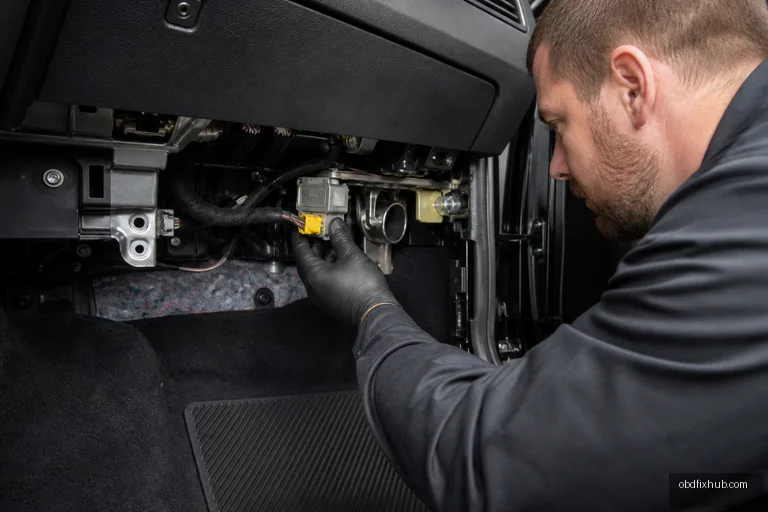
B0096 Right Side Restraints Sensor 1 means the vehicle has detected a fault in the right-side crash or supplemental restraint sensor circuit. The car may still start and drive normally, but the airbag control module can disable one or more airbags or pretensioners until the fault is repaired. Because this is a safety-system code, do not clear it repeatedly without finding the cause.
What Does the B0096 Code Mean?
B0096 is a generic OBD-II body code associated with the right-side restraints sensor, often called a side-impact sensor or satellite sensor. “Sensor 1” identifies the sensor position in the manufacturer’s restraint-system layout; it does not necessarily mean the first sensor installed on the vehicle.
The right side is normally determined from the driver’s seated position, not from someone standing in front of the vehicle. Depending on the model, the sensor may be mounted near the right front door, B-pillar, lower side structure, or another reinforced section of the body.
Exact wording varies between manufacturers. A scan tool may describe B0096 as a circuit fault, invalid signal, communication problem, internal sensor failure, or configuration issue. The manufacturer-specific subcode is essential before replacing parts.
Common Symptoms of B0096
The most obvious symptom is an illuminated SRS, Airbag, or Supplemental Restraint System warning light. In many vehicles, the warning appears immediately after starting and remains on. Other symptoms can include an airbag message in the instrument cluster or a scan tool showing additional restraint-system codes.
- Airbag or SRS warning light stays illuminated
- “Service Airbag” or “Supplemental Restraint System Problem” message
- Passenger or side-airbag indicator behaves abnormally
- One or more airbag or seat-belt pretensioner circuits are disabled
- Additional communication, voltage, or configuration codes appear
A damaged sensor will not usually affect engine performance, braking, steering, or fuel economy. That can make the problem easy to underestimate, even though the restraint system may not provide full protection during a crash.
What Causes B0096?
In real-world diagnosis, the sensor itself is only one possible cause. Wiring and connector problems are particularly common after a collision, door repair, interior removal, water intrusion, or aftermarket electrical work.
- Failed right-side impact sensor
- Loose, damaged, corroded, or water-contaminated connector
- Open circuit, short to ground, or short to power in the harness
- Chafed wiring beneath carpet, trim, or the right-side kick panel
- Low battery voltage or a weak battery during a previous start
- Crash data stored in the airbag control module
- Incorrect sensor installation or missing mounting hardware
- Airbag module software, communication, or configuration fault
Mounting matters more than many owners realize. A side-impact sensor uses the vehicle body as part of its reference, so a loose bolt, distorted mounting surface, or sensor installed in the wrong location can create a fault even when the connector looks clean.
How to Diagnose B0096 Properly
Do not begin by buying a sensor based only on the generic code description. A professional diagnosis starts with the complete SRS code, including any manufacturer-specific suffix, freeze-frame data, and related codes stored in the restraint control module.
- Check the battery and charging voltage. Low voltage can create misleading body and SRS faults. Confirm battery condition and verify that charging voltage is stable.
- Scan the SRS module with a compatible tool. Many basic OBD readers can access engine codes but cannot read or clear airbag faults. Use a scan tool that supports the vehicle’s restraint system.
- Inspect the right-side sensor area. Look for collision damage, moisture, corrosion, disturbed trim, and signs that the sensor has been replaced.
- Inspect the harness and connector. Check for bent terminals, broken locks, stretched wires, and wiring trapped under trim or a seat rail.
- Follow the manufacturer’s circuit tests. Test continuity, voltage, ground, and communication only as specified by the service manual.
- Repair the root cause, then clear and retest. The warning should be cleared with a proper SRS scan tool, followed by a key-cycle and road-test confirmation when required.
Never probe an airbag squib circuit with a conventional test light or an ohmmeter unless the manufacturer specifically permits that procedure. Airbag circuits contain pyrotechnic devices, and incorrect testing can deploy a component or cause injury. Disconnecting the battery alone is not a substitute for following the vehicle’s required waiting time and safety procedure.
How Is B0096 Fixed?
The repair depends on the test results. A loose connector may need terminal repair and secure reinstallation. A damaged harness should be repaired with the correct automotive method or replaced, rather than twisted together and covered with household tape. If the sensor fails its specified tests, replacement and correct mounting are normally required.
Vehicles involved in a crash may also need a new airbag control module, deployed airbags, seat-belt pretensioners, or crash-data reset. Replacing only the sensor will not solve the warning if the module still contains an impact event or another restraint fault.
Aftermarket sensors can create compatibility and calibration problems. Use a part that matches the vehicle’s exact year, body style, and restraint-system configuration. Some models require initialization, coding, or a zero-point procedure after installation.
Can You Drive With a Bad Airbag Sensor?
The vehicle will often drive mechanically with B0096 present, but driving it is not considered safe. The SRS warning means the control module may not deploy the affected side airbag, curtain airbag, or pretensioner correctly. In some designs, a single detected fault can disable several restraint components.
If you must move the vehicle, drive only the shortest practical distance to a qualified repair facility. Do not carry on normal driving, transport children unnecessarily, or assume that a working airbag light means the system is functioning correctly—the warning light itself is the problem indicator.
What Does “Supplemental Restraint System Problem” Mean in a Honda Pilot?
On a Honda Pilot, this message means the SRS control unit has detected a fault in one or more airbags, seat-belt pretensioners, impact sensors, wiring circuits, or related modules. It does not identify the failed part by itself.
A Honda-capable scan tool is needed to read the specific SRS DTC. Depending on the year, B0096 may correspond to a right-side restraint sensor fault, but the exact sensor location and diagnostic procedure can vary. Check for recent battery replacement, water intrusion, seat movement, collision repairs, or wiring disturbed during interior work before condemning the sensor.
What Does Ford DTC B0091-93-8B Mean?
Ford’s extended code format provides more information than the base B0091 code. B0091 is generally associated with the left-side restraints sensor 1, while B0096 is commonly associated with the right-side restraints sensor 1. The suffix -93-8B is a manufacturer-defined failure detail and should be interpreted with Ford’s service information for the specific model and year.
In practical terms, B0091-93-8B can indicate that the restraint control module is receiving an invalid, implausible, or otherwise unacceptable signal from the left-side sensor circuit. Do not assume the sensor is defective until wiring, connector security, power supply, module communication, and crash history have been checked.
How Do You Know an Airbag Sensor Is Bad?
A warning light alone cannot prove that the sensor has failed. The most reliable confirmation comes from a scan tool, a visual inspection, and the manufacturer’s electrical tests. The sensor becomes a strong suspect when its connector and wiring are intact, supply and communication circuits are correct, and the sensor fails the specified test or the fault follows the sensor after an approved diagnostic procedure.
Never substitute a resistor or bypass device to turn off the SRS light. That may hide the warning while leaving the airbag system inoperative, and it can create a dangerous condition during a collision.
Repair Cost and Next Step
Cost varies widely. A diagnosis may be inexpensive compared with a sensor, harness, control module, or post-crash restraint repair. A loose connector can take minutes to correct, while collision-related repairs may involve several components and programming.
Before approving parts, ask the repair shop for the exact SRS code, the tested circuit, the sensor location, and whether the vehicle has crash data stored. That information prevents the common mistake of replacing an expensive sensor when the real cause is corrosion, wiring damage, or low system voltage.
Key Takeaway
B0096 points to a fault involving the right-side restraints sensor 1 circuit, but it does not automatically prove the sensor has failed. Treat the warning as a genuine safety issue, obtain a manufacturer-capable SRS scan, inspect the wiring and mounting carefully, and repair the tested cause before clearing the code. If the SRS light remains on, arrange professional diagnosis rather than continuing to drive normally.
Frequently Asked Questions
Is B0096 an engine problem?
No. B0096 is a body and supplemental restraint system code. It normally does not cause drivability symptoms, but it can affect airbags or seat-belt pretensioners.
Can a weak battery cause B0096?
Yes. Low voltage during starting can trigger SRS and communication faults. Battery voltage should be checked, but correcting the battery does not automatically prove that the original code is resolved.
Can I reset B0096 by disconnecting the battery?
Usually not. The code may remain stored, return immediately, or require an SRS-capable scan tool. Disconnecting the battery also does not repair a damaged sensor or harness.
Where is the right-side restraint sensor located?
Location depends on the vehicle. It may be near the right front door, B-pillar, rocker panel, or side body structure. Use the vehicle’s service information rather than guessing from the code alone.




