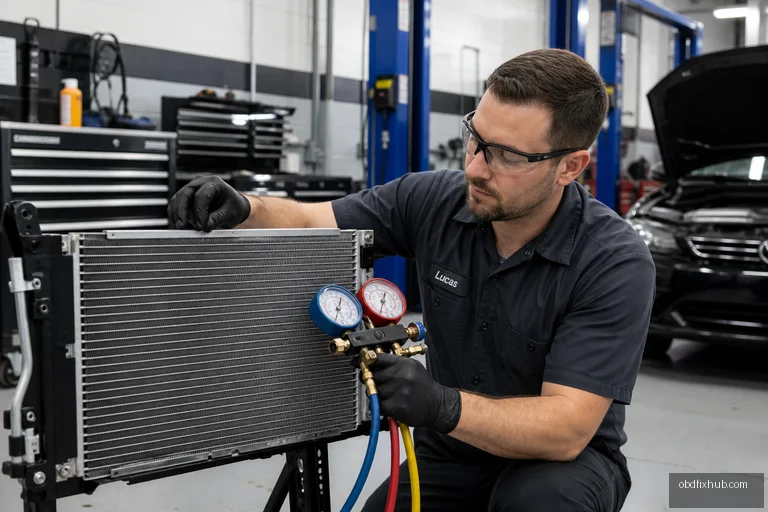
B3A1B A/C system pressure too high generally means the vehicle’s HVAC control module has detected an excessive refrigerant-pressure signal or an A/C pressure condition outside its expected range. The most common causes are an overcharged system, poor condenser airflow, a restricted refrigerant circuit, incorrect refrigerant, or a faulty pressure sensor. Do not release refrigerant through a service port; proper recovery equipment is required.
This is an information-focused fault, not a part-swapping diagnosis. The code tells you that the system sees high pressure, but it does not always prove that the refrigerant pressure is genuinely too high. A scan tool reading, manifold or digital gauge readings, ambient temperature, condenser airflow, and the pressure sensor signal must be evaluated together.
What Does B3A1B A/C System Pressure Too High Mean?
B3A1B is a body or HVAC-related diagnostic trouble code rather than a universal powertrain code. Its exact definition can vary by vehicle manufacturer, model year, HVAC configuration, and scan-tool database. In practical terms, the climate-control module has identified an excessive high-side pressure condition or a pressure signal that appears excessive.
The A/C system contains refrigerant under substantial pressure. The compressor raises the refrigerant pressure and temperature, while the condenser must remove heat before the refrigerant reaches the expansion device. If heat cannot leave the condenser, or if too much refrigerant is present, high-side pressure can rise rapidly and the control module may disable the compressor to prevent damage.
Symptoms of a High-Pressure A/C System
High pressure often produces recognizable symptoms before the fault code is stored. The exact pattern depends on whether the pressure is genuinely high or the pressure sensor is reporting incorrectly.
- The A/C blows warm or only slightly cool air.
- The compressor engages briefly, then switches off.
- The compressor clutch cycles rapidly or will not engage at all.
- The cooling fan runs at high speed after A/C operation begins.
- Engine idle becomes rough or the engine nearly stalls when the compressor engages.
- A high-side hose or condenser area becomes unusually hot.
- The system works better while driving than when stopped, suggesting an airflow problem.
- The A/C pressure warning returns immediately after clearing the code.
A particularly useful clue is the difference between performance at highway speed and at idle. If the air becomes colder while driving, natural airflow may be temporarily compensating for a failed electric fan, blocked condenser, or damaged fan shroud. If the air remains warm at all speeds, overcharge, a restriction, compressor trouble, or a sensor fault becomes more likely.
What Causes Excessive High-Side A/C Pressure?
1. Too much refrigerant
An overcharged system has insufficient vapor space in the condenser and receiver-drier or accumulator. As ambient temperature rises, the liquid refrigerant expands and high-side pressure can become excessive. This commonly happens after refrigerant is added without first recovering and weighing the existing charge.
2. Insufficient condenser airflow
The condenser must reject heat to the outside air. A failed electric cooling fan, faulty fan relay, damaged wiring, blocked grille, bent condenser fins, or debris between the condenser and radiator can prevent that heat transfer. At idle, this problem can create very high pressure even when the system appears normal at road speed.
3. Dirty or damaged condenser
Road dirt, insects, leaves, and oily dust can insulate the condenser surface. Bent fins reduce the open area available for airflow. Cleaning should be performed carefully from the engine side outward when possible; high-pressure water used from the wrong direction can fold fins over and make the restriction worse.
4. Air or other non-condensable gases in the circuit
If the system was opened and evacuated incorrectly, air may remain inside. Air does not condense like refrigerant, so it occupies condenser space and contributes to elevated head pressure. This usually requires complete recovery, a proper vacuum procedure, leak repair, and charging by the exact specified weight.
5. A restriction in the refrigerant circuit
A restricted orifice tube, expansion valve, receiver-drier, or liquid line can create high pressure before the restriction and low pressure after it. Frost at one localized point, an unusual temperature difference across a component, or an abnormally low suction-side reading can support this diagnosis. Replacing a pressure sensor will not repair a blocked metering device.
6. Incorrect refrigerant or mixed refrigerants
Using the wrong refrigerant, adding an incompatible substitute, or mixing refrigerants changes the pressure-temperature relationship and can create unsafe operating pressures. The label under the hood identifies the approved refrigerant and factory charge. Do not rely on a generic refill can or color alone.
7. A defective pressure sensor or wiring fault
The high-pressure sensor usually sends a variable voltage or digital signal to the HVAC or engine control module. Corroded terminals, a damaged reference circuit, poor ground, a shorted signal wire, or a sensor stuck at a high value can trigger B3A1B even when mechanical pressure is normal. This is why actual gauge pressure must be compared with scan-tool data.
How to Diagnose B3A1B Correctly
- Confirm the code and vehicle specification. Record all HVAC, engine, and body codes before clearing anything. Verify the refrigerant type and factory charge listed on the vehicle label.
- Check operating conditions. Note outside temperature, engine temperature, compressor command, condenser-fan operation, and whether the fault appears at idle or while driving.
- Inspect airflow first. Look for blocked fins, debris, a missing fan shroud, and a cooling fan that fails to run when A/C is requested.
- Compare scan data with measured pressure. If the scan tool reports extreme pressure while properly connected gauges show a plausible value, test the pressure sensor circuit and sensor itself.
- Measure both sides when appropriate. High-side pressure alone is not enough. A high high-side reading combined with low suction pressure points toward a restriction or airflow problem, while both sides being high often suggests overcharge or poor heat rejection.
- Recover and weigh the refrigerant if charge is suspected. Do not estimate the charge by pressure alone. The correct quantity is specified by weight, not by how cold the vents feel.
For example, a vehicle that shows 350 psi on the high side at a 95°F ambient temperature, with the condenser fan not operating, should not immediately receive a new compressor. Restoring fan operation and confirming the charge may solve the problem. Conversely, normal fan operation with an overfilled system points toward recovery and recharge rather than an electrical repair.
How to Fix a High-Pressure A/C System
- Repair or replace a failed condenser fan, relay, fuse, wiring, or fan control module.
- Remove debris and carefully restore damaged condenser fins.
- Recover the refrigerant, repair leaks, evacuate the system, and recharge it by the manufacturer’s specified weight.
- Replace a restricted expansion valve, orifice tube, receiver-drier, accumulator, or contaminated line as required.
- Replace a faulty pressure sensor only after confirming its reference voltage, ground, signal, and mechanical pressure comparison.
- Flush or replace contaminated components when incorrect or mixed refrigerant has been identified.
How to Release Pressure in an A/C System Safely
There is no safe DIY method to release automotive A/C pressure into the atmosphere. Venting refrigerant is environmentally harmful, can violate local regulations, and may cause severe cold burns or eye injuries. Pressurized liquid refrigerant can also damage the compressor and contaminate the workshop.
A qualified technician uses an approved recovery machine to remove and store the refrigerant. The system can then be opened only after pressure has been safely recovered. After the repair, the technician evacuates the system with a vacuum pump, checks for leaks, and recharges it using the correct refrigerant and measured mass.
Which Causes Make High-Side Pressure Too High?
The most likely causes are an overfilled refrigerant charge, inadequate condenser airflow, a dirty condenser, non-condensable gas in the system, a refrigerant restriction, or incorrect refrigerant. A pressure sensor or wiring fault can mimic any of these conditions. The fastest reliable approach is to compare actual pressure, sensor data, fan operation, and the system’s temperature pattern instead of guessing from vent temperature alone.
Key Takeaway
B3A1B A/C system pressure too high should be treated as a pressure-control problem that requires verification, not as automatic proof that the compressor has failed. Start with condenser airflow and the refrigerant specification, then compare scan data with real pressure readings. If refrigerant recovery or charging is needed, have the work completed with certified equipment rather than venting or adding refrigerant blindly.
Frequently Asked Questions
What are the symptoms of a high-pressure A/C system?
Common symptoms include warm air, compressor cycling, compressor shutdown, high-speed condenser-fan operation, poor cooling at idle, and a stored pressure-related HVAC code.
Can low refrigerant cause high-side pressure to become too high?
Low refrigerant usually causes low suction and low high-side pressure, not excessive high-side pressure. However, inaccurate readings, airflow faults, or a restriction can make the diagnosis appear confusing, so both sides should be tested.
Can I fix B3A1B by replacing the A/C pressure sensor?
Only if testing proves that the sensor or its wiring is inaccurate. Replacing it without comparing the signal to actual refrigerant pressure can leave an overcharge, fan failure, or restriction unresolved.
How do I safely lower excessive A/C pressure?
A technician must recover the refrigerant with approved equipment, identify the cause, repair the fault, evacuate the system, and recharge it by the specified weight. Never vent refrigerant or loosen a service fitting to release pressure.
Why is the A/C colder while driving than at idle?
This pattern strongly suggests inadequate condenser airflow at low speed, often caused by a failed electric fan, relay, wiring fault, blocked condenser, or damaged fan shroud.




