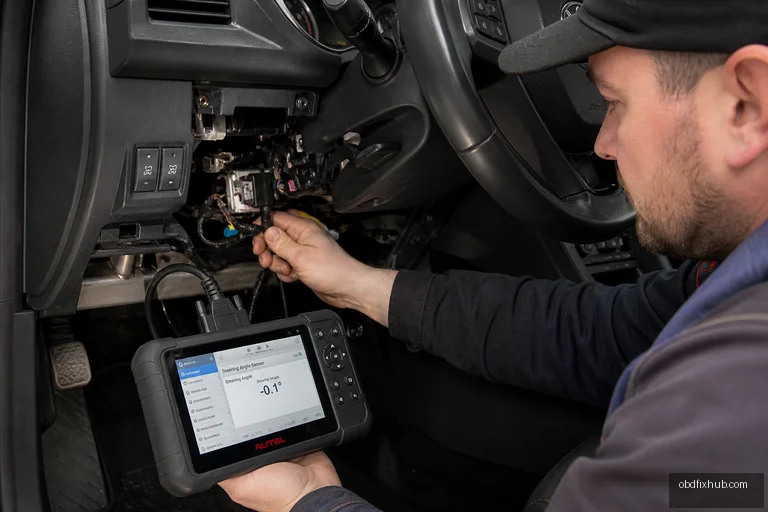
C0051 means the vehicle has detected a problem with the steering wheel position sensor circuit or its signal. This sensor, often called a steering angle sensor, tells the ABS, traction-control, electronic stability control, and sometimes electric power steering systems where the steering wheel is pointing. A failed sensor can trigger several warning lights, but the code does not automatically mean the sensor itself needs replacement. Wiring damage, incorrect calibration, a damaged clock spring, low voltage, or a steering component that was recently disturbed can produce the same fault.
What Is the C0051 Steering Wheel Position Sensor Code?
The C0051 diagnostic trouble code is a chassis code used by many manufacturers to identify a steering wheel position or steering angle sensor fault. The exact wording and subcode depend on the vehicle. For example, a suffix may indicate a signal plausibility problem, an open circuit, a short circuit, or an incorrect sensor position.
On some vehicles, the sensor is mounted behind the steering wheel and integrated into the clock spring or steering column module. On others, the steering angle information is calculated by a steering control module. That difference matters: replacing a sensor without checking the vehicle-specific service information is a common and expensive mistake.
What Happens When the Steering Wheel Position Sensor Goes Bad?
When the sensor stops reporting a credible steering angle, the vehicle cannot reliably determine whether your steering input matches the direction of travel. The ABS and stability-control systems may disable themselves as a precaution. The car may still steer normally, but electronic safety functions may be unavailable until the fault is repaired and the sensor is calibrated.
- ABS, traction control, ESC, or stability-control warning lights may illuminate.
- A steering wheel, power steering, or service-vehicle message may appear.
- Traction control or stability control may switch off automatically.
- Lane-keeping or driver-assistance features may become unavailable.
- Electric power steering may reduce assist or enter a protective mode on some models.
- The steering wheel may feel normal but sit off-center while driving straight.
A C0051 fault can also appear immediately after a wheel alignment, steering rack replacement, battery discharge, clock spring replacement, or work involving the steering column. In those cases, lost calibration is often more likely than a failed sensor.
Common Causes of C0051
- Lost steering angle calibration: The steering wheel was not centered during an alignment or the module lost its learned zero position.
- Damaged clock spring or steering column module: A clock spring can be torn if the steering wheel is rotated while disconnected or installed off-center.
- Wiring or connector problems: Loose terminals, corrosion, pulled wires, water intrusion, and poor grounds can interrupt the sensor signal.
- Low system voltage: A weak battery, failed alternator, or voltage drop during starting can create temporary sensor and communication faults.
- Incorrect steering geometry: A bent suspension component, uneven toe setting, or steering wheel installed out of position can make the reported angle appear implausible.
- Internal sensor failure: Wear, contamination, or electronic failure may cause an intermittent or permanent signal fault.
- Module or communication faults: CAN-bus wiring problems or a failed ABS, body, or steering-control module can prevent valid sensor data from reaching other systems.
C0051 Symptoms to Watch For
Is a bad power steering sensor the same as C0051?
Not necessarily. Many drivers call any steering-related sensor a power steering sensor, but C0051 normally refers to steering wheel position or steering angle information. A power steering pressure sensor, torque sensor, and steering angle sensor perform different jobs and may use different trouble codes.
Signs that a steering-related sensor or its circuit may be faulty include a heavy steering wheel, intermittent loss of electric steering assist, an EPS warning, steering assist that changes unexpectedly, or a steering wheel that does not return smoothly to center. Those symptoms can also be caused by a weak battery, a failing steering motor, low fluid in hydraulic systems, a bad rack, or mechanical binding. A complete scan of the EPS and ABS modules is essential before identifying the failed component.
How to Diagnose C0051 Properly
A basic code reader may show C0051 but cannot always access the live steering-angle data or perform the required calibration. A professional scan tool that communicates with the ABS, stability-control, and steering modules is preferable.
- Record all codes and freeze-frame data. Related communication, voltage, ABS, or wheel-speed codes may reveal the original cause.
- Check battery voltage. Inspect battery terminals, charging voltage, and relevant fuses before condemning a sensor.
- Inspect the steering wheel position. With the front wheels straight, the steering wheel should be centered. A visibly crooked wheel after an alignment is a useful clue.
- Inspect connectors and wiring. Look behind the steering column and at module connectors for chafing, stretched wires, corrosion, or signs of previous repairs.
- Read live data. The steering angle should change smoothly as the wheel turns and should return close to zero when the wheels are straight. Sudden jumps or an impossible angle indicate a signal problem.
- Perform the vehicle-specific zero-point calibration. If calibration fails, investigate wiring, clock-spring position, alignment, and module faults rather than repeatedly attempting the reset.
One practical diagnostic clue is whether the steering angle value changes smoothly. A sensor that moves from zero to a large value in clean, consistent steps may simply need calibration. A value that freezes, jumps backward, or changes while the wheel is still usually points toward a sensor, clock spring, wiring, or module problem.
How Do I Reset the Steering Position Sensor?
The correct reset is usually called steering angle sensor calibration, zero-point calibration, or steering position relearn. It is not the same as erasing the C0051 code. Clearing the code without correcting the sensor’s reference position often causes the warning lights to return as soon as the vehicle moves.
- Park on a level surface and set the front wheels straight ahead.
- Make sure the steering wheel is physically centered and the battery is adequately charged.
- Connect a scan tool with ABS or steering-module calibration capability.
- Choose the steering angle or steering position zero-point procedure for the exact vehicle.
- Follow the tool’s instructions, which may require cycling the ignition, turning the wheel, or driving a short distance.
- Clear stored codes, then road-test the vehicle while monitoring steering-angle and wheel-speed data.
Some models support a manual relearn, but the procedure varies widely and may be unsafe or ineffective if the steering wheel is not centered mechanically. If the code returns immediately after a correct calibration, the problem is probably not a simple reset issue.
How Much Does It Cost to Fix a Steering Sensor?
Repair cost depends heavily on the vehicle and the actual failed part. A diagnostic scan and calibration may cost approximately $80 to $180. If calibration is required after an alignment or battery event, that may be the only expense.
- Wiring or connector repair: commonly $100 to $350, depending on access and damage.
- Steering angle sensor replacement: roughly $250 to $700 on many vehicles, including labor and calibration.
- Clock spring or steering column module replacement: often $300 to $1,000 or more.
- Electric power steering module or rack repair: approximately $800 to $2,500 or higher on some vehicles.
Dealer pricing, luxury vehicles, integrated modules, airbag-related procedures, and required post-repair programming can raise the total. Ask the repair shop whether the quote includes calibration, code verification, wheel alignment, programming, and any necessary steering-wheel or airbag removal.
Can You Drive With C0051?
If the steering feels normal, the vehicle may remain driveable for a short trip to a repair facility, but ABS and stability-control protection may be disabled. Drive cautiously, especially in rain, snow, or emergency maneuvers. Do not continue driving if the steering becomes heavy, binds, pulls sharply, or the steering wheel cannot be controlled normally; those symptoms suggest a separate mechanical or power-assist problem that requires immediate attention.
Bottom Line
C0051 identifies a problem with steering wheel position information, not proof that the sensor must be replaced. Start with a full module scan, battery and wiring checks, steering-wheel centering, and live-data testing. If the sensor was disturbed during alignment or steering work, a proper zero-point calibration may solve the problem; if calibration fails, the clock spring, wiring, module, or sensor itself needs further testing.
Best next step: have the vehicle scanned with an ABS-capable tool and request the exact C0051 subcode before approving parts replacement.
Frequently Asked Questions
What are the signs that my power steering sensor is bad?
Common signs include an EPS warning, intermittent or reduced steering assist, heavy steering, inconsistent assist, and additional ABS or stability-control warnings. Because these symptoms overlap with battery, motor, rack, and wiring faults, scan the relevant modules before replacing a sensor.
Will disconnecting the battery reset C0051?
It may erase some temporary faults, but it usually does not perform the required steering-angle calibration. The code can return immediately or after the vehicle begins moving.
Can a wheel alignment cause C0051?
Yes. If the steering wheel is not locked and centered, or the steering-angle sensor is not recalibrated after the alignment, the module may see an implausible relationship between steering angle and vehicle direction.
Does C0051 mean the car will lose power steering?
Not always. C0051 primarily concerns steering position data. Some vehicles keep normal power assist while disabling stability functions; others may reduce electric assist if the steering module cannot trust the sensor signal.
Should I replace the sensor before clearing the code?
No. Check the exact suffix, live data, wiring, voltage, steering centering, and calibration procedure first. Replacing an integrated sensor or clock spring without that testing can create unnecessary cost and introduce airbag or steering-column problems.




