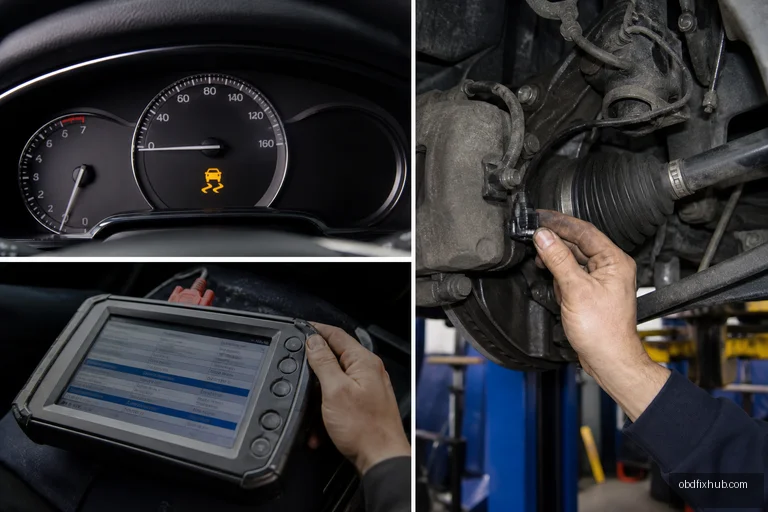
C006B Stability System Active Too Long means the vehicle’s electronic stability control system has detected that a stability-control intervention lasted longer than expected. On a Cadillac, the related message may appear as Service Stability System. The warning does not automatically mean the stability control module has failed; a wheel-speed sensor, steering-angle signal, low battery voltage, wiring fault, mismatched tire, or brake-control problem can trigger it.
This is primarily a diagnostic issue, not a code that can be accurately solved by replacing parts at random. The correct repair starts with scanning the ABS or electronic brake control module, checking live data, and confirming why the system believed the vehicle was still sliding or losing directional control.
What Does the Service Stability System Message Mean on a Cadillac?
The Service Stability System message means Cadillac’s StabiliTrak or electronic stability control system has detected a fault and may reduce or disable its ability to correct a skid. The system normally compares wheel speed, steering angle, yaw rate, and lateral acceleration. If those signals do not agree, the control module may illuminate the stability-control warning and store a diagnostic trouble code.
When the system is working correctly, it can apply an individual brake or reduce engine torque when it detects understeer, oversteer, or wheel spin. With a C006B fault present, the vehicle may still drive normally on dry pavement, but the electronic safety net may not be available during an emergency maneuver, rain, snow, or a sudden lane change.
On some Cadillac models, the message appears alongside the ABS light, traction-control light, check-engine light, or a warning that traction control has been turned off. The exact wording and code description can vary by model year and module software, so always verify the definition in the factory service information for that specific vehicle.
C006B Stability System Active Too Long: What the Code Is Reporting
C006B is generally associated with a stability-control intervention that remains active beyond the period the module considers reasonable. In practical terms, the controller believes it is still correcting wheel slip or vehicle rotation, even though the sensor data does not return to a normal condition.
That can happen because the vehicle is genuinely losing traction, but a persistent code usually points to an inaccurate input or a communication problem. For example, a wheel-speed sensor that drops to zero intermittently can make the module believe one wheel is behaving differently from the others. A steering-angle sensor that is not centered after an alignment can create a similar conflict.
Common Causes of C006B
- Faulty wheel-speed sensor: Dirt, corrosion, internal sensor failure, or physical damage can produce an erratic wheel-speed signal.
- Damaged reluctor ring or encoder: A cracked tone ring, damaged wheel bearing encoder, or excessive bearing play can distort the signal the sensor reads.
- Steering-angle sensor miscalibration: This is common after an alignment, steering-component replacement, battery event, or work involving the steering column.
- Yaw-rate or lateral-acceleration sensor fault: These sensors tell the stability module how the vehicle is rotating and moving sideways.
- Low system voltage: A weak battery, poor ground, failing alternator, or voltage drop during starting can create misleading ABS and stability codes.
- Damaged wiring or connectors: Harnesses near the wheels are exposed to water, road salt, suspension movement, and previous repair damage.
- Tire mismatch: Different tire sizes, substantially different tread depths, incorrect pressure, or one temporary spare can make wheel-speed readings disagree.
- ABS hydraulic or electronic control fault: A problem in the brake pressure-control unit can keep an intervention active or prevent it from completing normally.
- CAN communication or software issue: Lost communication between the brake, engine, steering, or body modules can interrupt stability-control decisions.
Symptoms You May Notice
The most obvious symptom is a warning such as Service Stability System, but the driving behavior can provide useful clues. Some vehicles set the code immediately after startup, while others wait until the car reaches a particular speed or makes a turn.
- StabiliTrak, traction-control, ABS, or stability warning lamps
- Traction control switching off or intervening unexpectedly
- Reduced engine power or a restricted throttle response
- ABS activation that feels incorrect at low speed
- A steering wheel that is not centered while driving straight
- Speedometer fluctuations or cruise control being disabled
- One wheel appearing to lock or spin during acceleration
- Warnings that disappear after cycling the ignition but return during the next drive
A warning that clears after restarting does not prove the problem is fixed. It often means the module has temporarily regained a plausible signal. Intermittent faults are especially important to diagnose using a road test and live data rather than by reading stored codes alone.
How to Diagnose C006B Correctly
1. Use a scanner that can access the ABS module
A basic OBD-II reader may only communicate with the engine computer and may not see C006B at all. Use a professional scan tool or a capable aftermarket scanner that can enter the electronic brake control module, read manufacturer-specific subfaults, display freeze-frame data, and perform sensor relearn procedures.
2. Record every related code
Do not diagnose C006B in isolation. Codes for a specific wheel-speed sensor, steering-angle sensor, yaw sensor, low voltage, or lost module communication may identify the root cause. The first code in the sequence is not always the failed part, but a companion sensor code is often more useful than C006B itself.
3. Check battery and charging voltage first
Measure voltage at the battery rather than relying only on the dashboard. A healthy battery is typically near 12.6 volts with the engine off, while charging voltage commonly falls in the mid-13 to mid-14 volt range with the engine running, depending on the vehicle’s charging strategy. A professional should also test voltage during cranking and inspect battery terminals and grounds.
4. Compare live wheel-speed data
During a controlled road test, all four wheel-speed readings should rise smoothly and remain reasonably consistent when the vehicle is traveling straight. A reading that drops out, lags behind, or shows speed while the vehicle is stationary is a strong clue. Do not replace a sensor before inspecting the sensor connector, harness routing, wheel bearing, and reluctor surface.
5. Verify steering-angle and stability-sensor values
With the front wheels pointed straight ahead, the steering-angle value should be close to its calibrated center. A steering wheel that is visibly off-center is an important clue, but the sensor can also be wrong even when the wheel looks straight. Yaw-rate and lateral-acceleration readings should be plausible with the vehicle parked on level ground; a sensor showing substantial movement while stationary deserves investigation.
6. Inspect tires, brakes, and recent repair history
Confirm that all tires are the correct size and properly inflated. Ask whether the code appeared after an alignment, wheel-bearing replacement, tire change, suspension repair, battery replacement, or jump-start. That timing often narrows the diagnosis faster than the code description itself.
How to Fix C006B
The fix depends on the failed input or component. A repair may involve cleaning and securing a wheel-speed sensor connector, replacing a damaged sensor or wheel bearing, repairing a harness, correcting tire differences, restoring battery voltage, or calibrating the steering-angle sensor.
If the vehicle recently had an alignment, the front wheels must be mechanically centered before performing a steering-angle relearn. Calibrating a sensor while the steering geometry is still incorrect can make the warning return. After the repair, clear the codes, complete the required relearn or calibration, and perform a road test that includes gentle turns, straight-line driving, and safe braking.
Do not replace the ABS control module simply because C006B is stored. Module replacement is expensive and may require programming, configuration, and brake bleeding. It should be considered only after power, grounds, communication circuits, sensor inputs, and hydraulic operation have been tested.
Can You Drive With C006B?
If the vehicle has a stability warning but brakes, steering, and tire behavior feel normal, drive only as far as necessary to reach a qualified repair facility. Reduce speed and avoid wet, icy, gravel, or aggressive driving because stability and traction assistance may be unavailable.
Stop driving and arrange a tow if the brake pedal feels soft, the ABS activates unexpectedly, the vehicle pulls sharply, multiple warning lamps appear with reduced braking, or the steering becomes difficult. C006B is not usually an immediate engine-damage issue, but it can represent a significant safety-system failure.
Key Takeaway
C006B does not identify one guaranteed bad part. It reports that the stability system remained active longer than expected, usually because wheel-speed, steering, yaw, voltage, wiring, tire, or brake-control information was incorrect. Scan the ABS module, examine live data, check voltage and tires, then complete any required calibration after the underlying fault is repaired.
Best next step: have the vehicle scanned with an ABS-capable tool and request the complete code list, freeze-frame data, and live wheel-speed readings before authorizing parts replacement.
Frequently Asked Questions
What does the Service Stability System message mean on a Cadillac?
It means the Cadillac has detected a fault in the StabiliTrak or electronic stability-control system and may have disabled or limited its ability to correct a skid. The cause may be a sensor, wiring, low voltage, tire mismatch, brake-control issue, or module communication fault.
Is C006B the same as a bad wheel-speed sensor?
No. A bad wheel-speed sensor is one possible cause, but C006B can also result from a damaged encoder, wiring problem, steering-angle calibration issue, low voltage, or another stability-control input. Live data and related ABS codes are needed to identify the actual failure.
Can a weak battery cause C006B?
Yes. Low voltage during starting or unstable charging voltage can cause ABS and stability modules to store faults. Battery terminals, grounds, alternator output, and cranking voltage should be checked before replacing expensive stability components.
Will disconnecting the battery fix the Stability System warning?
Disconnecting the battery may clear some temporary symptoms, but it does not repair the underlying problem. The warning will usually return once the module sees the same invalid signal, and some vehicles may require steering-angle or other sensor relearning afterward.
Can I clear C006B with a basic code reader?
A basic reader may not access the ABS module or clear manufacturer-specific stability codes. Use a scanner with ABS, StabiliTrak, and service-function support, then verify the repair with a road test rather than relying only on a cleared warning light.




