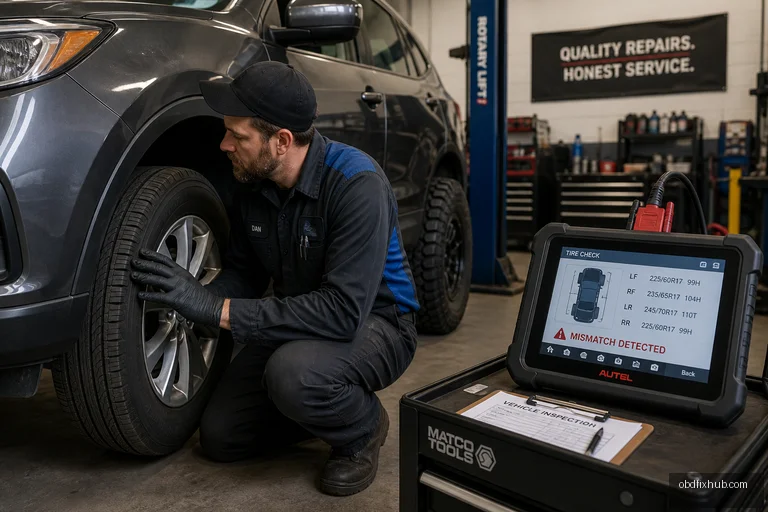
If your scan tool displays C0078 Tire Diameter, the vehicle has detected a problem with the tire-size information used by its ABS, traction control, or chassis control system. The usual causes are mismatched tire sizes, incorrect tire calibration, worn or damaged tires, or a fault in the module that monitors wheel-speed data. The code does not automatically mean the ABS sensor itself is bad.
C0078 is a chassis-related diagnostic trouble code, so it may not appear when using a basic engine-only code reader. Its exact definition and testing procedure can vary by manufacturer, but the underlying issue is generally the same: the control module is seeing a tire diameter or rolling-circumference value that does not agree with the vehicle’s stored specifications or with the other wheels.
What Does C0078 Tire Diameter Mean?
Every wheel-speed sensor measures how quickly a wheel rotates. The ABS and stability-control systems then compare those rotation speeds to determine whether a wheel is slipping, locking, or turning at an unexpected rate. Because a smaller tire rotates more times over the same distance than a larger tire, even a modest difference in rolling circumference can confuse the system.
When C0078 is stored, the control unit has identified a tire-diameter value outside its expected range or has detected inconsistent wheel-speed behavior. In some vehicles, the code refers to a programmed tire-size setting. In others, it is triggered by the relationship between wheel-speed signals and the vehicle’s calibration data.
Common Causes of the C0078 Code
- Incorrect tire size: One or more tires may not match the size specified on the driver’s door-jamb label or in the owner’s manual.
- Different tires on the same axle: Mixing brands or models can create different rolling circumferences even when the printed size appears identical.
- Uneven tread wear: A severely worn tire has a smaller effective diameter than a new tire of the same nominal size.
- Incorrect tire pressure: A significantly underinflated tire can change its loaded rolling radius and produce abnormal wheel-speed data.
- Recent wheel or tire modification: Aftermarket wheels, low-profile tires, or a change in overall diameter may require a calibration update.
- Incorrect tire-size programming: The body, ABS, or vehicle-dynamics module may contain the wrong tire-diameter parameter.
- Wheel-speed sensor or wiring faults: A damaged sensor, excessive air gap, corroded connector, or broken wire can imitate a tire-size problem.
- Wheel bearing or tone-ring damage: Mechanical play or a damaged reluctor ring can distort the speed signal.
- Low system voltage: A weak battery or charging problem can cause unreliable chassis-module data, particularly after battery replacement or a jump-start.
Symptoms You May Notice
The warning signs depend on the vehicle and how far the measured tire diameter is from the expected value. Some vehicles store C0078 without any obvious drivability problem, while others disable important driver-assistance functions.
- ABS, traction-control, stability-control, or 4WD warning lights
- Illuminated check-engine light on vehicles that report chassis faults through the powertrain module
- Traction control activating on dry pavement
- ABS intervention that feels premature or inconsistent
- Disabled cruise control, hill-descent control, or stability-control functions
- Speedometer or odometer readings that seem inaccurate after a tire-size change
- Clunking, humming, or looseness caused by a related wheel-bearing problem
How to Diagnose C0078 Correctly
A good diagnosis begins with the tires, not with an expensive ABS module. In workshop practice, a visual and measurement check often finds the problem faster than replacing sensors based only on the fault code.
1. Confirm the code and access live data
Use a scan tool that can communicate with the ABS or chassis-control module. Record all stored and pending codes, freeze-frame information, and live wheel-speed data. If another code identifies a particular wheel-speed sensor, address that fault before treating C0078 as a tire-calibration issue.
2. Compare all four tire sizes
Read the complete size printed on each sidewall, such as 225/55R17, and compare it with the vehicle’s recommended size. Do not rely only on the first three numbers. Aspect ratio, wheel diameter, load rating, and the tire’s actual construction all affect rolling circumference.
Measure tread depth at several points across each tire. A practical clue is a large difference between tires on the same axle. On full-time or automatic all-wheel-drive vehicles, replacing only one tire can create enough circumference difference to stress the driveline as well as trigger a chassis code. Always follow the manufacturer’s maximum tread-depth difference specification.
3. Set tire pressures accurately
Check pressures when the tires are cold and use the door-jamb label rather than the maximum pressure molded into the sidewall. Correct the pressures, drive the vehicle, and rescan. Pressure correction may resolve a borderline fault, but it will not compensate for a fundamentally incorrect tire size.
4. Inspect sensors, wiring, and wheel bearings
Look for damaged wheel-speed sensor wiring, corrosion in connectors, metal debris on magnetic sensors, and a cracked or contaminated tone ring. Check for wheel-bearing play and compare live wheel-speed readings during a slow road test. One wheel showing a drop-out or a speed that differs consistently from the others points toward a sensor, bearing, tone ring, or wiring problem rather than tire diameter alone.
5. Verify the tire-size calibration
If the tires are correct but the code returns, check whether the vehicle allows tire circumference or tire-size configuration with a factory-level scan tool. Some models require a steering-angle calibration, tire-pressure initialization, or ABS relearn after tire or module work. Do not change coding values without the manufacturer’s service information; an incorrect parameter can create additional stability-control faults.
How to Fix C0078
- Install four tires with the correct size and compatible rolling circumference when the current set is mismatched.
- Replace a damaged or excessively worn tire, and follow the vehicle maker’s guidance for AWD tread matching.
- Inflate all tires to the specified cold pressure and perform the required TPMS or tire-position reset.
- Repair damaged wheel-speed sensor wiring, connectors, tone rings, or wheel bearings.
- Program the correct tire-size parameter or perform the required ABS/chassis calibration.
- Clear the code and complete a road test on a safe, dry road while monitoring wheel-speed data.
Simply clearing C0078 without correcting the tire mismatch is not a repair. The warning may disappear briefly, but the module will usually detect the same inconsistency again. More importantly, driving with ABS or stability control disabled can increase stopping and handling risk, especially on wet or slippery roads.
Can You Drive With C0078?
You may be able to drive a short distance if the vehicle feels normal, but treat the warning as a safety-related issue. If the ABS, traction-control, or stability light remains on, those systems may not operate as intended. Avoid hard braking, high-speed driving, towing, and slippery roads until the tire sizes and wheel-speed signals have been verified.
Final Takeaway
C0078 Tire Diameter usually indicates that the vehicle’s expected tire circumference does not match what its chassis-control system is calculating. Start with tire size, tread depth, and pressure, then move to live wheel-speed data, sensors, bearings, wiring, and calibration. A careful diagnosis prevents an unnecessary ABS sensor or control-module replacement and restores the safety systems the code has disabled.
Frequently Asked Questions
Is C0078 caused by low tire pressure?
It can be, especially when one tire is substantially underinflated, but low pressure is not the only possible cause. Check tire size, tread depth, wheel-speed data, and sensor condition before deciding on a repair.
Can changing to larger tires trigger C0078?
Yes. A larger or smaller overall tire diameter changes wheel rotation speed and may fall outside the ABS or stability-control module’s calibration range. Some vehicles also need a tire-size configuration update.
Do all four tires need to be the same size?
Most vehicles require matching tire sizes on the same axle, while many AWD systems require all four tires to remain within a specified circumference difference. Follow the vehicle manufacturer’s exact specification.
Will clearing the code fix C0078?
No. Clearing the code only removes the stored fault temporarily. If the tire mismatch, sensor fault, or incorrect calibration remains, C0078 will return after the vehicle compares wheel-speed data again.
Is C0078 an ABS sensor code?
Not necessarily. C0078 concerns tire diameter or rolling-circumference information. A faulty ABS sensor, wiring problem, bearing, or tone ring can cause similar data, so live-data testing is important before replacing parts.




