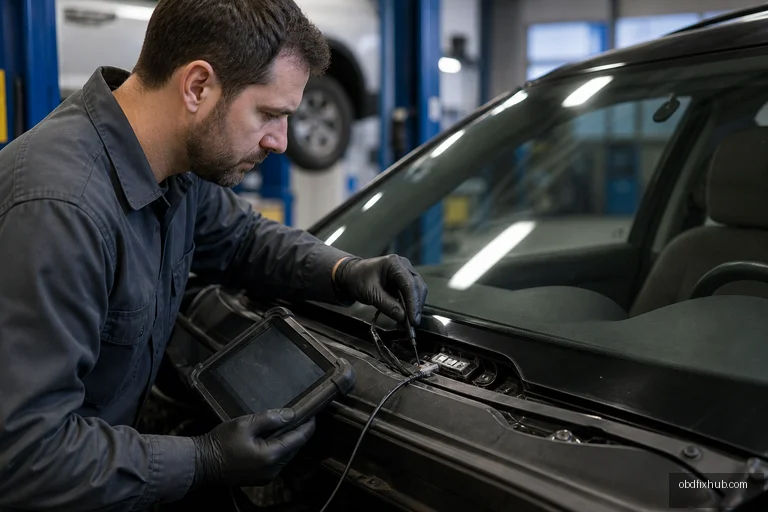
P00F2 means the vehicle’s engine or body control module has detected an open or interrupted circuit in the humidity sensor system. The fault is usually caused by a disconnected sensor, damaged wiring, corrosion, or water intrusion rather than an immediate engine failure. Although the car may continue to drive normally, automatic climate control, windshield defogging, and air-quality functions can be affected.
This guide explains what the code means, how to diagnose it without replacing parts unnecessarily, and how P00F2 differs from the related P00F4 code.
What Does P00F2 Humidity Sensor Circuit/Open Mean?
Diagnostic trouble code P00F2 is a generic OBD-II fault code for a humidity sensor circuit that the control module interprets as open. In practical terms, the module is not receiving a valid electrical signal from the sensor or cannot communicate with the sensor through its circuit.
The humidity sensor measures moisture in the cabin or incoming air. Depending on the vehicle, it may be installed near the windshield, inside the HVAC housing, near the interior rear-view mirror, or as part of a combined humidity, temperature, and solar-load sensor assembly. Its data helps the climate-control system decide when to activate automatic demisting and how to regulate cabin comfort.
Exact wiring and sensor design vary significantly by make and model. Some sensors use a conventional reference voltage and signal wire, while others contain electronics and communicate over a dedicated data line. For that reason, a vehicle-specific wiring diagram is more reliable than assuming every P00F2 system uses the same pinout.
Common Symptoms of P00F2
P00F2 often causes fewer driving symptoms than a fuel, ignition, or emissions-related code. The first sign may simply be an illuminated check-engine light or a climate-control warning. Common symptoms include:
- Check Engine or service warning light
- Automatic windshield defogging that does not activate correctly
- Unexpected changes in HVAC fan speed or air distribution
- Climate control switching to a backup operating strategy
- Incorrect humidity or interior comfort readings on vehicles that display them
- Intermittent HVAC behavior after rain, washing, or heavy condensation
- Other communication or sensor codes stored at the same time
In many cases, the air conditioner still cools and the heater still produces heat. That does not mean the fault is harmless: poor automatic defogging performance can reduce visibility in damp weather, especially during cold starts.
Why Does the P00F2 Code Appear?
1. Unplugged or poorly seated connector
A connector may be left partially disconnected after windshield, dashboard, mirror, trim, or HVAC work. A terminal that has lost tension can look connected but still create an open circuit when the vehicle vibrates.
2. Damaged wiring
Wires can be pinched under interior trim, stretched near a sensor bracket, or damaged by repeated movement. Rodent damage is also possible, particularly when the sensor wiring runs through a quiet area behind the dashboard.
3. Corrosion or water intrusion
Moisture around the windshield, sunroof drains, cowl area, or HVAC case can reach the connector. Green corrosion on copper terminals, white residue, or a connector that feels damp are strong clues. Cleaning the visible surface is not always enough because corrosion can travel inside the terminal crimp.
4. Failed humidity sensor
The sensor itself can fail internally, especially after prolonged condensation, liquid contamination, or an electrical short. A failed sensor should be confirmed with testing before replacement because sensor assemblies can be expensive and difficult to access.
5. Power, ground, or control-module fault
A missing power supply, poor ground, blown fuse, or damaged communication circuit can imitate a defective sensor. In rare cases, a software issue or control-module fault may set P00F2, particularly when other unrelated sensor communication codes appear together.
How to Diagnose P00F2 Correctly
- Scan all modules, not just the engine computer. Record every code, freeze-frame detail, and the module that reported P00F2. A body or HVAC module may provide more useful information than a basic code reader.
- Check for recent work or water exposure. Ask whether the windshield, dashboard, rear-view mirror, sunroof, or HVAC components were recently removed. A code that appeared immediately after such work deserves a connector inspection before electrical testing.
- Locate the sensor using factory service information. Do not assume it is under the hood. On some vehicles, the humidity sensor is attached to the windshield area or integrated into an interior climate sensor.
- Inspect the connector and terminals. Look for pushed-back pins, bent terminals, corrosion, moisture, broken locks, and signs of overheating. Gently tug each wire near the connector; a wire may be broken inside its insulation.
- Test power and ground under load. A quick voltage check can miss a high-resistance connection. Use the manufacturer’s pinout and test procedure, and avoid probing sealed terminals in a way that spreads them.
- Check continuity only when appropriate. Disconnect the battery or control modules as specified before testing resistance. If the sensor uses a data bus, do not apply test voltage to the communication wire.
- Compare live data. A humidity value fixed at an impossible reading, missing entirely, or changing erratically can help confirm the fault. Compare the reading with actual cabin conditions, but remember that a displayed percentage may be filtered or substituted by the module.
- Repair the root cause, then verify. After repairing a wire or replacing the sensor, clear the code and perform the required ignition cycle or road test. Confirm that the code does not return and that automatic defogging responds normally.
A common diagnostic mistake is replacing the humidity sensor immediately after seeing P00F2. In workshop situations, connector damage and water intrusion are frequent enough that the wiring should be checked first.
How Is P00F2 Repaired?
The correct repair depends on the test results. Possible fixes include securing a loose connector, repairing a broken wire with an appropriate sealed splice, replacing corroded terminals, drying and resealing a water leak, replacing the humidity sensor, or updating a control module with manufacturer-approved software.
Do not simply spray general-purpose lubricant into the connector. Some products leave residue that interferes with low-current sensor signals. Use an electronics-safe contact cleaner only when appropriate, allow the connector to dry, and correct the source of moisture before reconnecting it.
If the sensor is mounted near the windshield or mirror, removal may involve trim clips, a mirror cover, or a sensor pad attached to the glass. Forcing the housing can damage the windshield or the optical components used by rain and light sensors in the same assembly.
P00F2 Repair Cost
Costs vary widely by vehicle access and sensor design. A simple connector repair may cost approximately $50 to $200, while wiring diagnosis can take one to several labor hours. Replacing a humidity sensor or combined climate sensor may range from about $150 to $600, and integrated windshield-mounted assemblies can cost more.
These are broad U.S. estimates, not a fixed quote. The labor required to access the sensor, the use of an integrated assembly, dealer programming, and windshield-related work can change the final price substantially. A written diagnosis is more valuable than approving a sensor replacement based only on the code description.
Can You Drive With P00F2?
Usually, the vehicle can be driven if it runs normally and no overheating, electrical burning smell, or severe visibility problem is present. However, test the defroster before driving in wet or cold conditions. If the windshield does not clear properly, repair the fault promptly because reduced visibility is a safety issue.
What Does Engine Code P00F4 Mean?
P00F4 means Humidity Sensor Circuit Low. It indicates that the control module is seeing a humidity sensor signal or circuit voltage below the expected range, whereas P00F2 indicates an open or interrupted circuit. P00F4 can be caused by a short to ground, a failed sensor pulling the signal low, damaged wiring, or a connector problem.
The two codes can have similar symptoms and may occasionally appear together. Diagnose the actual circuit with the vehicle’s wiring diagram instead of relying only on the code label. A low-voltage reading does not automatically prove that the sensor is defective, and an open-code reading does not always mean the sensor itself is physically disconnected.
Frequently Asked Questions
Is P00F2 a serious engine problem?
Usually not. P00F2 primarily affects humidity sensing and climate-control functions, although poor automatic defogging can become a safety concern in damp weather.
Can a bad battery cause P00F2?
Low system voltage can create misleading sensor and communication codes, especially after a weak-battery start. Check battery voltage and charging performance, but inspect the humidity circuit if P00F2 returns after voltage is normal.
Where is the humidity sensor located?
Its location depends on the vehicle. Common positions include the windshield or rear-view mirror area, the dashboard, the HVAC intake, and the interior climate-control sensor housing. Use the factory repair information for the exact location.
Can I clear P00F2 without repairing it?
You can clear the code with a scan tool, but it will return if the circuit remains open. Clear it only after recording diagnostic data and making a repair, then verify the system during a complete drive cycle.
Should I replace the humidity sensor first?
No. Inspect the connector, wiring, power, ground, and any signs of water intrusion first. Confirming the sensor’s input and output with the correct service procedure prevents an unnecessary replacement.
Bottom Line
P00F2 identifies an open humidity sensor circuit, not a guaranteed bad sensor. Start with the connector, wiring, water leaks, power supply, and module data before buying parts. If automatic defogging is unreliable or the windshield will not clear, treat the repair as a visibility and safety priority rather than a cosmetic warning-light issue.




