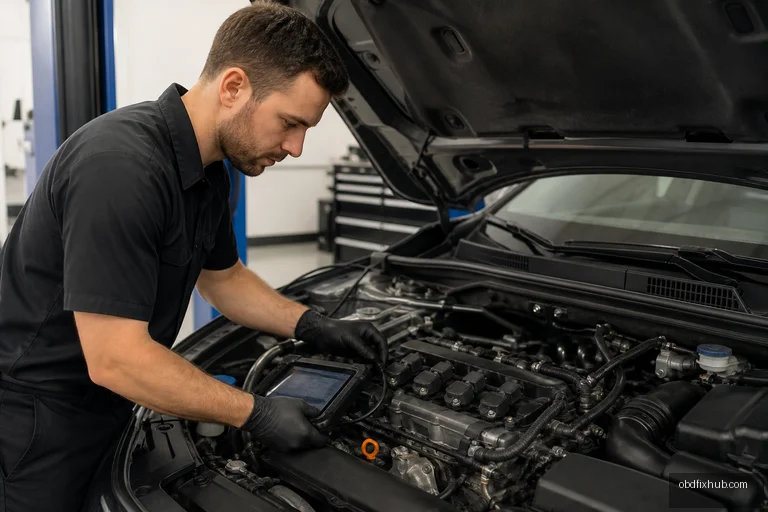
P039E Cylinder 1 Combustion Performance means the engine control module has detected that cylinder 1 is not producing the expected combustion contribution. The fault may be caused by an ignition problem, a faulty injector, low compression, incorrect valve timing, an air or fuel delivery issue, or an electrical fault. Do not assume the injector is bad simply because the code names a cylinder; a proper diagnosis must confirm whether cylinder 1 is receiving spark, fuel, air, and adequate compression.
What Does P039E Cylinder 1 Combustion Performance Mean?
The powertrain control module (PCM) monitors crankshaft speed changes after each firing event. A healthy cylinder accelerates the crankshaft consistently. If cylinder 1 produces noticeably less power than expected, the PCM can store P039E, sometimes alongside a conventional misfire code such as P0301.
The exact monitoring strategy varies by manufacturer. On some vehicles, the code is based on crankshaft acceleration; on others, it can involve combustion-pressure estimation, ion-sensing ignition feedback, or data from a cylinder-pressure monitoring system. For that reason, the factory service information for the specific make, model, engine, and model year matters.
Common Symptoms of P039E
A weak combustion event may be obvious at idle, or it may only appear under load. In a workshop, the most useful clue is often whether the engine runs poorly all the time or only during cold start, acceleration, or towing.
- Rough or uneven idle
- Engine hesitation during acceleration
- Reduced power, especially uphill
- Longer cranking or difficult starting
- Increased fuel consumption
- Flashing or illuminated check engine light
- Fuel smell from the exhaust when cylinder 1 is not burning correctly
- Unusual exhaust vibration or a noticeable rhythmic misfire
A flashing check engine light should be treated as urgent. An active misfire can send unburned fuel into the catalytic converter, raising its temperature enough to damage the substrate. Avoid hard acceleration and arrange testing promptly.
Most Likely Causes of the P039E Code
1. Ignition failure on cylinder 1
On gasoline engines, the ignition coil, spark plug, coil connector, or wiring can prevent a reliable spark. A cracked insulator, incorrect plug gap, oil in the plug well, or carbon tracking on the plug boot can create an intermittent fault that is difficult to reproduce at idle.
A useful workshop test is to inspect cylinder 1’s plug and compare it with the other cylinders. If the code or misfire moves after swapping the coil with another cylinder, the coil becomes a strong suspect. Always verify that the misfire actually follows the component; replacing parts based only on appearance is not a reliable diagnosis.
2. Faulty or restricted fuel injector
A clogged injector may deliver too little fuel, while a leaking injector can overfuel cylinder 1 and wash oil from the cylinder wall. Either condition can reduce combustion quality. A professional diagnosis may include injector balance testing, an electrical resistance check, a noid-light test, or oscilloscope analysis of injector current.
Listen for injector operation, but do not treat a clicking sound as proof that the injector is flowing correctly. An injector can click normally while its filter is restricted or its spray pattern is poor.
3. Low compression or mechanical damage
Burned valves, worn piston rings, a damaged piston, head-gasket leakage, or incorrect valve clearance can all produce weak combustion. Mechanical problems are particularly likely when the misfire remains on cylinder 1 after ignition and injector components have been tested.
A compression test is a useful first check, but a leak-down test usually provides more direction. Air heard at the throttle body suggests an intake valve leak; air at the exhaust indicates an exhaust valve problem; air from the crankcase points toward piston rings or piston damage; bubbles in the cooling system raise concern about a head gasket or cracked head.
4. Air, vacuum, or intake manifold problems
A leaking intake manifold gasket near cylinder 1 can create a localized lean condition. This is more likely to cause a rough cold idle that improves as the engine warms. Smoke testing the intake system is safer and more precise than spraying flammable chemicals around a running engine.
Check for a damaged PCV hose, loose intake runner, disconnected vacuum line, or carbon buildup affecting airflow. On engines with variable valve timing, a control problem can also alter cylinder filling and create combustion-quality faults.
5. Wiring, connectors, or control-module issues
Heat, oil contamination, rodent damage, and previous repairs can affect the coil, injector, or cylinder-monitoring circuits. Carefully inspect the connector for pushed-back terminals, corrosion, broken locks, and wiring that is stretched tight against the engine.
Voltage-drop testing under load is more informative than a simple continuity check. A wire may show continuity with the connector disconnected but fail when current flows through it. PCM failure is possible, but it should be considered only after power, grounds, inputs, outputs, and mechanical condition have been verified.
How to Diagnose P039E Step by Step
- Record all stored and pending codes. Note whether P0301, fuel-trim, oxygen-sensor, camshaft, or crankshaft codes are present. A companion code may identify the real cause.
- Save the freeze-frame data. Engine temperature, load, RPM, fuel trims, and vehicle speed show when the fault occurred. A cold-start fault points in a different direction than a high-load fault.
- Confirm the misfire. Use scan-tool misfire counters or cylinder contribution data. If cylinder 1 is not misfiring at the time of testing, look for an intermittent wiring, heat, or load-related problem.
- Inspect the basics. Check the cylinder 1 spark plug, coil, injector connector, intake tract, and visible wiring. Look for oil or coolant contamination around the plug.
- Perform a controlled component swap. Swap the coil or plug with a matching cylinder, clear the codes, and repeat the test. A fault that moves with the component is valuable evidence.
- Test fuel delivery. Verify fuel pressure under the conditions where the fault occurs and test injector command and balance. Do not rely on static fuel pressure alone.
- Check compression and perform a leak-down test. If electrical and fuel tests are normal, confirm that cylinder 1 can mechanically seal and breathe.
- Use an oscilloscope when needed. Coil current, injector current, crankshaft signal, camshaft synchronization, and relative-compression patterns can reveal faults that a basic code reader cannot.
One practical diagnostic shortcut is to compare cylinder contribution before and after disabling the fuel injector during a controlled test. A healthy cylinder causes a measurable RPM change when contributing; a weak cylinder causes a much smaller change. Follow the manufacturer’s safety procedure because disabling injectors or coils incorrectly can damage components or create dangerous exhaust temperatures.
How to Fix P039E
The correct repair depends on the failed test, not on the code alone. Possible repairs include replacing a worn spark plug, repairing a coil or injector circuit, cleaning or replacing a defective injector, repairing an intake leak, correcting valve timing, or repairing an internal engine fault.
- Replace ignition parts only after confirming the misfire follows the part or testing proves it is defective.
- Use the correct injector part number and verify its flow characteristics; some vehicles require injector coding or calibration after replacement.
- Repair wiring with properly sealed terminals and routing that protects it from heat and vibration.
- After mechanical repairs, recheck compression and confirm camshaft timing before clearing the code.
- Clear the code only after repairs, then complete a road test using the original freeze-frame conditions where safe.
If the code returns immediately after clearing, do not continue driving in the hope that it will resolve itself. A persistent combustion fault can damage the catalytic converter and may leave the vehicle unable to pass an emissions inspection.
Can You Drive With P039E?
Short, gentle driving may be possible if the check engine light is steady and the engine is running smoothly, but the vehicle should be diagnosed soon. Do not drive it normally if the light is flashing, the engine is shaking, power is severely reduced, or the exhaust smells strongly of raw fuel. Towing is the safer choice when an active misfire is severe.
Key Takeaway
P039E identifies a combustion-performance problem affecting cylinder 1, not a specific failed part. Start with scan data and a controlled ignition check, then test fuel delivery and engine compression before authorizing expensive repairs. A methodical diagnosis prevents the common mistake of replacing an injector when the real fault is a coil, intake leak, wiring problem, or mechanical loss of compression.
Frequently Asked Questions
Is P039E the same as P0301?
No. P0301 generally indicates a detected misfire on cylinder 1, while P039E describes a cylinder 1 combustion-performance fault. They can appear together, but the exact meaning of P039E depends on the vehicle manufacturer’s diagnostic strategy.
Can bad spark plugs cause P039E?
Yes. A worn, fouled, cracked, or incorrectly gapped spark plug can weaken combustion on cylinder 1. Inspect the plug and confirm the fault moves during a controlled swap before replacing other components.
Will an injector cleaner fix P039E?
Injector cleaner may help with mild deposit-related restriction, but it will not repair an electrically failed injector, a leaking injector, low compression, or damaged wiring. Test injector operation before relying on a chemical treatment.
Is P039E expensive to repair?
Repair cost ranges widely. A spark plug or damaged connector may be inexpensive, while an injector, valve, timing problem, or internal engine fault can cost considerably more. Testing first is the best way to avoid unnecessary parts replacement.




