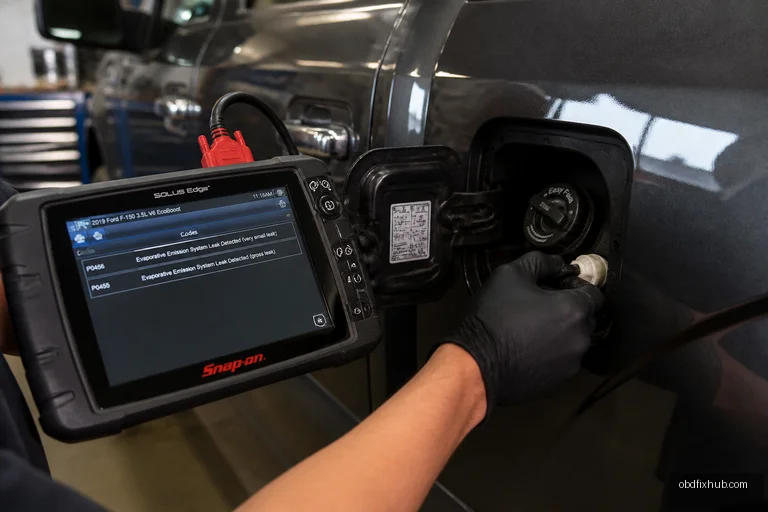
P04B5 Fuel Fill Door Stuck Open means the vehicle’s fuel-filler door position system is reporting that the door remains open when it should be closed. In many Ford vehicles, the problem involves the fuel-door actuator, position sensor, wiring, or a capless fuel-fill inlet rather than the exterior door alone. You can often perform a few safe checks at home, but a persistent code requires proper scan-tool diagnosis before replacing parts.
What Does DTC Code P04B5 Mean?
DTC P04B5 is generally defined as Fuel Fill Door Stuck Open. The powertrain or body control system monitors a switch, sensor, or actuator circuit associated with the fuel-filler door. If the reported position does not match the commanded position for a specified period, the module stores P04B5 and may illuminate the check-engine light.
Exact code wording and component locations can vary by manufacturer, model year, and body-control configuration. For that reason, do not diagnose P04B5 from the code description alone. The vehicle’s wiring diagram and manufacturer service information will identify whether your model uses a separate door switch, an integrated actuator sensor, or a capless inlet monitoring circuit.
Common Symptoms of P04B5
The obvious symptom is a fuel door that will not latch or appears open, but the electrical fault can exist even when the door looks normal. Typical symptoms include:
- Check-engine light or a fuel-system warning on the dashboard
- A fuel door that springs open, will not lock, or cannot be released
- A message such as Check Fuel Fill Inlet on certain Ford models
- Remote locking that does not secure the fuel door
- The fuel-door release button or touch-sensitive release failing intermittently
- P04B5 returning immediately after the code is cleared
An intermittent warning is especially useful diagnostically. If the code appears after heavy rain, a car wash, or freezing weather, moisture, corrosion, or ice is more likely than a failed control module.
Why Does the Fuel Door Get Stuck Open?
1. Failed actuator or latch mechanism
The actuator moves a locking pin or latch that holds the fuel door closed. Dirt, a broken spring, internal wear, or a seized mechanism can leave the door mechanically open even though the vehicle commands it to close. On some vehicles, the actuator and position sensor are one assembly, so the entire unit must be replaced.
2. Damaged position switch or sensor
A door can physically close while the sensor still reports an open position. This commonly happens when the switch plunger is bent, the mounting bracket has shifted, or the sensor has failed internally. Do not assume the exterior door is the defective part simply because it is the visible component.
3. Wiring, connector, or ground fault
The fuel-door circuit is often located behind an inner fender panel or near the filler neck, where it can be exposed to water, road salt, and pressure-washing. Look for green corrosion, pushed-out connector terminals, rubbed insulation, or wiring stretched near the hinge. A poor ground can produce a sensor reading that changes when the harness is moved.
4. Ice, dirt, or body misalignment
A frozen latch or compacted dirt may prevent full closure. A minor parking-lot impact can also shift the door or striker far enough that the latch no longer reaches its correct position. If the door is visibly sitting high, low, or uneven against the body, mechanical alignment should be checked before electrical parts are replaced.
5. Capless fuel-fill problems on Ford models
Many Ford vehicles use a capless fuel-filler system. A message such as Check Fuel Fill Inlet can be caused by debris in the inlet flaps, a damaged sealing surface, a stuck flap, or a leak-detection issue. This message is related to the fuel-fill system, but it is not automatically proof that the exterior fuel door actuator has failed.
What to Do If the Fuel Door Is Stuck Open
- Park safely and switch off the vehicle. Avoid smoking, open flames, and unnecessary electrical work around spilled fuel or strong fuel vapors.
- Inspect the door and latch. Remove ice or loose debris gently. Do not pry against the painted edge with a screwdriver, because bending the door can create a second repair.
- Try the normal release method once. Lock and unlock the vehicle, then operate the fuel-door release. Repeatedly cycling a failing actuator can drain the battery without solving the fault.
- Use the emergency release only if necessary. Many vehicles have a manual release cable or lever behind the trunk side trim, cargo panel, or interior access cover. Consult the owner’s manual for its exact location.
- Check the latch and wiring. With the door open, look for a broken plastic guide, loose connector, or damaged wires. Never bridge terminals unless the service procedure specifically calls for it.
- Scan the vehicle. Record P04B5 and any related body or fuel-system codes before clearing them. Freeze-frame data can show whether the fault occurred during a low-voltage, cold-weather, or intermittent condition.
If the door is open but the vehicle can be driven, keep the filler area clean and avoid high-pressure washing until it is repaired. An open fuel door can allow water and grit to collect around the filler neck, especially on trucks and SUVs.
How to Diagnose and Fix P04B5
A professional diagnosis usually starts with a scan tool that can access the body control module, not just a basic engine-code reader. The technician checks the live fuel-door status while commanding the actuator open and closed. If the command changes but the reported position does not, the actuator or sensor is suspect. If neither value changes, power, ground, communication, or module-side faults become more likely.
A practical electrical test includes checking battery voltage, actuator power, ground voltage drop, and continuity through the harness. Continuity alone is not enough: a corroded wire may pass a static test but fail under load. Wiggle-testing the connector while watching live data often exposes an intermittent open circuit.
Typical repairs include cleaning and lubricating the approved latch contact points, realigning the fuel-door striker, replacing the actuator, replacing a door-position switch, repairing wiring, or cleaning a contaminated capless fuel inlet. Use only lubricant specified for the mechanism; heavy grease can attract dust and cause the latch to stick again.
How to Fix Check Fuel Fill Inlet on a Ford
When a Ford displays Check Fuel Fill Inlet, first inspect the capless filler opening with a flashlight. Remove visible dirt around the outer flap without forcing the internal seals. If the inlet has been contaminated by a mis-sized fuel nozzle, a damaged funnel, or debris, the flaps may not close correctly and the evaporative-emissions system may detect a leak.
Ford vehicles commonly include a special funnel in the roadside tool kit or vehicle storage area. It can be used to open the capless inlet during refueling, but it should not be used as a pry tool or left inserted. If the warning returns after the inlet is clean and the fuel door latches correctly, test the evaporative-emissions system and fuel-door circuit rather than repeatedly clearing the code.
How Much Does It Cost to Fix a Fuel Door?
Repair pricing depends on whether the problem is mechanical, electrical, or part of the capless fuel-filler assembly. Typical U.S. ranges are:
- Cleaning, adjustment, or minor latch repair: $50–$150
- Diagnostic scan and electrical testing: $100–$200
- Fuel-door actuator or latch replacement: $150–$400
- Wiring or connector repair: $100–$350, depending on access
- Capless fuel-fill inlet replacement: approximately $250–$700
- Painted or body-damaged fuel door replacement: $200–$600 or more
Dealer pricing, labor rates, vehicle design, and part availability can change these figures significantly. Ask for a written diagnosis that identifies the failed test result, not merely a recommendation to replace the visible fuel door.
Can You Keep Driving With P04B5?
Usually, a vehicle with P04B5 can be driven if there is no fuel leak, strong fuel odor, damaged filler neck, or difficulty securing the fuel system. However, the open door can expose the filler area to contamination, and a related evaporative-emissions fault may affect inspection readiness. Stop driving and have the vehicle inspected promptly if fuel is leaking or vapors are present.
Final Takeaway
P04B5 does not automatically mean the fuel door itself must be replaced. Start with the latch, alignment, moisture, connector, and capless inlet, then confirm the actuator and sensor operation with live data. For a Ford Check Fuel Fill Inlet warning, inspect the capless filler separately from the exterior door. A focused diagnosis is usually cheaper and more reliable than replacing parts by guesswork.
Frequently Asked Questions
What does the P04B5 code mean?
P04B5 generally means the vehicle detects that the fuel-fill door is stuck open or that its position signal does not match the commanded position. The precise circuit varies by vehicle.
What should I do if my fuel door is stuck open?
Inspect for ice, dirt, misalignment, and visible wiring damage, then use the manufacturer-approved emergency release if needed. Avoid prying the door and arrange a scan if the problem returns.
How do I fix Check Fuel Fill Inlet on a Ford?
Inspect and clean the capless filler flaps, use the correct Ford funnel when required, and check that the fuel door latches. If the warning returns, test the inlet, evaporative system, actuator, and wiring.
How much does it cost to repair a fuel door?
Simple cleaning or adjustment may cost $50–$150, while an actuator, wiring repair, or capless inlet replacement commonly ranges from $150 to $700 depending on the vehicle and labor.




