Search intent: Informational — Drivers searching for P0500 Vehicle Speed Sensor A Circuit usually want to know whether the sensor itself has failed, whether the car is safe to drive, and what the repair will cost. P0500 means the vehicle’s control system is not receiving a credible vehicle-speed signal; the cause may be a faulty speed sensor, damaged wiring, an instrument cluster problem, an ABS wheel-speed signal issue, or a communication fault. Do not replace the sensor before testing the signal path, because the sensor is often blamed when the real fault is a broken wire or a failed reluctor ring.
What Does P0500 Vehicle Speed Sensor A Circuit Mean?
P0500 is a generic OBD-II diagnostic trouble code for a vehicle speed sensor malfunction. The transmission control module, engine control module, ABS module, or another control unit uses vehicle-speed data to manage fuel delivery, shifting, cruise control, torque-converter lockup, and speedometer operation.
The wording varies by manufacturer. On some vehicles, “Vehicle Speed Sensor A” refers to a transmission-mounted output-speed sensor. On others, the PCM calculates road speed from ABS wheel-speed sensors and network data. That is why a P0500 on a Toyota, Nissan, Ford, Volkswagen, or GM vehicle cannot be diagnosed correctly from the code description alone. The factory wiring diagram and service information identify which sensor or data network the vehicle actually uses.
Common Symptoms of a P0500 Fault
A P0500 fault can produce one symptom or several at the same time. A car that still drives normally may nevertheless have a serious loss of speed information, so the absence of drivability problems does not prove the code is harmless.
- Check Engine Light or ABS warning light
- Inoperative, erratic, or inaccurate speedometer
- Automatic transmission stuck in one gear or shifting harshly
- Cruise control that will not set or suddenly cancels
- Disabled traction control, stability control, or hill-start functions
- Delayed torque-converter lockup and higher fuel consumption
- Engine stalling when coasting to a stop on some vehicles
- Distance, trip computer, or fuel-economy readings that become inaccurate
One useful clue is the speedometer. If it drops to zero while the vehicle is moving and the transmission begins shifting abnormally, the speed signal may be missing before it reaches the engine or transmission module. If the speedometer works but the ABS and stability lights are on, an ABS wheel-speed circuit or wheel bearing may be the more likely source.
What Causes P0500?
- Failed vehicle speed sensor: Internal electronics can fail intermittently, especially when the sensor is exposed to transmission heat and fluid contamination.
- Damaged wiring or connectors: Chafed insulation, corrosion, loose terminals, and wiring stretched near the transmission are frequent real-world causes.
- Damaged reluctor or tone ring: A cracked, missing, or heavily rusted trigger ring can make a good sensor produce an unreliable signal.
- ABS wheel-speed sensor fault: Some vehicles derive road speed from one or more wheel sensors rather than a separate transmission VSS.
- Instrument cluster failure: The cluster may receive the signal but fail to display it or pass it through the vehicle network.
- Transmission or differential work: Incorrect installation, an incorrect air gap, or a displaced connector after repairs can trigger P0500.
- CAN-bus communication problems: A shorted network wire, low system voltage, or a failed module may interrupt speed data.
- Incorrect tire or wheel configuration: Major tire-size differences or mismatched wheel-speed signals can create implausible speed readings on some systems.
How to Diagnose P0500 Correctly
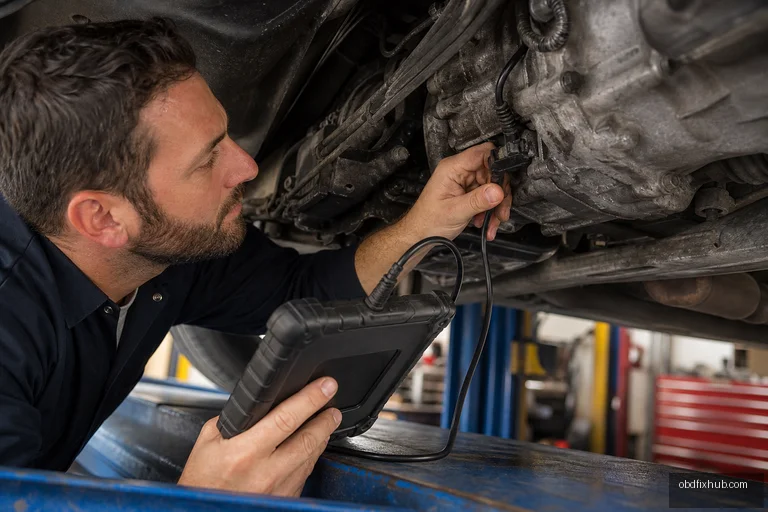
A professional diagnosis starts with data, not parts replacement. The following sequence prevents the common mistake of installing a new sensor when the fault is actually in the harness or ABS system.
- Scan every module, not only the engine computer. Record freeze-frame data and check the ABS, transmission, body, and instrument-cluster modules for related codes. U-codes, wheel-speed codes, and low-voltage codes can change the entire diagnosis.
- Compare live speed readings. During a road test or with the vehicle safely raised, compare the scan tool’s vehicle-speed value, individual wheel speeds, transmission output speed, and the dashboard speedometer. One reading that suddenly drops to zero is a valuable lead.
- Inspect the physical circuit. Follow the sensor harness from the transmission or wheel hub. Look for rubbing against a driveshaft, oil saturation, broken clips, bent pins, green corrosion, and connectors that are not fully locked.
- Test power, ground, and signal. A digital multimeter can verify supply voltage and ground, but a scope is better for checking a digital speed waveform. Hall-effect sensors generally require correct power and ground; simply measuring resistance may incorrectly condemn a good sensor.
- Check the trigger mechanism. Inspect the tone ring, reluctor, wheel bearing, and sensor mounting surface. Excessive wheel-bearing play can change the sensor air gap and cause an intermittent signal.
- Confirm the repair. Clear the code, perform a controlled road test, and verify that all modules receive a stable speed signal. A code that returns immediately during a stationary key-on test may indicate a circuit or communication problem rather than a mechanical road-speed issue.
When testing a wheel-speed sensor, compare its waveform or live data with the sensor on the opposite side. A slow-speed comparison often reveals a missing pulse, while a visual inspection alone may miss a reluctor ring that is cracked only in one position.
How Do You Fix a P0500 Fault Code?
The correct repair depends on the failed part identified during testing. Typical fixes include replacing the transmission speed sensor, repairing or replacing damaged wiring, cleaning or replacing a corroded connector, fitting a new ABS wheel-speed sensor, replacing a damaged wheel bearing or reluctor ring, or repairing a failed instrument cluster or network circuit.
After the repair, secure the harness away from heat and moving components. Use the correct connector terminals and weather seals; twisting wires together and covering them with electrical tape may produce a temporary improvement but often allows moisture to return and the code to come back.
If the vehicle has recently had transmission, axle, brake, or wheel-bearing work, inspect the repaired area first. A pinched harness or incorrectly seated sensor is often more likely than a coincidental electronic module failure.
How Much Does It Cost to Replace a P0500 Vehicle Speed Sensor?
The cost to replace a vehicle speed sensor is commonly about $150 to $450, including parts and labor, although the exact amount varies widely by vehicle and sensor location. An easily accessible external sensor may cost less, while a sensor inside a transmission, an integrated hub assembly, or a difficult ABS sensor can cost considerably more.
- Diagnostic testing: approximately $80–$180
- External transmission speed sensor: approximately $150–$450 installed
- ABS wheel-speed sensor: approximately $200–$600 installed
- Wheel hub with integrated sensor: approximately $350–$900 installed
- Wiring or connector repair: approximately $100–$500, depending on access
- Cluster, CAN-bus, or module repair: often $300–$1,500 or more
These are practical price ranges rather than a fixed quote. Before approving a replacement, ask the shop which test proved the sensor was defective. Paying for diagnosis is usually cheaper than replacing a sensor, ABS hub, and cluster in sequence without evidence.
Can I Drive With a Faulty Speed Sensor?
You may be able to drive a short distance if the vehicle brakes, steering, and engine operate normally, but it is not wise to continue using it for weeks. A missing speed signal can disable ABS or stability control, interfere with transmission shifting, and make the speedometer inaccurate. You may also unintentionally exceed the speed limit because the dashboard is not reporting road speed correctly.
Stop driving and arrange a repair or tow if the brake pedal feels abnormal, the ABS and red brake warnings appear together, the transmission is stuck in gear, the vehicle shifts violently, or the speedometer remains at zero. Driving conditions matter: a vehicle with disabled traction control is significantly less safe on wet, icy, or gravel roads.
Is It Safe to Drive With a P0500 Code?
There is no universal yes-or-no answer. A P0500 with only a Check Engine Light may allow cautious driving to a repair facility, but it should not be treated as a routine emissions code. Confirm that the speedometer works, avoid high-speed travel and poor weather, leave extra stopping distance, and have the fault diagnosed promptly.
If the ABS, traction-control, or stability-control lamps are also illuminated, assume those safety systems may not function during an emergency stop or skid. In that situation, professional diagnosis is the safer choice than continuing normal daily driving.
Frequently Asked Questions
Is P0500 caused by the speed sensor every time?
No. Wiring, connectors, ABS sensors, tone rings, wheel bearings, the instrument cluster, and CAN-bus communication faults can all create the same code. Test the signal before replacing the sensor.
Will disconnecting the battery fix P0500?
Disconnecting the battery may clear the stored code temporarily, but it does not repair the underlying fault. The code will return when the control module again detects a missing or implausible speed signal.
Can bad tires cause a P0500 code?
Incorrect tire sizes or a major difference in tire circumference can confuse wheel-speed calculations on some vehicles, particularly when traction-control or ABS data is used to calculate vehicle speed. Check tire size and inflation, but do not assume tires are the cause without checking live data.
How long does a P0500 repair take?
A straightforward sensor replacement may take 30 minutes to two hours. Wiring faults, integrated wheel hubs, internal transmission sensors, and intermittent network problems can require several hours of testing and repair.
Bottom Line
P0500 identifies a lost, implausible, or unavailable vehicle-speed signal—not automatically a failed speed sensor. Scan all modules, compare live speed data, inspect the wiring and trigger ring, and confirm the repair with a road test. If the speedometer, ABS, or transmission behavior is abnormal, limit driving and arrange a proper diagnosis before a minor electrical fault becomes a safety or transmission problem.




