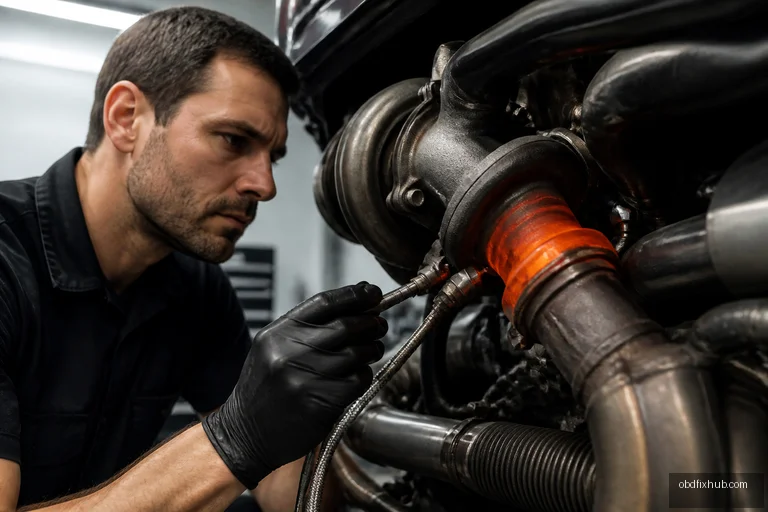
P0544 means the engine computer has detected a problem in the exhaust gas temperature (EGT) sensor circuit, usually Bank 1 Sensor 1. In practical terms, the PCM is receiving an implausible signal, no signal, or an electrical reading outside the expected range. You may be able to drive a short distance, but continuing to ignore the fault can affect turbocharger protection, emissions control, diesel particulate filter regeneration, and fuel economy.
What Does the P0544 Fault Code Mean?
The diagnostic trouble code P0544 is defined as “Exhaust Gas Temperature Sensor Circuit, Bank 1 Sensor 1.” Bank 1 is the side of the engine containing cylinder number one. Sensor 1 normally refers to the first EGT sensor in the exhaust system, often positioned before a turbocharger, catalytic converter, or diesel particulate filter, depending on the vehicle.
There is no universal sensor location across all makes and models. On one turbocharged gasoline engine, Bank 1 Sensor 1 may be installed in the exhaust manifold. On a diesel, it may be mounted in the exhaust pipe before the turbocharger or oxidation catalyst. Always confirm the location using the vehicle’s service information rather than replacing the most accessible sensor.
Common Symptoms of a Bad Exhaust Gas Temperature Sensor
A failed EGT sensor does not always produce dramatic drivability problems. The sensor’s primary job is to report exhaust temperature so the PCM can protect components and control emissions systems. Symptoms may therefore appear as warning lights or reduced performance rather than a complete breakdown.
- Check Engine Light or an engine/emissions warning message
- Reduced engine power or limp-home mode
- Turbocharger boost being limited or delayed
- Poor fuel economy and altered fuel injection strategy
- Harder diesel particulate filter regeneration or a failed regeneration cycle
- Cooling fan operation after shutdown, depending on the vehicle
- Unusually high or low EGT data on a scan tool
- Other related codes for the DPF, turbocharger, catalyst, or air-fuel system
A useful clue is a temperature value that is impossible for the operating conditions. With the engine cold, the EGT reading should usually be reasonably close to intake air temperature and other nearby temperature sensors. A reading stuck at an extreme value, such as a very high temperature immediately after a cold start, points toward an open circuit, short circuit, or sensor failure.
What Causes P0544?
The sensor itself is only one possible cause. EGT wiring operates close to extreme heat, so harness damage is particularly common. Heat can harden the insulation, expose copper strands, or cause the wiring to contact the exhaust and intermittently short as the engine moves.
- Open, shorted, melted, or chafed EGT sensor wiring
- Loose, corroded, contaminated, or heat-damaged connector terminals
- Failed exhaust gas temperature sensor
- Incorrect sensor fitted after an exhaust, turbo, or DPF repair
- Exhaust leaks near the sensor or an altered exhaust system
- Damaged sensor threads or a sensor installed without proper heat protection
- Rarely, a PCM fault or a power, ground, or reference-voltage problem
Aftermarket exhaust modifications deserve special attention. Removing or relocating a sensor, extending its wiring with unsuitable cable, or installing a sensor with a different resistance curve can create P0544 even when the sensor is new.
Can You Drive With a Faulty Exhaust Gas Temperature Sensor?
Short trips to a repair facility are often possible if the vehicle runs normally and no red warning lights appear. However, it is not wise to continue driving for weeks with P0544. The PCM may disable protective strategies or use substitute values, potentially allowing excessive exhaust temperature that can damage a turbocharger, catalyst, or DPF.
Stop driving and arrange professional diagnosis if the vehicle enters limp mode, loses substantial power, produces heavy smoke, shows a flashing Check Engine Light, overheats, or displays a DPF warning. Avoid towing, sustained high-speed driving, and heavy acceleration until the fault is understood. A sensor problem can also prevent a diesel from completing regeneration, which may eventually lead to an expensive DPF restriction.
How to Diagnose the P0544 Exhaust Gas Temperature Sensor Circuit
Replacing the sensor immediately is a common mistake. A professional diagnosis begins with the code details, freeze-frame data, wiring inspection, and live temperature readings.
- Confirm the code: Scan for P0544 and related codes. Record engine temperature, exhaust temperature, vehicle speed, and load from the freeze-frame data.
- Locate Bank 1 Sensor 1: Use manufacturer documentation to identify the correct sensor. Do not assume the first visible EGT sensor is the one named by the code.
- Inspect the harness: Follow the wiring from the sensor to the main loom. Look for melted insulation, pulled wires, corrosion, poor repairs, and contact with the exhaust.
- Check cold-engine data: Before starting the engine, compare the EGT reading with ambient temperature and other temperature sensors. A wildly inaccurate value is a strong diagnostic clue.
- Test the circuit: Check supply voltage, ground, continuity, and short-to-ground or short-to-power conditions as specified by the manufacturer. EGT sensor resistance is not universal, so use the correct service-manual specification.
- Inspect exhaust condition: Check for leaks, missing heat shields, or modifications that may expose the sensor and wiring to abnormal temperatures.
- Repair and verify: After repairing the wiring or replacing the sensor, clear the code and perform a road test. Confirm that the temperature rises smoothly and plausibly under load.
Never test a hot EGT sensor with bare hands. The sensor and surrounding exhaust can remain hot long after the engine is switched off. Also avoid applying excessive force to a seized sensor; damaged exhaust threads can turn a straightforward repair into a manifold or pipe replacement.
How Is P0544 Fixed?
The repair depends on the confirmed failure. A damaged connector may need terminal replacement rather than electrical tape. A melted section of wiring should be repaired with high-temperature-rated wire, correctly sealed splices, and safe routing away from the exhaust. If the sensor is faulty, it should be replaced with the correct part number or an OE-quality equivalent.
On vehicles with a seized sensor, a technician may need penetrating fluid, controlled heat, and the correct deep socket. The exhaust should be cool before removal, and the new sensor should be installed using the manufacturer’s torque and anti-seize instructions. Some sensors must not have anti-seize applied to the sensing tip or threads because contamination can affect the reading.
How Much Does It Cost to Replace an Exhaust Gas Temperature Sensor?
In the United States, a typical EGT sensor replacement costs approximately $200 to $600, including parts and labor. The sensor itself may cost $80 to $300, while labor commonly ranges from $100 to $300 depending on access and corrosion.
- Wiring or connector repair: roughly $100–$400
- Accessible sensor replacement: roughly $200–$450
- Diesel, turbo, or seized-sensor repair: roughly $400–$900 or more
- Additional DPF or catalyst damage: potentially well above $1,000
Prices vary significantly by vehicle, region, sensor position, and whether the exhaust has been modified. Ask the workshop whether the quote includes diagnosis, sensor replacement, removal of seized hardware, code clearing, and post-repair verification.
How to Prevent the Code From Returning
- Keep the wiring clipped securely away from the exhaust and turbocharger.
- Repair oil or coolant leaks that can contaminate connectors.
- Use the correct sensor rather than a visually similar universal part.
- Inspect EGT wiring whenever a DPF, turbocharger, manifold, or exhaust is removed.
- Do not ignore related boost, DPF, or overheating faults that may overload the sensor.
Bottom Line
P0544 is an electrical circuit fault involving the Bank 1 Sensor 1 exhaust gas temperature sensor, not a diagnosis that automatically proves the sensor itself has failed. Check the wiring, connector, sensor location, live data, and manufacturer specifications before buying parts. If the vehicle is losing power or showing DPF or overheating warnings, stop driving and have it diagnosed promptly to prevent secondary exhaust-system damage.
Frequently Asked Questions
What does P0544 mean on a diesel?
It means the PCM detected a problem in the Bank 1 Sensor 1 exhaust gas temperature sensor circuit. On a diesel, the fault can interfere with DPF regeneration and exhaust-temperature protection.
What are the symptoms of a bad exhaust gas temperature sensor?
Common symptoms include a Check Engine Light, reduced power, incorrect scan-tool temperature readings, poor fuel economy, turbo protection, and DPF regeneration problems. Some vehicles show only the warning light.
Can I clear P0544 without replacing the sensor?
You can clear the code temporarily, but it will return if the electrical fault remains. If inspection finds a broken wire, corroded terminal, or poor connector, repairing that issue may resolve P0544 without sensor replacement.
Is P0544 expensive to fix?
Many repairs fall between $200 and $600, although a simple wiring repair may cost less and a seized sensor or related DPF damage may cost considerably more.




