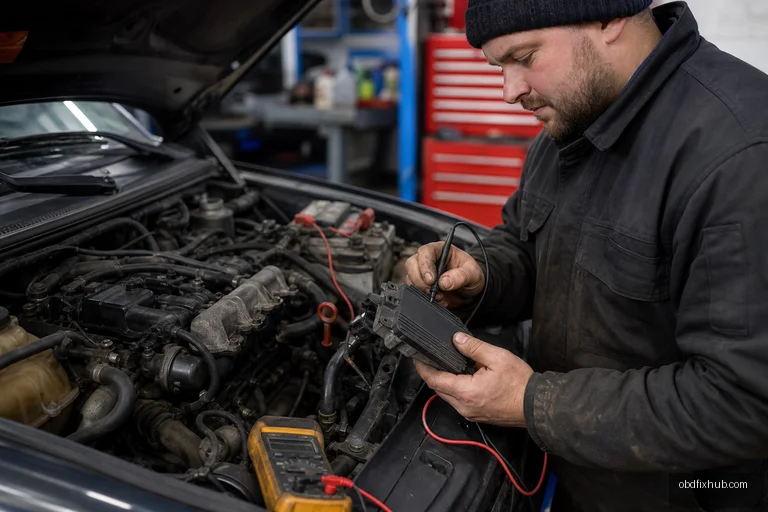
P064C Glow Plug Control Module means the engine computer has detected a fault involving glow plug control module 1, its internal operation, power supply, communication, or control circuit. The code can cause hard cold starts, extended cranking, white smoke, and reduced diesel performance, but it does not automatically prove that the module itself has failed. Battery voltage, grounds, wiring, glow plugs, and software must be checked before replacing an expensive control unit.
What Does Fault Code P064C Mean?
P064C is a generic OBD-II powertrain code associated with the glow plug control module. On many diesel vehicles, the engine control module commands the glow plug module, while the module supplies and monitors high current to the individual glow plugs. If the expected voltage, timing, feedback, or communication is not present, the PCM can store P064C.
The exact wording and test strategy vary by manufacturer. Some vehicles describe it as a glow plug control module internal performance fault, while others focus on module communication or timing. For that reason, the vehicle-specific service information and freeze-frame data are more useful than relying on a universal parts-swapping procedure.
Common Symptoms of P064C
A failed or poorly supplied glow plug module is usually most noticeable when the engine is cold. A warm engine may start almost normally because diesel ignition depends less on glow plug assistance after the combustion chamber has reached operating temperature.
- Hard starting or extended cranking below freezing
- Rough running for the first few seconds after startup
- White or gray exhaust smoke during cold starts
- Glow plug warning light or check engine light
- Reduced glow plug preheat time or no visible preheat operation
- Battery drain caused by repeated long cranking
- Reduced fuel economy or poor cold-weather drivability
Some modern diesel vehicles will not show dramatic symptoms when P064C first appears. The module may work intermittently, or only one bank of glow plugs may be affected. A vehicle that starts well at 70°F but struggles at 20°F is a typical real-world pattern.
How to Know If a Glow Plug Control Module Is Bad
The most reliable diagnosis combines scan data, electrical testing, and an output test. Do not condemn the module solely because P064C is stored; a weak battery or corroded ground can produce the same result.
- Record all diagnostic codes. Scan the PCM and, when possible, the glow plug module itself. Codes for low system voltage, communication, individual glow plugs, or open circuits may identify the original fault.
- Check battery voltage first. A healthy battery should generally measure about 12.4–12.7 volts with the engine off. During cranking, voltage should not collapse excessively. Diesel glow systems are very sensitive to low voltage.
- Inspect power and ground circuits. Look for blown fuses, overheated connectors, loose terminals, damaged harnesses, and corrosion near the module. Voltage-drop testing under load is more useful than a simple continuity check.
- Test the glow plug command. With a bidirectional scan tool, activate the glow plug system if the vehicle supports that function. Verify that the module receives the command and delivers the expected output.
- Measure individual glow plugs correctly. A shorted glow plug can overload the control module. Resistance specifications differ, but a single reading that is dramatically different from the others deserves attention. Use the manufacturer’s test procedure because some modern glow plugs operate at very low voltage.
- Confirm module communication. If power, ground, wiring, and glow plugs are good but the module does not respond or repeatedly fails its internal test, replacement becomes much more likely.
A useful workshop clue is whether the code returns immediately after clearing. An instant return with verified power and ground points toward a module or communication problem. A code that returns only during a cold start may indicate an intermittent connection, temperature-sensitive component, or a glow plug that fails under load.
Most Common Causes of P064C
- Failed glow plug control module
- Low battery voltage or a weak charging system
- Blown glow plug fuse or fusible link
- Corroded, loose, or overheated module connector
- Damaged power, ground, or communication wiring
- One or more shorted, open, or incorrect glow plugs
- Engine control module software or calibration issue
- Water intrusion, road salt, or excessive heat around the module
On heavy-duty diesel trucks, the module can be exposed to substantial heat and vibration. A connector may look clean from above but have terminal tension problems underneath. Gently tugging each wire, checking terminal fit, and inspecting for heat discoloration often reveals a fault that a visual inspection misses.
How to Fix P064C
Begin by charging or replacing a weak battery and repairing any blown fuse, poor ground, or damaged wiring. If a fuse has failed, find out why before installing another one; a shorted glow plug or internally damaged module may blow it again. Clear the code and perform a cold-start verification after repairs.
If the glow plugs test correctly and the module has stable power, ground, and communication, replace the glow plug control module with the correct part for the engine calibration. Some vehicles require programming, initialization, or a relearn procedure after installation. Always compare the original connector, part number, and software requirements before ordering a replacement.
Do not use a conventional test light or apply battery voltage to modern low-voltage glow plugs unless the service procedure specifically allows it. Incorrect testing can damage the glow plug or the new control module.
How Much Does It Cost to Replace a Glow Plug Control Module?
In the United States, a typical glow plug control module replacement costs approximately $250 to $900, including parts and labor. Many passenger diesel vehicles fall near the lower or middle part of that range, while large diesel pickups using an expensive OEM module can reach $800 to $1,500 or more.
- Aftermarket module: roughly $100–$400
- OEM module: roughly $250–$800 or higher
- Diagnostic labor: commonly $100–$200
- Installation labor: usually 1–3 hours, depending on access
These figures exclude related repairs such as glow plugs, corroded wiring, batteries, fuses, or programming. A low-cost module installed without testing can become an expensive repeat repair, especially if a shorted glow plug destroys the replacement.
How Long Does a Glow Plug Control Module Last?
There is usually no scheduled replacement interval. A glow plug control module may last 8–15 years or well over 100,000 miles, but severe winters, frequent short trips, moisture, engine heat, and poor battery condition can shorten its life considerably. The module works hardest during cold starts, so a vehicle used in a cold climate experiences more operating cycles than one used in a warm region.
Maintaining the battery, charging system, engine grounds, and correct glow plugs is the best way to extend module life. If the module has already failed once, check for excessive glow plug current before installing the next one.
Can You Drive With P064C?
Short-term driving may be possible if the engine starts normally, but the vehicle may fail to start after the temperature drops. Repeated long cranking can damage the starter and weaken the battery. If the warning light is accompanied by severe misfiring, heavy smoke, low voltage, or multiple electrical codes, diagnose the vehicle promptly rather than continuing to drive.
Final Takeaway
P064C identifies a glow plug control module-related fault, not automatically a bad module. Start with battery voltage, fuses, grounds, wiring, module communication, and glow plug condition. Once those checks pass, replacing and, where required, programming the correct control module is the dependable repair. A proper diagnosis can prevent both unnecessary parts costs and a repeat failure on the next cold morning.
Frequently Asked Questions
What does P064C mean in a glow plug system?
It indicates a detected problem with glow plug control module 1, such as internal performance, power supply, communication, or control operation. The exact definition depends on the vehicle manufacturer.
Can bad glow plugs cause P064C?
Yes. A shorted or incorrectly rated glow plug can overload the module and trigger a control-module fault. Test the individual glow plugs before installing a replacement module.
Will P064C prevent a diesel engine from starting?
It can, particularly in cold weather, although many engines still start when warm. The actual result depends on ambient temperature, engine condition, battery strength, and how many glow plugs are affected.
Is it safe to replace the module without programming?
Some vehicles accept a direct replacement, while others require initialization or software programming. Check the manufacturer’s procedure before installation and complete any required setup with a capable scan tool.




