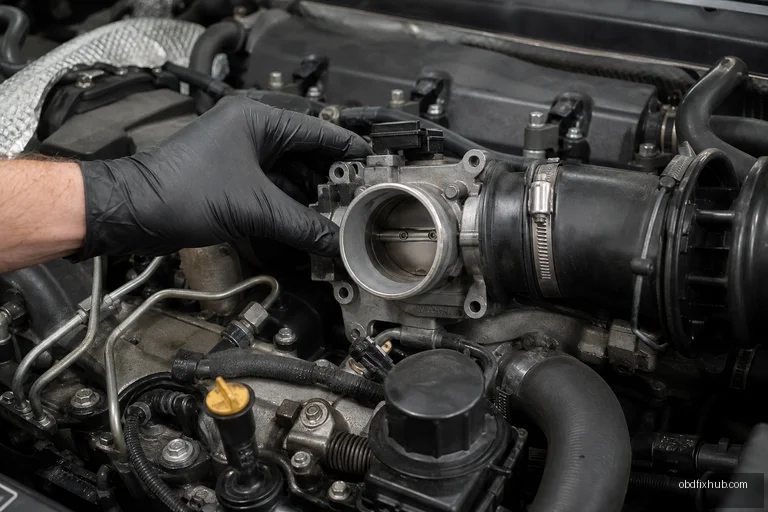
P06FE Cold Start Diesel Intake Air Flow Control Performance means the engine computer has detected that the intake air control system is not behaving as expected during a cold start. On many diesel engines, this points to a sticking or electronically misbehaving intake throttle valve, air control valve, wiring fault, or an airflow problem caused by heavy carbon buildup. The code does not automatically mean the valve itself must be replaced; a proper diagnosis must confirm whether the fault is mechanical, electrical, or caused by another system.
What Does the P06FE Code Mean?
Diesel engines do not normally use a conventional throttle plate to control engine power like gasoline engines do. However, many modern diesels have an intake throttle valve, diesel throttle valve, or air control valve. The engine control module uses it during cold starting, exhaust gas recirculation operation, DPF regeneration, emissions control, and sometimes engine shutdown.
When the engine is cold, the control module commands a specific valve position and expects to see a corresponding response from the position sensor or airflow-related readings. P06FE is stored when the actual response does not match the commanded performance within a calibrated period. The exact wording and test strategy can vary by manufacturer, so the vehicle’s service information is important.
P06FE Symptoms You May Notice
Some vehicles trigger only the check engine light, while others develop obvious drivability problems. Symptoms depend on whether the valve is stuck open, stuck closed, moving slowly, or producing an unreliable position signal.
- Check engine light or malfunction indicator lamp
- Hard starting or extended cranking when the engine is cold
- Rough idle immediately after startup
- Hesitation, reduced power, or limp mode
- Excessive black smoke during acceleration
- Engine stumble or stalling after a cold start
- Unsuccessful or interrupted DPF regeneration
- Higher fuel consumption
- A delayed or harsh engine shutdown on some models
A useful diagnostic clue is temperature dependence. If the vehicle starts and drives normally once warm but acts up after sitting overnight, focus first on the cold-start command, intake valve movement, connector condition, and battery voltage during cranking.
Common Causes of P06FE
1. Carbon buildup in the intake air control valve
Diesel intake systems routinely carry oil mist from the crankcase ventilation system and soot from the EGR system. Over time, this mixture can form a sticky deposit around the throttle plate and bore. The actuator may still make noise, but the valve can move too slowly or fail to reach its commanded cold-start position.
2. Faulty intake throttle or air control actuator
The electric motor, internal gears, or position sensor can fail independently. A common pattern is a valve that passes a basic movement test but becomes unreliable at one section of its travel. This is why checking only whether the valve moves is not enough; commanded position and actual position should be compared with a scan tool.
3. Wiring, connector, or ground problems
Oil contamination, water intrusion, corroded terminals, and wiring rubbed against the engine can interrupt the actuator power or feedback circuit. A connector that looks acceptable may still have loose terminal tension. Voltage-drop testing under load is more useful than simply checking continuity with the connector unplugged.
4. Low battery voltage during cold cranking
Cold temperatures expose weak batteries and poor connections. If system voltage drops sharply while the starter is operating, the actuator may not complete its initialization routine, and the control module may record a performance fault. Always test battery condition and charging voltage before condemning an expensive air control valve.
5. Airflow restriction or related engine faults
A blocked air filter, severely restricted intake, collapsed hose, EGR valve problem, or excessive intake manifold deposits can make the measured airflow inconsistent with the valve command. On some vehicles, P06FE appears alongside EGR, MAF, boost, or DPF codes. Those additional codes may identify the root cause rather than being unrelated complaints.
How to Diagnose P06FE Correctly
Replacing the intake valve immediately is a common and expensive mistake. A disciplined test sequence usually separates a dirty valve from an electrical fault in less time than repeated parts replacement.
- Record all stored and pending codes. Save freeze-frame data, especially coolant temperature, intake air temperature, battery voltage, engine speed, and the commanded valve position when P06FE was set.
- Confirm the fault is cold-start related. Compare the freeze-frame temperature with the actual temperature after the vehicle has been parked overnight. A code set at a fully warm engine may require a different diagnostic path.
- Inspect the valve and intake plumbing. Look for oil-soaked connectors, damaged wiring, loose clamps, split hoses, a blocked air filter, and heavy deposits around the throttle plate.
- Use an actuator test. With a capable scan tool, command the valve through its operating range. Watch for smooth movement, abnormal noise, delayed response, or a large difference between desired and actual position.
- Measure electrical values under load. Check actuator supply voltage, ground voltage drop, signal reference, and feedback voltage according to the wiring diagram. Do not apply battery power to a smart actuator unless the manufacturer specifically permits it.
- Check battery and charging performance. Test cranking voltage, battery state of health, ground straps, and alternator output. A marginal electrical system can create a cold-start fault that disappears after the engine warms.
- Verify the repair with a cold soak. Clear the code, allow the vehicle to cool to ambient temperature, then repeat the cold-start procedure while monitoring live data. A short warm test drive is not sufficient proof.
P06FE Repair Options
If carbon is the only problem and the actuator responds normally, remove and clean the valve using a cleaner approved for the component. Keep liquid away from the electric motor and position sensor, and do not force the plate against its stop. Some manufacturers require an intake throttle relearn or actuator calibration after cleaning.
Replace the air control valve when the motor is weak, the position sensor signal is erratic, the shaft binds after cleaning, or the actuator fails its self-test. Use the correct part for the engine calibration; visually similar diesel throttle bodies may have different connector pinouts and software requirements.
Repair damaged wiring with sealed automotive splices or the correct replacement harness section. Clean corroded terminals only when the terminal tension remains good; a terminal that has lost its grip should be replaced rather than sprayed and reconnected.
If intake deposits, EGR malfunction, MAF contamination, or DPF problems are present, fix the underlying airflow issue as well. Otherwise, a replacement valve may work briefly before P06FE returns.
Can You Drive With P06FE?
Short-distance driving may be possible if the engine starts normally, has no severe smoke, and is not in limp mode. However, continued driving is risky when the engine stalls, loses power in traffic, or repeatedly fails DPF regeneration. Ignoring the code can increase soot loading, fuel consumption, and the likelihood of a more expensive emissions-system repair.
Estimated Repair Cost
Cost varies substantially by vehicle. Cleaning and relearning may be a relatively small service, while replacing an intake throttle assembly can become expensive because of restricted access and required programming. Before approving parts, ask the repair shop to provide the actuator test results, voltage measurements, and confirmation that the valve is receiving the correct command.
Final Takeaway
P06FE is a performance code for the diesel intake air control system during cold-start operation, not a diagnosis of one guaranteed failed part. Begin with freeze-frame data, battery voltage, wiring, valve movement, and carbon inspection. If the valve fails to follow its command after the electrical and airflow checks are complete, replacement followed by calibration is usually the correct fix. A verified cold-soak test should be the final step before considering the repair complete.
Frequently Asked Questions
Is P06FE caused by bad glow plugs?
Usually not directly. Glow plug faults can cause hard cold starting, but P06FE specifically concerns intake air control performance. If both code types are present, diagnose them separately while considering that low battery voltage may affect both systems.
Can a dirty MAF sensor cause P06FE?
It can contribute to an airflow plausibility problem on some vehicles, especially when the MAF reading is used to verify intake valve operation. Clean or test the MAF only according to the manufacturer’s procedure, and do not assume it is the primary cause without live-data evidence.
Does replacing the intake throttle valve always clear P06FE?
No. Wiring faults, low cranking voltage, restricted intake airflow, EGR issues, and missing actuator calibration can cause the code to return even with a new valve. The replacement should be followed by the required relearn and a cold-start verification.
Can I clean the diesel intake air control valve myself?
Basic inspection is often possible, but removal and cleaning require care because the actuator and position sensor can be damaged by solvent or forced movement. Follow the vehicle-specific procedure and confirm whether a relearn is required afterward.




