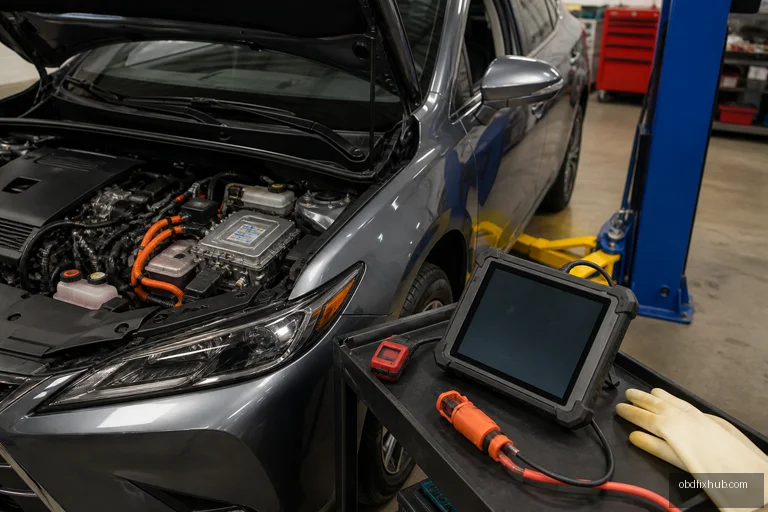
Search intent: Informational. Drivers searching for the P0A27 hybrid battery power-off circuit code usually want to know whether the vehicle is safe to drive, what caused the fault, and whether the repair requires a battery replacement. P0A27 indicates that the hybrid or EV control system detected an electrical problem in the circuit used to command or monitor high-voltage battery power shutdown. The code does not automatically mean the entire battery pack has failed.
What Does the P0A27 Code Mean?
P0A27 is a generic powertrain diagnostic trouble code associated with the hybrid battery power-off circuit. In practical terms, the vehicle is not seeing the expected electrical response from the circuit that controls, confirms, or communicates a high-voltage battery shutdown request.
Depending on the manufacturer, this circuit may include the battery control module, power management control ECU, high-voltage battery relays or contactors, service plug interlock, dedicated wiring, and low-voltage grounds or power supplies. The exact circuit logic varies between Toyota, Lexus, Ford, Hyundai, Kia, Honda, and other hybrid or EV platforms, so the factory wiring diagram and service information are essential.
Is P0A27 Dangerous to Drive With?
Potentially, yes. A fault involving the high-voltage battery power-off system can prevent the battery from disconnecting correctly during a crash, service procedure, or internal fault. The vehicle may also disable READY mode, electric propulsion, regenerative braking, or charging as a protective measure.
Do not remove orange high-voltage cables, open the battery case, or probe the battery terminals with a standard multimeter. Hybrid and EV systems can retain lethal voltage even when the vehicle appears switched off. If the vehicle will not enter READY mode, displays a high-voltage warning, smells overheated, or has been involved in a collision, have it transported to a qualified hybrid/EV technician.
Common Symptoms of P0A27
The symptoms depend on whether the fault is intermittent, detected during startup, or present continuously. A vehicle may still start normally at first if the control module can complete its self-check.
- Hybrid system, EV system, or powertrain warning message
- Check Engine or malfunction indicator lamp
- Vehicle will not enter READY mode
- Reduced power or limp-home operation
- Loss of electric drive or regenerative braking
- Charging interruption on a plug-in hybrid or EV
- High-voltage battery cooling fan running unexpectedly
- P0A27 returning immediately after the code is cleared
One useful diagnostic clue is timing. If P0A27 appears after a 12-volt battery replacement, collision repair, engine-bay work, or hybrid battery service, a disturbed connector, interlock, ground, or fuse is more likely than sudden cell failure.
What Causes the P0A27 Hybrid Battery Power-Off Circuit Code?
1. Open, shorted, or damaged wiring
Wiring near the battery enclosure, underbody harnesses, and connectors exposed to water or road salt can develop corrosion or high resistance. A wire may look intact but open when the harness flexes, creating an intermittent P0A27 during vibration or temperature changes.
2. Loose connector or service plug interlock
Many hybrid battery assemblies use a service plug with an interlock circuit. If the plug is not fully seated, its locking lever is damaged, or the interlock terminals are contaminated, the battery ECU may interpret the circuit as unsafe. This is a common post-repair issue, but the service plug should only be inspected or installed by a trained technician.
3. Blown fuse, poor ground, or unstable 12-volt supply
The high-voltage system is controlled by low-voltage electronics. A weak 12-volt battery, corroded ground strap, blown control fuse, or voltage drop during startup can create misleading hybrid fault codes, including P0A27. Measure system voltage under load rather than relying only on an open-circuit reading.
4. Failed battery control module or power management ECU
The battery ECU monitors contactor commands, interlocks, voltage, temperature, and shutdown status. Internal module failure is possible, but it should be diagnosed only after power, ground, communication, and wiring tests pass. Replacing the module first is an expensive form of parts guessing.
5. Faulty high-voltage contactor or related battery component
Contactors are electrically operated switches that connect the battery pack to the vehicle’s high-voltage bus. A contactor that sticks, fails to close, or cannot open as commanded may trigger P0A27. In some vehicles, a precharge circuit or contactor feedback circuit can produce a similar result.
How Technicians Diagnose P0A27
A professional diagnosis begins with a complete scan of every control module, not just the generic OBD-II engine menu. Related codes for isolation resistance, interlock status, contactor operation, battery voltage, or communication loss often identify the real starting point.
- Record all codes and freeze-frame data. Note battery voltage, ignition state, temperature, and whether P0A27 is current or history.
- Check the 12-volt system. Inspect battery state of charge, charging voltage, main grounds, and relevant fuses.
- Inspect accessible connectors and harnesses. Look for water intrusion, bent pins, rodent damage, pulled wires, and evidence of recent repairs.
- Verify the service plug and interlock circuit. Follow the manufacturer’s shutdown and personal-protection procedure exactly.
- Test circuit continuity and voltage drop. Use the manufacturer’s specified test points and measurements; never improvise on a live high-voltage circuit.
- Test contactor command and feedback. A factory scan tool may show whether the battery ECU commanded the contactors and whether the expected state was confirmed.
- Clear the code and perform a controlled road or charging test. If P0A27 returns immediately, the fault is usually active rather than historical.
How Is P0A27 Fixed?
The correct repair depends on the failed part. Typical fixes include repairing a damaged low-voltage wire, cleaning or replacing a corroded connector, restoring a ground, replacing a fuse, servicing the interlock, repairing the battery control harness, or replacing a failed contactor or control module.
A complete hybrid battery replacement is not the default repair for P0A27. If the battery pack has no cell imbalance, insulation fault, overheating evidence, or internal damage, replacing the entire pack may waste money and leave the original circuit problem unresolved. Ask the shop to provide the failed test result before approving a costly battery assembly.
Can You Clear P0A27 Yourself?
You may be able to erase the code with a scan tool, but clearing it does not repair the power-off circuit. If the code is active, it will return as soon as the vehicle repeats its self-test, and the hybrid system may remain disabled.
Basic checks such as inspecting the 12-volt battery terminals and reviewing visible fuse damage are reasonable for a vehicle owner. High-voltage isolation, battery pack removal, contactor testing, and service-plug work should be left to a technician certified for the specific hybrid or EV system.
Key Takeaway
P0A27 means the vehicle has detected a problem with the circuit responsible for switching off or confirming shutdown of the hybrid/EV high-voltage battery. Start with the 12-volt supply, fuses, grounds, connectors, and interlock history before condemning the battery pack. Because the circuit is tied to high-voltage safety, use manufacturer-specific diagnostic information and professional equipment rather than replacing parts or probing the orange wiring at home.
Frequently Asked Questions
Can a weak 12-volt battery cause P0A27?
Yes. Low voltage during startup can prevent the battery ECU or power management module from completing its self-test. Test the 12-volt battery under load and inspect its terminals and grounds before diagnosing high-voltage components.
Does P0A27 mean the hybrid battery must be replaced?
No. The code concerns the power-off circuit and may be caused by wiring, an interlock, a fuse, a control module, or a contactor. Battery replacement is justified only when testing confirms internal battery damage or another battery-specific fault.
Can I drive with the P0A27 code?
If the vehicle is operating normally, a short trip to a qualified repair facility may be possible, but the safest option depends on the warning messages and other codes. Do not drive if the vehicle will not enter READY mode, shows a high-voltage warning, or has collision or overheating damage.
Why did P0A27 appear after hybrid battery service?
A partially seated service plug, an incomplete interlock connection, pin damage, or a disturbed harness can trigger the code after battery work. The technician should verify the exact interlock and connector procedure for that model instead of simply clearing the code.




