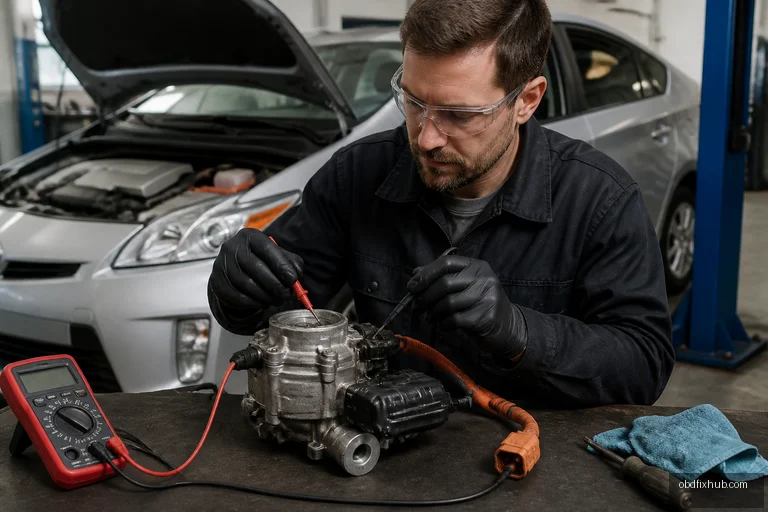
P0B00 means the vehicle control system has detected an abnormal current on phase U of the electric transmission fluid pump motor. The fault is most common in hybrid, plug-in hybrid, and electric vehicles that use an electrically driven pump to circulate transmission or transaxle fluid. Do not assume the pump itself is automatically defective: a damaged connector, low-voltage supply, seized pump, inverter problem, or internal wiring fault can produce the same code.
What Does the P0B00 Code Mean?
The official description is generally Electric Transmission Fluid Pump Motor Phase U Current. Many electric transmission pumps use a three-phase motor, with the phases commonly identified as U, V, and W. The transmission control module, hybrid control module, or motor-control inverter monitors current in each phase and compares the readings with expected values.
When phase U draws too much current, too little current, or behaves differently from the other phases, the module stores P0B00. In practical terms, the controller is saying that the pump motor’s electrical load does not look normal. The exact threshold and whether the code is set for high, low, or implausible current depend on the manufacturer.
Symptoms of a Failing Transmission Pump
A failing electric transmission fluid pump can cause symptoms before the fault becomes permanent. The pump may still operate intermittently, especially when the vehicle is cold, which is why some drivers see the warning disappear after a restart.
- Hybrid or transmission warning light on the dashboard
- Reduced-power mode or a drivetrain performance message
- Delayed engagement when selecting Drive or Reverse
- Harsh shifting, slipping, shuddering, or abnormal gear changes
- Whining, buzzing, grinding, or a pulsing sound from the transmission area
- Transmission overheating or an unusually hot transaxle case
- Vehicle refusing to enter Ready mode in some hybrid and EV applications
- Intermittent loss of electric drive or limited regenerative braking
A useful real-world clue is a pump that sounds normal for several seconds and then becomes noticeably louder as the fluid warms. Fluid becomes thinner with temperature, so a worn bearing, damaged impeller, or internal electrical fault may change its current draw during that transition.
Common Causes of P0B00
1. A worn or mechanically restricted pump
Contaminated fluid, debris from internal component wear, or a damaged pump bearing can make the motor work harder. A partially seized pump often produces excessive phase current rather than an obvious open-circuit fault.
2. Open or shorted phase-U wiring
Broken wiring, terminal spread, insulation damage, or a short to ground can interrupt the U phase. Harness damage is particularly common where the cable runs near the transmission housing, a bracket, or a high-temperature exhaust component.
3. Corroded or loose electrical connectors
Moisture inside the pump connector can increase resistance and create voltage drop. A connector may look acceptable from the outside while its terminal is recessed, overheated, or unable to maintain contact under vibration.
4. Faulty pump driver or inverter
Some systems control the three-phase pump through a dedicated inverter or an integrated motor driver. If the driver’s power transistor for phase U fails, a good pump can still trigger P0B00. Replacing the pump without testing the driver can lead to an expensive repeat repair.
5. Low system voltage or a control-software issue
A weak 12-volt battery, poor ground, or unstable DC-DC converter output can distort pump operation. In some vehicles, a software update or technical service bulletin addresses false current-monitoring faults. Always check manufacturer service information before condemning hardware.
How to Diagnose P0B00 Properly
Start by recording all stored, pending, and history codes. Codes relating to low 12-volt voltage, inverter temperature, motor position, insulation resistance, or transmission pressure may explain why P0B00 appeared. Freeze-frame data is valuable because it shows whether the code occurred during startup, high load, hot fluid, or regenerative braking.
- Check the fluid level and condition. Use only the fluid specified for that transmission or transaxle. Incorrect fluid can damage electric pumps and may be unsafe around high-voltage components.
- Inspect the pump connector and harness. Look for green corrosion, melted plastic, pushed-back terminals, chafing, and water entry. Perform a careful wiggle test while monitoring live data, but do not disturb high-voltage wiring.
- Verify the 12-volt supply and grounds. A battery that drops sharply during pump activation can create misleading motor-current faults.
- Use a scan tool to command the pump. Compare pump speed, commanded current, actual current, and phase-current values if the vehicle provides them. A U-phase reading that is substantially different from V and W is significant.
- Test the motor according to the service manual. Resistance checks, phase-to-phase comparison, insulation testing, and mechanical rotation may be required. Do not apply improvised battery power to a three-phase pump.
- Check the driver or inverter output. If the motor tests correctly but phase U is missing, shorted, or uncontrolled at the driver, the control unit may be the actual failure.
Hybrid and EV systems can contain lethal voltage even when the vehicle appears switched off. High-voltage service plugs, orange cables, inverter terminals, and motor windings should be handled only by a properly trained technician using the manufacturer’s shutdown and isolation procedure.
What Is the Correct Fix for P0B00?
The repair depends on the test result, not just the code description. A damaged harness may require terminal repair or a complete sub-harness. A contaminated connector may need replacement rather than cleaning alone, because corrosion often remains inside the crimp. If the pump has excessive current, abnormal noise, poor flow, or failed insulation testing, replacing the electric transmission fluid pump is usually the appropriate repair.
If the pump is good but the phase-U driver is defective, the inverter or pump-control module may need replacement and programming. After the repair, clear the code, complete the required initialization or pump-learning procedure, and perform a road test while watching pump current and transmission temperature. Simply clearing P0B00 without confirming stable current can leave the vehicle vulnerable to a second failure.
Does P0B00 Mean the Transmission Fluid Pressure Sensor Switch B Circuit Is Low?
No. P0B00 is a pump motor phase-current code, not a transmission fluid pressure sensor or switch code. The description Transmission Fluid Pressure Sensor/Switch B Circuit Low usually refers to a separate fault, commonly associated with code P0872, although the exact code mapping can vary by vehicle and manufacturer.
A pressure-sensor circuit-low code means the control module sees a voltage signal below the expected range on the B sensor or switch circuit. Possible causes include a short to ground, a failed sensor, low reference voltage, damaged wiring, or a transmission hydraulic problem. If both P0B00 and a pressure-sensor code are present, diagnose power, grounds, fluid pressure, and shared wiring before replacing either component. One fault can sometimes cause the other if pump operation is poor.
Can You Drive With P0B00?
Driving should be limited until the cause is identified. If the pump is not circulating fluid, the transmission or electric drive unit may overheat even if the vehicle still moves normally. Stop driving if there is a temperature warning, severe shifting, grinding noise, loss of propulsion, burning odor, or a drivetrain message instructing you to stop.
For a vehicle that still operates normally with only a stored code, a short trip to a qualified repair facility may be possible, but towing is the safer option for hybrids and EVs. Do not continue driving simply because the warning disappears after a key cycle.
Key Takeaway
P0B00 identifies abnormal current in phase U of an electric transmission fluid pump motor. The most reliable repair begins with code and freeze-frame analysis, connector and voltage checks, pump testing, and verification of the inverter driver. Because the code can be caused by wiring or control electronics as well as the pump, accurate testing is far cheaper than replacing parts by guesswork.
Frequently Asked Questions
What are the symptoms of a failing transmission pump?
Typical symptoms include whining or grinding, delayed engagement, harsh shifting, overheating, reduced power, drivetrain warnings, and limited hybrid or EV operation. Some pumps fail intermittently and only become noisy or current-hungry when warm.
Can low transmission fluid cause P0B00?
Low or incorrect fluid can make the pump cavitate, overheat, or work under abnormal load, but it is not the only possible cause. Check the fluid using the manufacturer’s exact temperature and level procedure.
Is P0B00 the same as a transmission pressure sensor code?
No. P0B00 concerns electric pump motor phase current. A pressure sensor or switch B circuit-low code is separate and should be diagnosed through its reference voltage, signal circuit, wiring, and hydraulic data.
Should I replace the electric transmission pump immediately?
Not without testing. Inspect the connector, harness, 12-volt supply, grounds, pump current, phase balance, and inverter output first. A wiring or driver fault can produce the same P0B00 code as a failed pump.




