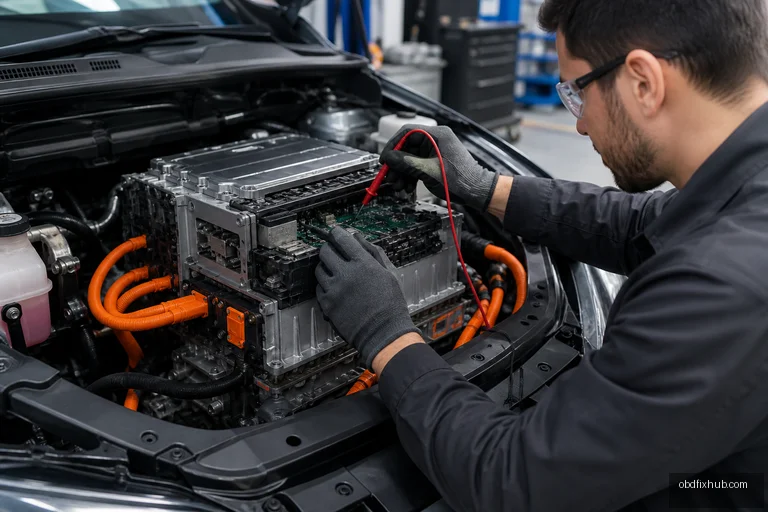
P0C0B indicates a problem in the drive motor inverter power supply circuit, usually within a hybrid or electric vehicle’s high-voltage propulsion system. The code does not automatically mean the inverter itself is defective; a weak 12-volt battery, blown fuse, damaged wiring, failed contactor, poor ground, or internal inverter fault can all produce the same diagnostic result.
Because this circuit is connected to potentially lethal high voltage, diagnosis should be limited to visual checks and low-voltage testing unless you are trained and equipped for EV service. The exact definition and test procedure can vary by manufacturer, so the vehicle’s service information remains the final authority.
What Does the P0C0B Code Mean?
P0C0B is a generic powertrain diagnostic trouble code associated with the drive motor inverter power supply circuit. The inverter converts the battery pack’s DC voltage into controlled three-phase AC power for the traction motor. In regenerative braking, it performs the reverse function by converting motor-generated AC back into DC for battery charging.
The inverter also contains control electronics, gate drivers, current sensors, cooling hardware, and communication circuits. If its required supply voltage is missing, unstable, outside the expected range, or interrupted during operation, the hybrid control system may store P0C0B and disable READY mode or limit propulsion.
Common Symptoms of P0C0B
Some vehicles will continue to drive with reduced power, while others will refuse to enter READY mode. The severity depends on whether the fault is intermittent, low-voltage related, or caused by a genuine high-voltage inverter failure.
- Check Engine, Hybrid System, EV System, or Powertrain warning light
- “Stop vehicle safely” or “Check hybrid system” message
- Vehicle will not start or enter READY mode
- Reduced acceleration or limp-home operation
- Loss of electric-only driving
- Unexpected engine operation in a hybrid vehicle
- Whining, clicking, or cooling-fan activity near the inverter
- Additional communication, battery, or motor-control codes
A useful diagnostic clue is whether the problem appears after the vehicle sits overnight, during acceleration, or when the battery state of charge is high. A fault that appears only during high load often points toward a power connection, voltage drop, thermal issue, or inverter component that fails under demand.
Most Likely Causes of the P0C0B Code
1. Weak or unstable 12-volt battery
The inverter is a high-voltage component, but its control modules commonly depend on the vehicle’s 12-volt electrical system for startup and communication. A battery that drops sharply during cranking or DC-DC converter initialization can create misleading inverter power-supply codes. Test the battery under load rather than relying only on its resting voltage.
2. Blown fuse, fusible link, or failed relay
Many hybrid systems use separate fuses and relays for inverter control power, motor-generator electronics, and high-voltage battery circuits. A fuse may open because of an internal short, water intrusion, wiring damage, or an incorrect jump-start procedure. Replacing it without finding the reason it failed can cause immediate repeat damage.
3. Damaged wiring, connectors, or ground points
Road vibration, heat, rodents, and moisture can affect the inverter harness. Look for green corrosion, pushed-back terminals, overheated connector plastic, coolant contamination, and loose ground fasteners. A connector can appear plugged in while a terminal has lost tension and opens the circuit when the vehicle moves.
4. High-voltage battery contactor or precharge problem
Before the inverter receives full pack voltage, the battery system normally uses a precharge circuit to charge the inverter’s DC-link capacitors gradually. A failed precharge resistor, contactor, fuse, or sensing circuit can prevent the inverter from receiving the expected supply voltage and may set P0C0B along with high-voltage battery or isolation codes.
5. Inverter internal failure
Power transistors, gate-driver circuits, capacitors, internal relays, sensors, and control boards can fail because of overheating, coolant loss, electrical surges, or a motor-cable short. An internal failure becomes more likely when power and ground are correct, supply voltage remains stable, related wiring passes inspection, and the code returns immediately after clearing.
6. Software or communication fault
A low-voltage event or interrupted module update can leave the inverter controller with invalid data. Manufacturer service bulletins may specify a software update or a module initialization procedure. Do not condemn an expensive inverter until all relevant modules have been scanned and software information has been checked.
How to Diagnose P0C0B Safely
Do not probe orange high-voltage cables, inverter terminals, or battery connections with ordinary test equipment. High-voltage systems can remain energized after the vehicle is switched off. Proper diagnosis requires EV-rated insulated tools, personal protective equipment, an approved isolation procedure, and verification of zero voltage by a qualified technician.
- Record every stored code and freeze-frame value. Scan the hybrid control, battery, inverter, motor, and body modules. Codes for isolation, contactor performance, DC-link voltage, or low 12-volt voltage may identify the primary fault.
- Check the 12-volt system first. Inspect battery terminals and grounds, then perform a load test. Confirm that voltage does not collapse during vehicle wake-up or READY-mode initialization.
- Inspect low-voltage fuses and connectors. Use the wiring diagram to identify inverter power feeds, grounds, relays, and control circuits. Check for voltage drop under load, not just continuity with the circuit disconnected.
- Review live data. Compare commanded and actual inverter supply voltage, contactor status, precharge voltage, DC-link voltage, and inverter temperature. A supply that fails only during startup is particularly important.
- Follow the manufacturer’s high-voltage test sequence. If the low-voltage side is healthy, an authorized repair facility should test isolation resistance, precharge operation, inverter input voltage, and internal self-test results.
One practical mistake is clearing P0C0B before saving freeze-frame data. The code may disappear temporarily after a battery disconnect, but the operating conditions that triggered it will also be lost. Record the data first, including outside temperature, battery state of charge, vehicle speed, and system voltage.
P0C0B Repair: What Usually Fixes It?
The correct repair depends on the failed part. A discharged 12-volt battery may require replacement and a charging-system check. Corroded terminals may need terminal repair rather than simple cleaning. A blown fuse requires an electrical short investigation, and damaged harnesses should be repaired with the correct automotive terminals and sealing methods.
If the high-voltage contactor or precharge circuit is faulty, the battery assembly may need a controlled service procedure. If the inverter has an internal power-stage or control-board failure, replacement or specialist refurbishment may be necessary. Some vehicles require inverter programming, calibration, coolant bleeding, and a post-repair isolation test before they can safely return to service.
Can You Drive With P0C0B?
Driving is not advisable if the vehicle displays a hybrid or EV system warning, refuses READY mode, loses power, or shows a red stop warning. Continuing to operate a vehicle with an inverter power-supply fault can leave you without propulsion and may worsen damage to the inverter or motor-generator system.
If the vehicle still operates normally and the warning is amber, move it only as far as necessary to reach a qualified repair facility. Avoid towing it with the drive wheels on the ground unless the manufacturer specifically permits that method.
Frequently Asked Questions
Is P0C0B caused by the hybrid battery?
It can be related to the battery contactors, precharge circuit, or battery-to-inverter power path, but P0C0B does not prove that the battery pack itself is bad. Scan for companion battery and contactor codes before replacing any major component.
Can a weak 12-volt battery trigger P0C0B?
Yes. Low 12-volt voltage can interrupt inverter startup and create a power-supply code. Test the battery and charging system first because this is cheaper and safer than assuming the high-voltage inverter has failed.
Can I clear P0C0B by disconnecting the battery?
Disconnecting the 12-volt battery may erase the code temporarily, but it does not repair the cause. It can also erase useful diagnostic data and reset vehicle settings. Save scan results before clearing anything.
How much does a P0C0B repair cost?
Cost ranges from a relatively inexpensive 12-volt battery, fuse, or connector repair to a major inverter or high-voltage battery repair. Labor, programming, cooling-system service, and manufacturer-specific procedures can significantly change the final price.
Key Takeaway
P0C0B means the drive motor inverter is not receiving or recognizing its required power supply correctly. Start with a complete scan, 12-volt battery testing, fuse and connector inspection, and freeze-frame analysis. Because the circuit is part of a high-voltage propulsion system, leave inverter, contactor, isolation, and precharge testing to a qualified hybrid or EV technician.




